
Preserving books, journals, manuals, and family records is much easier with the right overhead scanner. The best book scanners for archiving capture bound pages quickly while reducing shadows, curvature, and handling damage.
These 10 models range from portable document cameras to professional systems with OCR, automatic page flattening, high-resolution imaging, and A3-size support. Use the guide below to match features and workflow to your archive.
Best 10 Book Scanners for Archiving Picks for 2026
Best All-Around Pick

- Two-second page scanning
- 180+ language OCR and searchable PDFs
- Curve flattening plus adjustable lighting
Best For: Fast home archiving of books and mixed documents
Best for Fragile Books

- Overhead scanning preserves bound books
- Automatic curve and distortion correction
- Page-turn and multi-document detection
Best For: Non-destructive archiving of books and newspapers
Best High-Resolution Option

- 38MP sensor with 410 DPI capture
- Approx. 1.5-second page scanning
- Windows, macOS, and Ubuntu support
Best For: Detailed, high-volume book and document archiving
Best Portable Pick

- Approx. one-second page scanning
- Foldable four-pound portable design
- A3/A4 scanning and document-camera mode
Best For: Mobile archiving of flat papers and thinner books
Best A3 Archive Scanner

- A3 overhead scanning for books and large documents
- 16MP capture with up to 300 DPI resolution
- Anti-glare lighting and Windows/Mac compatibility
Best For: Libraries, offices, educators, and home archiving
Best Fast Book Scanner

- Curved-page flattening with three laser lines
- Approximately two-second single- or double-page scanning
- OCR support for more than 180 languages
Best For: Fast digitization of books and A3-size materials
Best Versatile Document Camera

- 18MP sensor with live display and projection
- OCR exports to PDF, Word, Excel, JPG, and PNG
- Foldable USB design with curve flattening
Best For: Scanning, teaching, presentations, and digital archiving
Professional A3 Archiving Pick
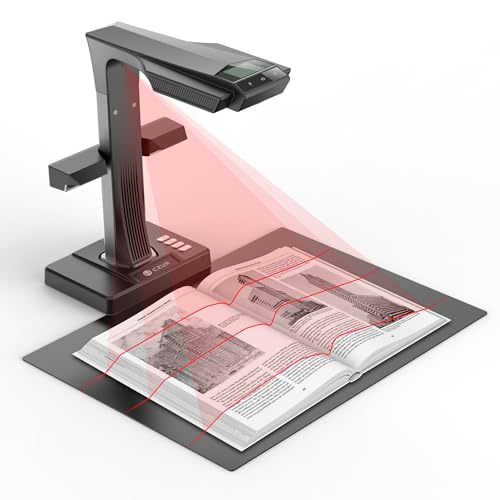
- 24MP camera captures up to 5696 × 4272 resolution
- Book-flattening technology helps digitize curved pages
- A3 scanning, OCR, HDMI, and multi-OS support
Best For: Serious book and oversized-document archiving
Efficient Workflow Pick

- 26MP capture supports A3 books and documents
- Software includes flattening, OCR, cropping, and finger removal
- Foot pedal and hand switch support repetitive scanning
Best For: Libraries and offices digitizing large collections
Portable Mac-Friendly Pick

- Foldable 0.5 kg design is easy to carry
- Automatic correction and continuous scanning simplify workflows
- OCR and three-level lighting support A4 projects
Best For: Portable A4 archiving on Windows, Mac, or Linux
Best All-Around Pick – CZUR Aura Pro
For book scanners for archiving, the CZUR Aura Pro is a versatile choice for home libraries and mixed document collections. It scans a page in about two seconds, supports A3 and A4 materials, and can export JPG, Word, PDF, and searchable PDF files.
Best For: Users who want fast book scanning, broad OCR support, and a built-in reading light in one device.
Pros:
- Scans pages in approximately two seconds and supports A3 and A4 sizes.
- OCR supports more than 180 languages and can create searchable PDFs.
- Laser-based curve flattening helps reproduce curved book pages clearly.
- Includes glare-free, adjustable lighting with four color temperatures.
Cons:
- Thai, Hebrew, and Arabic are not currently supported for OCR.
- Requires a USB connection and compatible Windows or macOS system.
The Aura Pro balances speed, OCR functionality, and book-friendly image correction. It is a practical archiving tool when you want more than basic image capture but do not need the highest-resolution camera in the lineup.
Best for Fragile Books – ScanSnap SV600
The ScanSnap SV600 is well suited to book scanners for archiving when preserving the original material matters. Its overhead design scans books, newspapers, magazines, and documents without cutting or damaging them, while automatic correction handles page curves and image orientation.
Best For: Archiving bound books, newspapers, photos, and other materials that should remain intact.
Pros:
- Scans books and other materials directly without unbinding or cutting them.
- Automatically flattens book curves and corrects distortion.
- Page Turning Detection can begin scans as pages are turned.
- Multi Document Detection can crop and rotate multiple items in one scan.
Cons:
- At 6.6 pounds, it is less portable than the lightweight CZUR models.
- Supports Windows 10/11 and macOS Monterey 12 or later rather than older listed systems.
- Its listed resolution is 1200, below the CZUR ET MAX’s stated resolution.
The SV600 emphasizes careful, non-destructive handling and automated workflow features. Choose it when scanning delicate or valuable bound material is more important than compact size or maximum capture resolution.
Best High-Resolution Option – CZUR ET MAX
For demanding book scanners for archiving projects, the CZUR ET MAX stands out with a 38MP CMOS sensor, 7168 × 5376 resolution, and a stated 410 DPI. It also combines curve flattening, OCR, A3 support, and compatibility with Windows, macOS, and select Ubuntu versions.
Best For: High-volume archiving and users who want detailed captures, strong OCR, and Linux support.
Pros:
- 38MP sensor and 410 DPI provide highly detailed image capture.
- Scans a page in about 1.5 seconds with practiced operation.
- Curve-flattening technology corrects bound-book distortion without unbinding.
- Supports Windows, macOS, and Ubuntu 20.04 through 24.04.
Cons:
- Not recommended for glossy or highly reflective materials.
- OCR support varies by language and operating system; Thai and Hebrew are not supported.
- Its advanced specifications may be more than needed for occasional home scanning.
The ET MAX is the strongest fit here for detail-focused digitization and larger workloads. Its fast operation and broad system compatibility add flexibility, while the material limitation is worth considering for photo-heavy or glossy collections.
Best Portable Pick – CZUR Shine Ultra
The CZUR Shine Ultra is a compact option for book scanners for archiving, especially when you need to move between workspaces. It scans pages in about one second, folds by 90 degrees, supports A3 and A4 materials, and can also function as a USB document camera.
Best For: Portable scanning of flat documents and thinner books, with occasional remote teaching or presentation use.
Pros:
- Scans pages in approximately one second.
- Foldable, height-adjustable design weighs about four pounds.
- OCR supports more than 180 languages and includes searchable file conversion.
- Offers auto cropping, smart paging, color modes, and document-camera functionality.
Cons:
- Curve flattening is intended for thinner books; thicker books are better suited to the ET series.
- Not compatible with Android or iOS.
- Thai, Hebrew, and Arabic are not currently supported for OCR.
The Shine Ultra prioritizes speed and portability over heavy-duty book handling. It is a convenient fit for flat papers and thinner volumes, but users archiving thick books should consider a model designed for more substantial curves.
Best A3 Archive Scanner – VIISAN DL16
If you need book scanners for archiving oversized pages, bound books, artwork, or sheet music, the VIISAN DL16 offers an overhead A3 design that is more flexible than a standard flatbed. Its 16MP camera, 300 DPI capture, OCR support, and page-flattening features are suited to organized digital storage and searchable document workflows.
Best For: Libraries, offices, educators, and home users digitizing A3-size materials and bound collections.
Pros:
- A3 overhead format handles books, artwork, sheet music, and large documents.
- 16MP camera and up to 300 DPI resolution capture text and document details clearly.
- Anti-glare LED lighting helps reduce reflections and uneven shadows.
- Works with both Windows and Mac computers.
Cons:
- Requires a USB connection and a suitable desktop workspace.
- Its 300 DPI resolution may be less suitable for users seeking higher-resolution image archiving.
The DL16 is a practical choice when A3 coverage and overhead book handling matter most. It combines useful archiving features with broad computer compatibility, making it a strong fit for everyday collection digitization.
Best Fast Book Scanner – CZUR Aura Pro
For book scanners for archiving that prioritize speed and hands-off operation, the CZUR Aura Pro combines A3 scanning with curved-page flattening and automatic page-turn detection. It can scan single or double pages in about two seconds and includes OCR support for more than 180 languages, with some language limitations.
Best For: Users digitizing books and A3-size materials who value rapid scanning, automatic page detection, and broad OCR support.
Pros:
- Three laser lines help flatten and replicate curved book pages.
- Scans single sheets and double-page books in approximately two seconds per page.
- Automatic page-turn detection and a foot pedal can streamline repeated scanning.
- OCR supports more than 180 languages, excluding Thai, Hebrew, and Arabic.
Cons:
- Thai, Hebrew, and Arabic are not currently supported for OCR.
- Some newer Mac users need macOS 12 or 13 or later, depending on the processor.
- The sound-controlled lamp function may be affected by noise and distance.
The Aura Pro is especially appealing for larger scanning projects where speed and page handling reduce repetitive work. Its A3 coverage and curved-page processing make it well suited to bound books, while the OCR language limitation should be checked before purchase.
Best Versatile Document Camera – 18MP Overhead Book Scanner
For book scanners for archiving that also need presentation and teaching capabilities, this USB-powered overhead scanner combines an 18MP sensor with live display and real-time projection. Its OCR software supports book-curve flattening, perspective correction, intelligent cropping, and export to common editable and image file formats.
Best For: Offices, classrooms, libraries, and home users who want scanning, live display, and multi-page document creation in one foldable device.
Pros:
- 18MP sensor captures books, documents, photos, certificates, ID cards, and QR codes.
- OCR can create editable PDF, Word, Excel, JPG, and PNG files.
- Automatic curve flattening, perspective correction, cropping, and background removal simplify processing.
- Foldable design and USB-ready setup support portable use.
Cons:
- The supplied details do not specify a maximum document size or scanning resolution in DPI.
- It is listed under a generic brand, so long-term support details may require verification.
- Its live-display features may be unnecessary for users seeking an archive-only scanner.
This model stands out as a multifunction option rather than a dedicated archival scanner. The high-resolution sensor, flexible file output, and foldable form make it useful when digitizing materials and displaying them on screen are both part of the workflow.
Professional A3 Archiving Pick – CZUR ET24 Pro
For demanding book scanners for archiving projects, the CZUR ET24 Pro combines a 24MP camera, A3 capture area, and book-flattening technology. Its OCR, multiple lighting options, and HDMI support make it suitable for digitizing books and other bound or oversized materials.
Best For: Home archives, libraries, offices, and users digitizing A3 books, magazines, documents, or artwork.
Pros:
- 24MP camera with 5696 × 4272 resolution and 320 DPI.
- Book-flattening technology helps correct curved pages.
- ABBYY OCR supports more than 180 languages and editable output formats.
- Supports Windows, macOS, Linux, and HDMI connections.
Cons:
- Very glossy paper is not recommended.
- Thai and Hebrew OCR are not supported; Arabic support is limited by operating system.
- Its 4.5 kg desktop design is less portable than compact scanners.
The ET24 Pro is the most feature-rich option here for serious archiving, particularly when A3 support, page flattening, and broad OCR compatibility matter more than portability.
Efficient Workflow Pick – Innex DS200
The Innex DS200 is a practical choice among book scanners for archiving, pairing 26MP capture with software designed for repetitive digitization. Curve flattening, page-turn detection, OCR, and automatic cropping help streamline book and document workflows.
Best For: Libraries, offices, schools, and users building searchable digital databases from books and flat documents.
Pros:
- 26MP resolution supports detailed A3 scans.
- Innex Scan includes curve flattening, OCR, auto-cropping, and finger removal.
- Page-turn detection supports a smoother scanning workflow.
- Includes a hand switch and foot pedal, plus an LED lamp and laser guide.
Cons:
- The supplied specifications list 300 DPI, lower than the stated 26MP capture resolution may suggest.
- USB connection is required.
- System compatibility is listed for Windows and macOS, without Linux support noted.
For users scanning many pages, the DS200’s workflow-focused software and hands-free controls may be more valuable than a simpler document camera design.
Portable Mac-Friendly Pick – NetumScan NS-800NC
The NetumScan NS-800NC offers a compact, foldable approach to book scanners for archiving. Its automatic correction, continuous scanning, OCR, and adjustable lighting are useful for smaller A4 projects where portability and straightforward USB operation are priorities.
Best For: Mac, Windows, and Linux users digitizing A4 books, notes, documents, and teaching materials in different locations.
Pros:
- Foldable aluminum-alloy design weighs 0.5 kg.
- Automatic correction and continuous scanning can reduce manual editing.
- OCR can export recognized text to editable Word or TXT files.
- Built-in LED lighting offers three dimming levels and supports video recording.
Cons:
- Its capture area is limited to A4 size.
- The 8MP CMOS sensor is lower resolution than the other listed models.
- USB connection and software installation are required for operation.
The NS-800NC is best suited to portable, moderate-volume archiving rather than oversized materials or the highest-detail preservation work.
How We Picked the Best Book Scanners for Archiving
We focused on the features that matter most when converting bound material into useful digital files: image resolution, page size, scanning speed, OCR support, page-flattening performance, lighting control, software compatibility, and ease of operation. The lineup includes overhead scanners from CZUR, ScanSnap, VIISAN, Innex, and NetumScan, along with more general-purpose document-camera designs.
Because archival projects vary widely, we considered both professional equipment for large collections and simpler USB-powered models for occasional scanning. A strong choice should minimize manual corrections without making setup or file management unnecessarily complicated.
Quick Comparison
| Best For | Look For | Recommended Type |
|---|---|---|
| Large book collections | Fast capture, automatic processing, reliable software | Professional overhead scanner |
| Fragile or tightly bound books | Page flattening, glare reduction, gentle handling | Book-focused scanner with correction tools |
| Mixed documents and books | A3 support, OCR, flexible capture modes | Versatile overhead document scanner |
| Portable or occasional use | Compact design, USB power, simple controls | Portable document-camera scanner |
Key Buying Factors for Book Scanners for Archiving
Resolution and Image Quality
Higher megapixel counts can preserve small print, illustrations, and fine line work, but lens quality and software processing matter just as much. For text-heavy archives, a scanner capable of clear 300-dpi-equivalent output is usually a practical baseline.
Page Size and Book Handling
Check whether the scanner supports A3, A4, or larger formats, and confirm the usable area when a book is open. A3 coverage is useful for oversized books, magazines, maps, and two-page spreads. A cradle or page-flattening system can help with curved pages and reduce pressure on bindings.
OCR and File Workflow
Optical character recognition makes archived material searchable and editable. Also check whether the included software exports searchable PDFs, JPEGs, TIFFs, or Word files, and whether it works with your operating system. Batch processing and automatic cropping can save substantial time on large projects.
Lighting and Glare Control
Built-in LED lighting, anti-glare features, and brightness adjustment are especially valuable for glossy pages, photographs, and documents with uneven surfaces. Adjustable lighting can also improve results when scanning dark or aged paper.
Who Should Buy Which Book Scanners for Archiving?
Choose a professional CZUR, ScanSnap, VIISAN, or Innex model if you are digitizing a substantial library and want faster capture with automated corrections. A high-resolution professional unit is also the better option for archival-quality images, oversized pages, and frequent use.
Portable CZUR, NetumScan, and USB-powered document-camera models make more sense for students, home archivists, teachers, and small office users who need flexible scanning without a permanent workstation. Prioritize OCR and simple software if your main goal is searchable research material rather than photographic reproduction.
Before buying, verify operating-system support, included accessories, warranty coverage, and the actual export options. The best book scanner is the one that produces clean files consistently and fits the pace, size, and preservation needs of your archive.