
Digitizing books is easier when your scanner can capture fine print, curved pages, and oversized layouts without forcing you to dismantle the original volume. The best high-resolution book scanners combine sharp cameras with page-flattening, OCR, and efficient software.
This roundup compares 10 options for home libraries, schools, offices, archives, and professional document workflows, including overhead, flatbed, portable, and large-format designs.
Best 10 High Resolution Book Scanners Picks for 2026
Professional Detail

- 38MP sensor with 7168 × 5376 resolution
- Curve flattening and 180+ language OCR
- A3 support, fast scans, and HDMI output
Best For: Professional book digitization and high-volume scanning
Organized Archiving

- 1200 dpi CCD flatbed scanning
- BookMaker organizes and searches files
- OCR, notes, tagging, and cloud collaboration
Best For: Searchable research libraries and document organization
Flexible Large Format

- Handles A2 and A3 materials
- 26MP capture with software-enhanced 600 DPI
- Auto-flattening, OCR, and foldable portability
Best For: Oversized documents, books, maps, and mobile scanning
Reader-Friendly Scanning

- A3/A4 scanning at 4320 × 3240 resolution
- Two-second scans with curved-page flattening
- Built-in adjustable smart reading lamp
Best For: Home, classroom, and everyday book digitization
Best Large-Format Pick
VIISAN S48 Duo A2/A3 Book Scanner
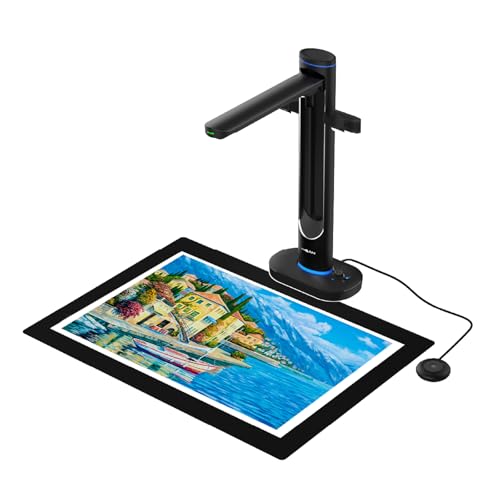
- Dual 48MP cameras with up to 600 DPI
- Handles bound materials and documents up to A2
- Includes AI correction, OCR, and text-to-speech
Best For: Archives, libraries, classrooms, and oversized books
Best for OCR Workflows

- 18MP camera with 4896 × 3672 resolution
- A3 scanning with curved-page flattening
- ABBYY OCR supports 180+ languages
Best For: Searchable PDFs and editable office documents
Best Versatile Value

- 26MP capture with software-enhanced 600 DPI
- Scans A2 materials with adjustable A2/A3 height
- Automates flattening, finger removal, and page splitting
Best For: Mixed-format scanning, manuscripts, maps, and remote collaboration
Best Portable Choice

- 13MP CMOS camera for A3 and A4 scanning
- About one-second page scanning
- Foldable design with OCR and document-camera modes
Best For: Portable scanning, remote teaching, and thinner books
Best High-Detail Pick
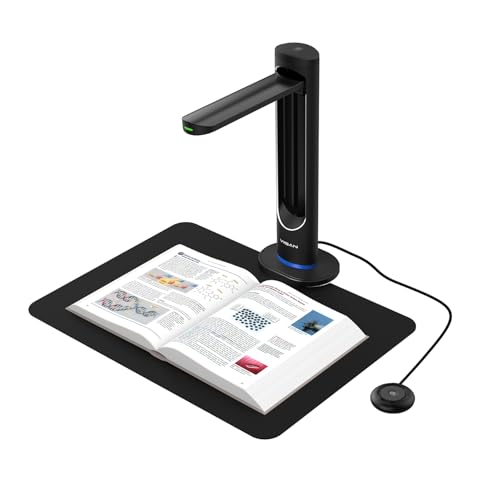
- 48MP Sony CMOS sensor with 600 DPI capture
- AI page smoothing and automatic double-page splitting
- Laser positioning with page-turn auto-scan
Best For: Archiving, high-volume digitization, and detailed A3 materials
Best Lightweight Option
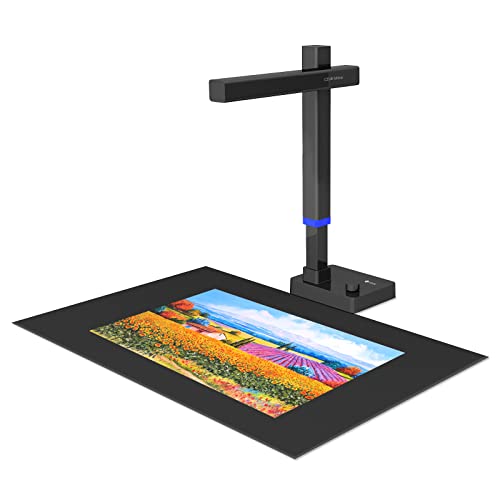
- 24MP CMOS camera with 5696 × 4272 resolution
- Exports searchable PDFs and editable Word or Excel files
- Two-pound, 90-degree-foldable design
Best For: Portable book scanning and flexible document exports
Professional Detail – CZUR ET MAX 38MP Book Scanner
For buyers seeking high resolution book scanners, the CZUR ET MAX stands out with a 38MP CMOS sensor, 7168 × 5376 resolution, and a large A3 scanning area. Its curve-flattening technology and fast capture workflow make it well suited to demanding digitization projects.
Best For: Professional users scanning bound books, large documents, and high volumes of material.
Pros:
- 38MP sensor and 410 DPI resolution capture highly detailed images.
- Automatically flattens curved pages and removes distortion without unbinding books.
- OCR supports editable and searchable Word, Excel, and PDF files in 180+ languages.
- Supports Windows, macOS, Linux, and HDMI output for live display.
Cons:
- Not recommended for glossy or highly reflective materials.
- Arabic OCR support is limited by operating system, while Thai and Hebrew are unsupported.
- Its feature set may be more than casual users need.
The ET MAX is a strong choice when image detail, book-page correction, and workflow speed matter most. Its A3 capability and broad connectivity make it especially practical for libraries, archives, educators, and bulk scanning.
Organized Archiving – Plustek OpticBook 4900
The Plustek OpticBook 4900 combines a 1200 dpi flatbed scanner with BookMaker software, making it one of the more organization-focused options among high resolution book scanners. It is designed for users who want to scan, classify, search, and share books and reference documents.
Best For: Researchers, offices, and professionals building searchable, well-organized digital libraries.
Pros:
- 1200 dpi CCD scanning supports detailed book, document, photo, and text captures.
- BookMaker helps organize scanned books, PDFs, magazines, and handwritten notes.
- OCR enables full-text search and editable formats.
- Includes one year of eDoc cloud storage for synchronization and collaboration.
Cons:
- Uses a flatbed design rather than a fast overhead page-capture system.
- Requires software downloads and registration for the cloud-storage service.
- Listed compatibility is limited to Windows 7–11 64-bit and macOS 10.13–14.x.
The OpticBook 4900 is less about rapid bulk capture and more about creating a manageable digital reference collection. Its software tools are the main attraction for users who value tagging, notes, search, and collaboration.
Flexible Large Format – VIISAN S21 Pro A2/A3 Scanner
For buyers comparing high resolution book scanners with large-format flexibility, the VIISAN S21 Pro supports both A2 and A3 materials. Its 26MP sensor, software-enhanced 600 DPI output, automatic page correction, and foldable design make it adaptable for books, maps, newspapers, and documents.
Best For: Users who need one portable scanner for books, oversized documents, visual presentations, and occasional object capture.
Pros:
- Switches between A2 and A3 formats with a foldable hinge and adjustable height.
- Auto-flattens pages, removes fingerprints, repairs edges, and splits spreads.
- OCR supports 180+ languages and exports to PDF, Word, Excel, ePub, and TXT.
- Works with Windows and macOS and supports UVC/UAC video conferencing.
Cons:
- Highly glossy or glare-prone paper is not recommended.
- Not compatible with ARM-based devices such as Surface Pro X.
- Its 600 DPI output is software-enhanced rather than the stated optical resolution.
The S21 Pro is a versatile option for mixed-format scanning rather than a dedicated flatbed workflow. Its A2 support, portability, and smart image processing are compelling for classrooms, libraries, studios, and mobile workstations.
Reader-Friendly Scanning – CZUR Aura Pro Book Scanner
The CZUR Aura Pro is a practical choice among high resolution book scanners for home offices, classrooms, and everyday book digitization. It combines A3/A4 capture, three-line laser page flattening, fast two-second scans, and a built-in smart lamp that also supports comfortable reading.
Best For: Students, educators, and home users who want straightforward book scanning with useful lighting features.
Pros:
- Captures A3 and A4 materials at up to 4320 × 3240 resolution.
- Laser-assisted flattening reproduces curved book pages more accurately.
- Scans a page in about two seconds and exports JPG, Word, PDF, and searchable PDF.
- Built-in lighting offers four color temperatures plus supplemental side lights.
Cons:
- Thai, Hebrew, and Arabic are not supported by its OCR.
- It uses a CIS sensor rather than the higher-resolution sensor found in the ET MAX.
- Its smart-lamp and scanning features require the CZUR app.
The Aura Pro balances scanning convenience with everyday usability. It is a sensible pick when you want reliable curved-page correction, quick output, and a built-in reading lamp without stepping up to a more specialized professional model.
Best Large-Format Pick – VIISAN S48 Duo A2/A3 Book Scanner
For libraries, archives, and classrooms comparing high resolution book scanners, the VIISAN S48 stands out with dual 48MP cameras, up to 600 DPI, and an overhead design that handles bound materials without flattening them. Its software also helps automate page correction and cleanup.
Best For: Large books, fragile materials, archival projects, distance education, and professional document sharing.
Pros:
- Scans oversized books, maps, and documents up to A2 size without pressing on bindings.
- Dual 48MP cameras capture detailed text, lines, and color at up to 600 DPI.
- AI-assisted flattening, finger-mark removal, edge correction, OCR, and text-to-speech reduce post-processing.
- Can function as a UVC camera for Zoom, Teams, presentations, and live instruction.
Cons:
- Requires a USB connection and a compatible Windows or macOS computer.
- Its 2.8 kg weight may be less convenient for frequent transport.
- At least 20GB of available hard-drive space is recommended.
The S48 is the strongest choice here for users who need both large-format coverage and especially detailed captures. Its accessibility and live-camera features add value beyond standard book digitization.
Best for OCR Workflows – CZUR ET18 Pro A3 Book Scanner
The CZUR ET18 Pro is a practical option among high resolution book scanners when searchable, editable files matter as much as image capture. Its 18MP camera, A3 coverage, curved-page flattening, and ABBYY OCR support make it suited to efficient document conversion.
Best For: Offices, researchers, and home users converting books and A3 documents into searchable or editable files.
Pros:
- Scans documents up to A3 size, including large books and business materials.
- Patented processing flattens curved book pages after pixel transformation.
- ABBYY OCR supports conversion to editable PDF, Word, and Excel files across 180+ languages, with noted exceptions.
- Scanning can take about two seconds per page after users become proficient.
Cons:
- Uses a cable connection and does not support Wi-Fi.
- Its 275 DPI specification is lower than the 600 DPI offered by some larger-format alternatives.
- Very reflective or glary paper is not recommended.
The ET18 Pro emphasizes speed and OCR rather than maximum resolution. Choose it when creating editable, searchable documents is the central task and A3 coverage is sufficient.
Best Versatile Value – VIISAN S21 A2/A3 Book Scanner
The VIISAN S21 combines high resolution book scanner capabilities with a flexible overhead design for books, maps, journals, documents, and even 3D objects. It offers 26MP capture, software-enhanced resolution up to 600 DPI, and automated page cleanup for varied scanning projects.
Best For: Users who need an adaptable A2/A3 scanner for books, manuscripts, maps, remote collaboration, and mixed media.
Pros:
- Captures A2-size materials and adjusts between A2/A3 scanning heights.
- Provides up to 26MP resolution and software-enhanced output up to 600 DPI.
- Automatically flattens curved pages, removes fingers, repairs edges, and separates facing pages.
- Built-in LED lighting, OCR, multiple export formats, and UVC/UAC support expand its usefulness.
Cons:
- Bundled OfficeCam software is not compatible with ARM-based Windows devices or Macs.
- Uses USB connectivity rather than wireless scanning.
- Glare-prone paper is not recommended, and built-in LEDs are not intended for bright-light use.
The S21 is a well-rounded choice for varied overhead scanning needs. It offers broad format support and strong automated processing, provided your computer uses a supported x64 or x86 architecture.
Best Portable Choice – CZUR Shine Ultra
For shoppers comparing high resolution book scanners, the CZUR Shine Ultra offers a portable setup for A3 and A4 materials, with roughly one-second page scans and a 13MP CMOS camera. It also works as a USB document camera and supports OCR in more than 180 languages, though some languages are excluded.
Best For: Portable book and document scanning, remote teaching, and users who need OCR and camera functionality in one device.
Pros:
- Scans A3 and A4 documents at about one second per page.
- 13MP camera with smart paging, auto-cropping, and multiple color modes.
- Foldable, height-adjustable design with a foot pedal.
- Supports OCR in 180+ languages and works as a USB document camera.
Cons:
- Curved-page flattening is intended for thinner books; thicker books may require the ET series.
- Not compatible with Android or iOS.
- Thai, Hebrew, and Arabic are not supported for OCR.
The Shine Ultra is a versatile choice when portability and fast workflow matter more than the highest stated resolution. Its broad document-size support and camera features make it practical for home offices, classrooms, and light book digitization.
Best High-Detail Pick – VIISAN K48 48MP Book Scanner
The VIISAN K48 stands out among high resolution book scanners with a 48MP Sony CMOS sensor and stated 600 DPI resolution. Its AI-assisted page smoothing, laser positioning, and automatic page-turn detection are designed for detailed, repeatable book digitization and archival work.
Best For: High-detail book archiving, libraries, accessibility projects, and users processing large quantities of pages.
Pros:
- True 48MP sensor with 600 DPI capture for detailed A3-size materials.
- AI-assisted smoothing helps remove curvature, finger shadows, and background interference.
- Laser positioning and automatic capture support faster page-turning workflows.
- Creates searchable PDFs, editable office files, and MP3 audio through OCR and text-to-speech features.
Cons:
- Requires Windows 10/11 or macOS 10.15 and later.
- The feature-rich design may be more than casual scanning users need.
- Its listed weight is 1.5 kg, making it less travel-focused than lighter portable models.
The K48 is the strongest fit here for resolution-focused digitization. Its automated alignment, page handling, and file-conversion features favor organized, high-volume scanning rather than occasional document capture.
Best Lightweight Option – CZUR Shine Ultra Pro
The CZUR Shine Ultra Pro is a compact option for shoppers seeking high resolution book scanners that are easy to move and store. Its 24MP document-scanning system can flatten curved book pages and export scans to JPG, PDF, searchable PDF, Word, and Excel formats.
Best For: Users who want a lightweight, foldable scanner for books and documents with flexible export options.
Pros:
- 24MP CMOS capture with a listed 5696 × 4272 resolution.
- Can flatten curved book pages after pixel transformation.
- Exports to JPG, PDF, searchable PDF, Word, and Excel.
- Weighs 2 pounds and folds 90 degrees for portability.
Cons:
- Its listed resolution specification is not expressed as a DPI figure.
- Requires USB connectivity and a compatible Windows or macOS computer.
- Supplied notes do not specify a separate automatic page-turn feature.
The Shine Ultra Pro balances image detail, portability, and useful file conversion. It is especially appealing when a scanner needs to move between workspaces and produce editable or searchable files without a bulky footprint.
How We Picked the Best High Resolution Book Scanners
We focused on scanners that offer a meaningful combination of image resolution, book-friendly capture hardware, page-flattening or distortion correction, OCR, and practical software. The selection includes overhead scanners for bound materials, flatbeds for precise single-page captures, portable models for flexible use, and large-format systems for maps, art books, and oversized documents.
We also considered capture size, lighting and shadow control, automatic page processing, connectivity, portability, and the type of workflow each scanner supports. Stated megapixel and DPI figures are useful, but real-world results also depend on page condition, software processing, alignment, and lighting.
Quick Comparison
Choose an overhead scanner when you need to preserve bound books without cutting or separating pages. Flatbed models are better for maximum contact with individual pages, photographs, and flat originals. Portable scanners suit occasional digitization and small workspaces, while A2/A3 models are the strongest choice for oversized books, drawings, newspapers, and archival materials.
OCR is especially useful if you plan to search, copy, or edit scanned text. Features such as automatic flattening, finger removal, timed page capture, and text-to-speech can reduce manual work, but compatibility with your computer and preferred file formats still matters.
Key Buying Factors for High-Resolution Book Scanners
Resolution and Image Quality
Higher resolution can preserve small type, footnotes, illustrations, and fine line work. Look beyond the headline megapixel number and check the scanner’s effective output resolution, lens quality, lighting consistency, and ability to produce clean images across a full page.
Book Handling and Page Correction
Overhead designs are generally more convenient for bound books. Automatic page flattening and curvature correction help make text near the spine more readable, while finger-removal software can keep hands out of the final image. A V-shaped cradle or compatible book support may also reduce strain on fragile bindings.
Capture Size and Workflow
A4 is adequate for most standard books and office documents. A3 or A2 capture areas are better for art books, newspapers, maps, and large archival pages. Consider whether you need batch capture, duplex imaging, automatic page turning support, or a portable setup.
OCR, Software, and Connectivity
Check whether OCR is included, which languages it supports, and whether exports can be saved as searchable PDF, Word, or image files. USB requirements, operating-system support, included software, and setup space can have as much impact on usability as scan quality.
Who Should Buy Which High Resolution Book Scanners?
Home researchers and students should prioritize simple overhead operation, OCR, and a compact footprint. Libraries, archives, and digitization professionals may benefit from 24MP to 48MP cameras, large-format capture, automatic processing, and durable software workflows. Offices handling receipts, contracts, and loose pages may prefer a flatbed or document-focused model. Artists, educators, and users working with oversized originals should look for A3 or A2 coverage.
Before buying, measure your workspace, confirm operating-system compatibility, and decide whether you need searchable text or only high-quality image files. The right scanner is the one that matches your book sizes, preservation needs, and expected scanning volume—not simply the model with the largest resolution claim.