
Preserving books, manuscripts, and other bound materials requires more than a basic flatbed scanner. The right overhead model can reduce spine stress, capture oversized pages, and streamline the process of turning fragile collections into searchable digital files.
We’ve selected 10 options ranging from compact portable scanners to high-resolution A2/A3 systems. Use the guide below to match scanning speed, image quality, OCR features, and workspace needs with your archival project.
Best 10 Book Scanners for Archival Projects Picks for 2026
Best Overall for Hands-Off Book Scanning

- Overhead design protects bound materials
- Automatic curve and page corrections
- Page-turn detection speeds batch scanning
Best For: Mixed-format book and document archiving
Best for Affordable OCR Workflows

- 18MP camera with A3 scanning area
- OCR supports 180+ languages
- Flattens curved bound pages
Best For: Searchable and editable book archives
Best for Oversized and Fragile Materials
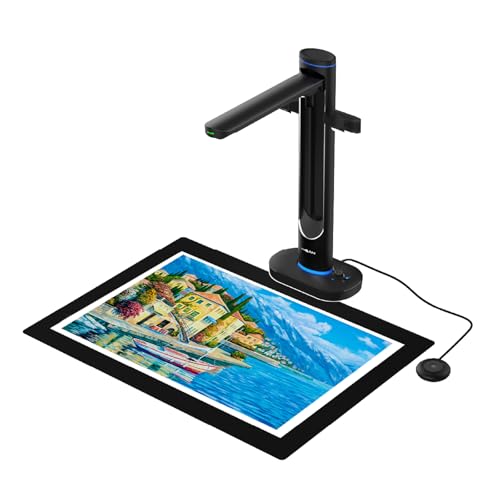
- A2 overhead scanning for delicate materials
- Dual 48MP cameras and up to 600 DPI
- OCR and text-to-speech support
Best For: Large-format library and archival collections
Best for High-Resolution Batch Digitization

- 38MP sensor with 7168 × 5376 resolution
- A3 scanning and curve flattening
- OCR plus Windows, macOS, and Ubuntu support
Best For: Detailed, high-volume archival scanning
Large-Format Archival Pick

- A2/A3 capture for newspapers, maps, and manuscripts
- 26MP imaging with enhanced 600 DPI output
- Auto-flattening, fingerprint removal, and OCR
Best For: Oversized archival materials and bound documents
Fast Everyday Archive Choice

- Approximately two seconds per page
- Curved-page flattening with three laser lines
- 180+ language OCR and searchable PDF output
Best For: Standard-size books and documents
Flexible AI-Ready Option

- Switches between A2 and A3 capture sizes
- 26MP sensor with enhanced 600 DPI output
- OCR, page correction, and Gemini web integration
Best For: Mobile, mixed-format archival workflows
Fast Archival Workhorse

- 16MP camera with fast page capture
- Flattens curved book pages
- OCR supports 180+ languages
Best For: Thick books and high-volume digitization
Portable Archive Companion

- About one-second-per-page scanning
- Handles materials up to A3 size
- Foldable 4-pound design
Best For: Thinner books and mobile scanning setups
Large-Format Archive Specialist

- A3 overhead scanning for large materials
- 16MP camera with up to 300 DPI
- Anti-glare LED lighting
Best For: Oversized books, artwork, and sheet music
Best Overall for Hands-Off Book Scanning – ScanSnap SV600
The ScanSnap SV600 is a practical choice among book scanners for archival projects when you need to digitize bound books, newspapers, magazines, photos, and documents without cutting or damaging them. Its page-turn detection and automatic corrections help streamline repeated scanning.
Best For: Home archivists, libraries, and offices digitizing mixed-size bound materials with minimal manual editing.
Pros:
- Scans books and other materials overhead without unbinding or cutting them.
- Automatically flattens curved pages and corrects page distortion.
- Page Turning Detection can start scans automatically as pages are turned.
- Multi Document Detection can crop and rotate multiple items in one scan.
Cons:
- Requires a USB connection rather than wireless operation.
- Its standard sheet capacity is limited to one sheet.
- Point Retouch finger removal may require additional editing attention.
The SV600 stands out for convenient, non-destructive scanning and automated workflow features. It is particularly well suited to personal and institutional collections where preserving bindings matters more than achieving the highest listed camera resolution.
Best for Affordable OCR Workflows – CZUR ET18 Pro
The CZUR ET18 Pro is a strong option among book scanners for archival projects that require searchable and editable files. Its 18MP camera, A3 scanning area, curved-page flattening, and ABBYY-powered OCR support efficient digitization of books and documents.
Best For: Users converting bound books and large documents into searchable PDFs, Word files, or spreadsheets.
Pros:
- Flattens curved book pages using image-processing technology.
- OCR supports more than 180 languages, with specified language limitations.
- Scans documents up to A3 size.
- Approximately two-second-per-page scanning after the user becomes proficient.
Cons:
- Uses a cable connection and does not support Wi-Fi.
- Glare-prone or highly reflective paper is not recommended.
- Arabic OCR support depends on the operating system, while Thai and Hebrew are not supported.
With strong OCR functionality and a large scanning area, the ET18 Pro makes sense for archival workflows where text retrieval and document conversion are priorities. Its cable-only design and material limitations should be considered before purchase.
Best for Oversized and Fragile Materials – VIISAN S48 Duo
The VIISAN S48 Duo is designed for book scanners for archival projects involving oversized or delicate materials. Its overhead A2-capable format, dual 48MP cameras, and image-processing tools are suited to books, maps, manuscripts, and other items that should not be pressed flat.
Best For: Libraries, schools, and archives handling large-format or fragile bound materials and needing high-resolution captures.
Pros:
- Captures oversized materials up to A2 without flattening or damaging bindings.
- Dual 48MP cameras provide detailed images at up to 600 DPI.
- AI-assisted processing can flatten pages, remove finger marks, and correct edge distortion.
- OCR and text-to-speech features support searchable and accessible content.
Cons:
- Requires a USB connection.
- The stated minimum storage requirement is 20GB, with 4GB RAM minimum and 16GB recommended.
- Its larger-format capability may be more than needed for ordinary letter-size documents.
The S48 Duo is the most suitable pick here for large, fragile, or valuable materials where non-contact handling and detail are central concerns. It also adds useful accessibility and presentation functions beyond basic scanning.
Best for High-Resolution Batch Digitization – CZUR ET MAX
The CZUR ET MAX is a high-resolution choice among book scanners for archival projects, combining a 38MP CMOS sensor with curve-flattening technology and OCR. Its A3 scanning area and rapid page capture make it practical for detailed, high-volume digitization.
Best For: Archival users who need detailed A3 scans, searchable files, and compatibility across Windows, macOS, and supported Ubuntu versions.
Pros:
- 38MP sensor captures images at 7168 × 5376 resolution.
- Automatically flattens curved pages and reduces distortion without unbinding books.
- OCR supports editable and searchable Word, Excel, and PDF files.
- Supports Windows, macOS, and Ubuntu 20.04 through 24.04.
Cons:
- Glossy or highly reflective materials are not recommended.
- OCR has stated limitations for Thai, Hebrew, and some Arabic operating-system configurations.
- Fast 1.5-second page scanning assumes practiced operation.
The ET MAX is a compelling fit when image detail, OCR, and system flexibility matter in a larger scanning project. Its A3 capacity and HDMI output add practical value for demonstrations, while material glare remains an important limitation.
Large-Format Archival Pick – VIISAN S21 A2/A3 Book Scanner
For book scanners for archival projects involving newspapers, maps, manuscripts, and oversized journals, the VIISAN S21 stands out with adjustable A2/A3 capture size and a 26MP sensor. Its software is designed to reduce common book-scanning cleanup work, including curved pages, fingers, damaged edges, and double-page spreads.
Best For: Archival projects that include large-format documents and oversized bound materials.
Pros:
- Captures A2 and A3 materials with up to 26MP resolution and software-enhanced 600 DPI output.
- Automatically flattens curved pages, removes fingerprints, repairs damaged edges, and splits facing pages.
- OCR exports scans to searchable or editable PDF, Word, Excel, EPUB, and text formats.
- Foldable 90-degree hinge, adjustable height, built-in three-level LED lighting, and UVC/UAC support add flexibility.
Cons:
- Bundled OfficeCam software supports x64/x86 Windows and macOS but not ARM-based devices such as Surface Pro X.
- Glare-prone paper is not recommended, and the built-in LEDs are not intended for bright-light use.
- It connects through USB rather than wireless networking.
The S21 is a strong fit when oversized source material matters as much as image cleanup. Confirm your computer architecture and workspace before buying, particularly if your archive includes glossy pages or you use an ARM-based Windows device.
Fast Everyday Archive Choice – CZUR Aura Pro A3/A4 Scanner
The CZUR Aura Pro is a practical option among book scanners for archival projects when you primarily work with A3 or A4 books and documents. It combines two-second-per-page scanning with curved-page flattening, searchable PDF creation, and OCR across more than 180 languages.
Best For: Home, school, and office archives focused on standard-size books and documents.
Pros:
- Scans a page in approximately two seconds and exports JPG, Word, PDF, and searchable PDF files.
- Uses three laser lines to flatten curved book pages and improve image clarity.
- OCR supports more than 180 languages, with AI-assisted image processing in the software.
- 32 LEDs and supplemental side lights provide adjustable, glare-free illumination and four color-temperature settings.
Cons:
- Capture size is limited to A3 and A4, so it is less suitable for oversized maps or newspapers.
- Thai, Hebrew, and Arabic are not currently supported by the stated OCR feature.
- It requires a USB connection and compatible Windows or macOS software.
Choose the Aura Pro when speed, lighting, and straightforward OCR are more important than A2 coverage. Its format limits and unsupported OCR languages are the main considerations for specialized archival collections.
Flexible AI-Ready Option – VIISAN S21 Pro A2/A3 Scanner
For book scanners for archival projects that need both oversized capture and portable setup, the VIISAN S21 Pro switches between A2 and A3 formats with a foldable hinge and telescopic arm. Its 26MP sensor, enhanced 600 DPI output, page correction tools, and OCR make it suited to digitizing varied collections.
Best For: Researchers and mobile archives that need A2/A3 flexibility plus OCR and AI-assisted document analysis.
Pros:
- Handles A2 and A3 materials, including large newspapers, maps, books, and documents.
- Automatically flattens pages, removes fingerprints, repairs edges, and separates double-page spreads.
- Supports 180+ language OCR with PDF, Word, Excel, EPUB, and text export.
- Foldable, lightweight design includes three-level LED lighting, UVC/UAC support, and Gemini integration through the VisualCam Lite web interface.
Cons:
- Not compatible with ARM-based devices such as Surface Pro X.
- Highly glossy or glare-prone paper is not recommended.
- Gemini features require the free VisualCam Lite Web UI and Chrome, while the scanner itself uses USB.
The S21 Pro is compelling for mixed-format collections and users who value portability alongside automated cleanup. Before purchasing, verify Windows or macOS compatibility and whether your workflow benefits from the browser-based Gemini features.
Fast Archival Workhorse – CZUR ET16 Plus
For book scanners for archival projects involving thick volumes and high page counts, the CZUR ET16 Plus stands out for its 16MP camera, curved-page flattening technology, and fast scanning workflow. It can scan books, binders, business cards, vouchers, and some physical objects, though very glossy paper is not recommended.
Best For: Digitizing thick books and large collections quickly on compatible Windows or Mac computers.
Pros:
- Patented technology helps flatten curved book pages.
- 16MP camera and approximately 1.5 seconds per page support rapid scanning.
- Ten LED lights plus two supplemental lights help reduce shadows.
- OCR supports more than 180 languages, with stated language limitations.
Cons:
- Very glossy paper is not recommended.
- Requires a USB-connected Windows or Mac computer.
- OCR support varies by language and operating system.
With its high-resolution camera and book-flattening system, the ET16 Plus is a practical choice when archival throughput matters more than a compact footprint.
Portable Archive Companion – CZUR Shine Ultra
The CZUR Shine Ultra is a portable option for book scanners for archival projects involving thinner books, flat papers, and documents up to A3 size. Its 13MP camera, roughly one-second-per-page speed, and foldable design make it suited to flexible scanning setups.
Best For: Portable scanning of thinner books, flat documents, artwork, and A3-size materials.
Pros:
- Scans pages at approximately one second per page.
- Supports documents and objects smaller than A3 size.
- Foldable, lightweight design with a height-adjustable neck and foot pedal.
- Includes automatic cropping, smart paging, side combining, and OCR functions.
Cons:
- Designed for thinner books; the manufacturer recommends the ET series for thicker books.
- Not compatible with Android or iOS.
- OCR does not currently support Thai, Hebrew, or Arabic.
The Shine Ultra offers useful portability and fast capture, making it a good fit for smaller archival stations or projects that require occasional relocation.
Large-Format Archive Specialist – VIISAN DL16 A3 Book Scanner
For book scanners for archival projects that include oversized pages, sheet music, artwork, or bound volumes, the VIISAN DL16 provides an A3 overhead scanning format. Its 16MP camera, 300 DPI capture, and anti-glare LED lighting are designed for clearer overhead digitization on Windows and Mac.
Best For: Libraries, offices, educators, and home archivists digitizing A3 materials and large documents.
Pros:
- A3 overhead format accommodates large documents and artwork.
- 16MP camera captures detail at up to 300 DPI.
- Anti-glare LED lighting helps reduce glare and uneven shadows.
- Compatible with both Windows and Mac computers.
Cons:
- USB connection requires a computer-based setup.
- Supplied notes do not specify the supported OCR language list or scanning speed.
- It is an overhead document scanner rather than a conventional flatbed design.
The DL16 is a sensible choice when page size and overhead access are priorities, especially for archival collections that extend beyond standard letter-sized documents.
How We Picked the Best Book Scanners for Archival Projects
We compared these scanners by examining their capture format, stated camera resolution, scanning resolution, page-flattening technology, OCR support, lighting design, and workflow features. For archival work, we gave particular attention to overhead designs because they can handle bound volumes with less pressure on spines than conventional flatbeds.
We also considered practical differences between models: compact units suit occasional home projects, while A2/A3 scanners are better for maps, newspapers, art books, and oversized archival materials. Features such as automatic page detection, finger removal, dewarping, text-to-speech, and batch processing can significantly reduce editing time.
Quick Comparison
| Best For | What to Prioritize | Recommended Type |
|---|---|---|
| Bound books and rare volumes | Gentle overhead capture, page flattening, and glare control | Overhead book scanner |
| Large-format documents | A2/A3 capture area and high-resolution imaging | Large-format document camera |
| Searchable digital archives | Reliable OCR and export options | OCR-capable scanner |
| Travel or limited workspace | Portable design and simple software | Compact smart scanner |
Key Buying Factors for Book Scanners for Archival Projects
Capture Size and Book Handling
Check whether the scanner supports A4, A3, or A2 material. Larger capture areas are useful for open books, newspapers, photographs, maps, and oversized illustrations. Also consider the maximum book thickness and whether the design accommodates a raised spine.
Image Quality and Lighting
Camera megapixels are only one part of image quality. Look for even lighting, anti-glare illumination, color consistency, and software that corrects curved pages. Higher resolution is valuable when preserving fine print, marginalia, illustrations, and photographs, but it can create larger files and slower processing.
OCR and File Workflow
OCR converts scanned pages into searchable and editable text. Verify which languages are supported and whether the software exports to PDF, searchable PDF, Word, TIFF, or common image formats. Batch processing and automatic page splitting are especially useful for long projects.
Speed, Stability, and Software
Archival scanning involves repetitive work, so page detection, automatic capture, finger removal, and dewarping can matter as much as raw resolution. Confirm operating-system compatibility, included accessories, and whether the software receives updates.
Who Should Buy Which Book Scanners for Archival Projects?
Choose a compact model such as the CZUR Shine Ultra when portability, occasional use, and limited desk space are the priorities. The ScanSnap SV600 is a strong fit for users who want a well-known overhead workflow for books and mixed documents.
For oversized books, newspapers, artwork, or institutional collections, consider an A2/A3 option such as the VIISAN S48 Duo, VIISAN large-format models, CZUR ET MAX, or the A3-capable CZUR Aura Pro. These provide more room for large originals and can reduce the need for stitching or multiple captures.
For searchable research archives, prioritize models with OCR and automatic page correction, including the CZUR ET18 Pro, ET16 Plus, and VIISAN DL16. Before buying, confirm the scanner’s supported software and export formats, then choose the highest capture size and image quality your budget, computer, and storage workflow can comfortably support.