
Studio monitors with ribbon tweeters can deliver detailed, controlled highs that help reveal reverb tails, vocal sibilance, cymbal texture, and mix balance. The right model depends on your room size, listening distance, low-end requirements, and whether you need a traditional nearfield pair or a compact desktop solution.
This roundup compares 10 options from ADAM Audio, PreSonus, and Yamaha, including compact monitors for desks and larger cabinets suited to more demanding home or project studios. Use the guide below to narrow the list by placement, output, connectivity, and overall value.
Best 10 Studio Monitors with Ribbon Tweeters Picks for 2026
Best for Bass-Heavy Rooms

- 8-inch woofer with 35Hz–22kHz response
- ART ribbon tweeter with HPS waveguide
- Isolation pads and XLR cables included
Best For: Bass-intensive production and larger mix rooms
Best Wide Sweet Spot

- Wide 100° × 60° EBM waveguide
- 6.55-inch woven-composite woofer
- Room-tuning controls included
Best For: Flexible home-studio mixing setups
Best Compact Ribbon-Style Monitor

- U-ART tweeter with HPS waveguide
- Compact 5-inch woofer cabinet
- DSP high- and low-shelf filters
Best For: Small rooms and desktop production
Best Compact Pair

- Compact 4.5-inch two-way monitor pair
- XLR/TRS, RCA, and stereo mini inputs
- Room control and high-trim adjustments
Best For: Small DAW workstations and video editing
Deep-Bass Ribbon Reference

- 8-inch woofer reaches down to 33 Hz
- U-ART ribbon tweeter extends to 25 kHz
- HPS Waveguide widens the sweet spot
Best For: Bass-heavy mixing, production, and film scoring
Compact Stereo Workhorse

- Includes a complete stereo pair
- U-ART tweeters deliver detailed highs
- 45 Hz–25 kHz response with 70 watts total power
Best For: Home studios and nearfield mixing
Desktop Ribbon Convenience
- USB-C connection for computers and mobile devices
- 1.5-inch D-ART desktop ribbon tweeters
- Compact pair with 80 watts and 45 Hz extension
Best For: Desktop production, songwriting, and computer listening
Best for Room-Tunable Home Studios

- U-ART ribbon tweeter reaches up to 25 kHz
- 7-inch woofer extends down to 39 Hz
- Room-tuning trims and cables included
Best For: Home studios needing fuller low-end monitoring
Best for Desktop Production

- D-ART ribbon tweeter for detailed highs
- USB-C connection for computers and mobile devices
- Angled stands and DSP placement controls
Best For: Compact desks and direct digital connections
Best for Flexible Nearfield Connections

- U-ART ribbon tweeter reaches up to 25 kHz
- XLR and RCA cables included
- 5-inch woofer reaches down to 45 Hz
Best For: Home studios with varied audio sources
Best for Bass-Heavy Rooms – ADAM Audio T8V
If you need studio monitors with ribbon tweeters for bass-intensive production, the ADAM Audio T8V pair offers an 8-inch woofer, ART ribbon tweeter with HPS waveguide, and 35Hz–22kHz response. This bundle also includes isolation pads and balanced XLR cables, making it a practical setup for larger rooms or mixes that demand extended low end.
Best For: Hip-hop, trap, electronic, R&B, and larger mix rooms where sub-bass accuracy matters.
Pros:
- ART ribbon tweeter and HPS waveguide support detailed highs and controlled stereo dispersion.
- 35Hz–22kHz response and up to 118dB SPL provide substantial low-frequency reach and headroom.
- Bundle includes large isolation pads, power cables, and multiple balanced XLR cables.
- XLR, TRS, and RCA inputs plus HF and LF shelving controls support flexible room setup.
Cons:
- The 8.5-inch cabinet and deep bass extension may be more monitor than a compact desktop room needs.
- Isolation pads and cables are bundle extras rather than features built into the monitor itself.
The T8V is the strongest choice here when low-end extension and output are priorities. Its size makes room placement and acoustic treatment more important than with smaller nearfields.
Best Wide Sweet Spot – PreSonus Eris E7 XT
PreSonus Eris E7 XT 2-Way Active Studio Monitor with EBM Waveguide (Pack of 1)
Check Price On AmazonThe PreSonus Eris E7 XT is a practical option for producers seeking studio monitors with ribbon tweeters, although its 1.25-inch driver is a silk-dome design rather than a ribbon tweeter. Its 6.55-inch woofer, wide EBM waveguide, and adjustable acoustic controls make it suited to flexible mixing setups.
Best For: Home studios that need a broad listening area, solid imaging, and room-adjustment controls.
Pros:
- 100° horizontal by 60° vertical EBM waveguide creates a wide sweet spot.
- 6.55-inch woven-composite woofer supports deep low-frequency reproduction.
- Level, high-pass, LF trim, HF trim, and acoustic-space controls help tailor the monitor to the room.
- Includes Studio One Prime and the Studio Magic plug-in suite.
Cons:
- It does not use a ribbon tweeter; its high-frequency driver is a silk-dome transducer.
- This listing is for one monitor, so a stereo setup requires purchasing two.
The E7 XT is worth considering if a wide sweet spot and room tuning are more important than a true ribbon high-frequency driver. Verify the included quantity before planning a stereo pair.
Best Compact Ribbon-Style Monitor – ADAM Audio T5V
For smaller workspaces, the ADAM Audio T5V brings ADAM’s U-ART tweeter and HPS waveguide to a compact 5-inch monitor. It is a suitable choice for shoppers comparing studio monitors with ribbon tweeters who want detailed highs, flexible connections, and room-adjustment filters without moving to a larger cabinet.
Best For: Desktop recording, podcast production, guitar tracking, audio editing, and smaller rooms.
Pros:
- U-ART tweeter and HPS waveguide deliver detailed high-frequency reproduction.
- 5-inch woofer keeps the cabinet practical for limited spaces.
- High- and low-shelf DSP filters help adapt the monitor to difficult acoustic environments.
- XLR, 1/4-inch TRS, and RCA compatibility supports varied interfaces and source devices.
Cons:
- The smaller woofer offers less low-end reach than the T8V and is designed to pair with the optional T10S subwoofer for extended bass.
- The supplied listing details are inconsistent about whether the package contains one monitor or two, so confirm quantity before ordering.
The T5V is the most space-conscious ADAM option in this group. Choose it when high-frequency detail and placement flexibility matter more than maximum bass output.
Best Compact Pair – Yamaha HS4
The Yamaha HS4 is a compact powered pair for desktop and DAW workstations. It is not a ribbon-tweeter monitor—the 1-inch dome tweeter is a conventional dynamic design—but its small footprint, included anti-slip pad, and broad input selection make it a useful alternative when space is limited.
Best For: Compact workstations, video editing, music production, and everyday nearfield monitoring.
Pros:
- Pair includes two-way monitors with 4.5-inch cone woofers and 1-inch dome tweeters.
- Compact tabletop design suits small desks and DAW workstations.
- XLR/TRS combo, RCA, and stereo mini inputs support computers and consumer devices.
- Room control and high-trim controls provide basic tonal adjustment.
Cons:
- It does not use ribbon tweeters, so it does not directly meet the target design preference.
- 60Hz–22kHz response provides less low-end extension than larger monitors.
- The listed output is 26W and above 26W, limiting headroom compared with larger models.
The HS4 is a sensible compact pair for general workstation use, but shoppers specifically seeking ribbon-tweeter treble should choose one of the ADAM models instead.
Deep-Bass Ribbon Reference – ADAM Audio T8V
For bass-heavy production, the ADAM Audio T8V is a strong choice among studio monitors with ribbon tweeters. Its 8-inch woofer reaches down to 33 Hz, while the U-ART Accelerated Ribbon Tweeter extends up to 25 kHz for detailed highs.
Best For: Producers, mixers, and film scorers who need extended low-end reproduction and a wider listening sweet spot.
Pros:
- Low-end extension reaches 33 Hz for bass-focused work.
- U-ART ribbon tweeter reaches up to 25 kHz and is designed to reduce high-frequency distortion.
- HPS Waveguide creates a more controlled, wider sweet spot.
- Includes XLR, 1/4-inch TRS, and RCA compatibility.
Cons:
- The 8-inch design is relatively large for compact desks.
- This listing is for one monitor, so a stereo pair requires two units.
- It is wired rather than a wireless monitoring solution.
The T8V prioritizes headroom and bass reach, making it better suited to larger workspaces and low-frequency-heavy material than compact desktop monitors. Its ribbon tweeter and waveguide help balance that power with focused high-frequency detail.
Compact Stereo Workhorse – ADAM Audio T5V Pair
The ADAM Audio T5V pair offers a practical entry point for shoppers seeking studio monitors with ribbon tweeters. Its U-ART tweeters, 5-inch woofers, and 70-watt bi-amplified design provide a detailed nearfield setup for mixing and monitoring.
Best For: Home studios and nearfield mixing setups that need a complete stereo pair with included XLR cables.
Pros:
- Includes a pair of T5V monitors, power cords, warranty coverage, and XLR cables.
- U-ART tweeters support detailed high-frequency reproduction.
- 45 Hz–25 kHz frequency response supports broad monitoring coverage.
- HPS waveguides help produce wide stereo imaging.
Cons:
- The 5-inch woofers do not offer the same bass extension as the T8V’s 8-inch design.
- Connectivity is limited to XLR and RCA inputs.
- Room correction features are limited to adjustable high- and low-shelf filters.
As a bundled stereo solution, the T5V keeps setup straightforward while retaining the detailed treble associated with ADAM’s U-ART tweeter. It is a sensible fit when nearfield accuracy and included accessories matter more than maximum low-end output.
Desktop Ribbon Convenience – ADAM Audio D3V
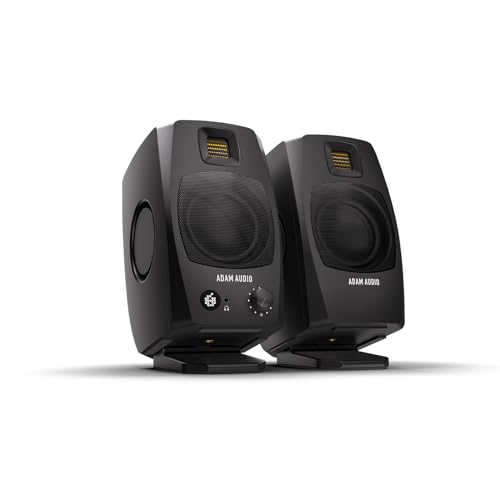
The ADAM Audio D3V brings ribbon-tweeter monitoring to a compact desktop system. These active monitors combine 3.5-inch aluminum woofers, passive radiators, USB-C connectivity, and D-ART desktop ribbon tweeters for computer-based production and everyday listening.
Best For: Songwriters, producers, and computer users who want a compact active pair with direct USB-C connection.
Pros:
- Compact active pair connects directly to computers and mobile devices via USB-C.
- 1.5-inch D-ART ribbon tweeters provide detailed, unfatiguing high-frequency reproduction.
- 80-watt amplification and passive radiators extend response down to 45 Hz.
- Includes angled stands, headphone output, volume control, and placement-focused DSP switches.
Cons:
- 3.5-inch woofers provide less low-end reach than larger monitors.
- USB-C and balanced 1/4-inch inputs may not suit every existing setup.
- The standard warranty is two years unless extended through registration.
The D3V is the most desk-friendly option here, with built-in conveniences that reduce the need for extra equipment. It is best viewed as a compact monitoring system rather than a substitute for large nearfield monitors in bass-intensive rooms.
Best for Room-Tunable Home Studios – ADAM Audio T7V Pair
The ADAM Audio T7V pair is a strong choice if you want studio monitors with ribbon tweeters and extended low-end reach for home production and mixing. Its U-ART tweeter reaches up to 25 kHz, while the 7-inch woofer reaches down to 39 Hz.
Best For: Home studios, project rooms, and producers who want a larger nearfield monitor with room-adjustment controls.
Pros:
- U-ART ribbon tweeter provides detailed, non-fatiguing high frequencies up to 25 kHz.
- 7-inch woofer reaches down to 39 Hz for clear kick, bass, and synth monitoring.
- High- and low-shelf trims help compensate for reflective desks or boomy corners.
- Includes balanced TRS-to-XLR cables for connecting to an interface or mixer.
Cons:
- The 7-inch cabinets may require more desk or stand space than compact monitors.
- The included cables are intended for balanced 1/4-inch outputs and XLR monitor inputs.
Choose the T7V if low-frequency extension and room-tuning flexibility matter more than having the smallest possible setup. RCA inputs also make the pair useful with some consumer line-level sources.
Best for Desktop Production – ADAM Audio D3V White
The ADAM Audio D3V is a compact option for anyone seeking studio monitors with ribbon tweeters in a desktop-friendly format. Its D-ART tweeter is paired with 3.5-inch woofers, passive radiators, USB-C connectivity, and detachable angled stands.
Best For: Songwriters, producers, and listeners who need a compact active monitoring system for a desk.
Pros:
- 1.5-inch D-ART ribbon tweeter is designed for precise, unfatiguing high-frequency reproduction.
- USB-C connection supports direct connection to computers and mobile devices.
- Detachable stands angle the monitors 15 degrees toward the listener.
- Includes balanced 1/4-inch inputs, DSP-powered placement switches, and a front headphone socket.
Cons:
- 3.5-inch woofers and a 45 Hz low-frequency limit offer less low-end reach than larger monitors.
- The feature set is centered on desktop use rather than a larger room-monitoring setup.
The D3V makes the most sense when convenience and desk integration are priorities. USB-C, headphone access, placement controls, and optional mic-stand mounting give it unusual flexibility for a compact pair.
Best for Flexible Nearfield Connections – ADAM Audio T5V Pair
The ADAM Audio T5V pair combines studio monitors with ribbon tweeters, a compact 5-inch woofer, and both balanced XLR and unbalanced RCA inputs. It is a practical nearfield option for home studios, especially when you want connection flexibility and included cabling.
Best For: Bedroom producers, singer-songwriters, and desktop mixing setups using interfaces, mixers, consoles, or unbalanced sources.
Pros:
- U-ART accelerating ribbon tweeter and HPS waveguide deliver highs up to 25 kHz.
- Includes both 10-foot balanced XLR cables and RCA-to-1/4-inch TS cables.
- 5-inch woofer reaches down to 45 Hz and the pair is rated for 106 dB SPL.
- HF and LF shelf controls help adjust the response for desks, walls, and corners.
Cons:
- Its 5-inch woofer provides less low-frequency extension than the T7V.
- The included RCA-to-TS cables are unbalanced and may be less suitable for noisy, longer runs.
Pick the T5V when you want a smaller nearfield footprint without giving up ribbon-tweeter detail or input versatility. The included cables make it especially convenient for mixed studio and consumer-source setups.
How We Picked the Best Studio Monitors with Ribbon Tweeters
We selected models based on the needs of home producers, project studios, content creators, and mix engineers. Key considerations included tweeter design, cabinet size, frequency range, maximum output, input options, stereo-pair availability, and ease of placement. We also included both conventional nearfield monitors and compact desktop speakers so buyers can match the speaker to their workspace rather than choosing by driver size alone.
Some listings are sold individually, while others include a pair or accessories such as cables and isolation pads. Confirm the package contents before ordering, especially if you need a complete stereo setup.
Quick Comparison
- Compact desktop choice: ADAM Audio D3V models suit small desks and close listening distances.
- Small-room 5-inch options: ADAM Audio T5V and Yamaha HS4 balance manageable size with useful nearfield detail.
- Flexible mid-size option: ADAM Audio T7V offers more low-frequency authority without the footprint of an 8-inch monitor.
- Larger-room choice: ADAM Audio T8V provides greater bass extension and headroom, but needs appropriate space and placement.
- Alternative voicing: PreSonus Eris E7 XT uses a broad waveguide design intended for a wide listening area.
Key Buying Factors for Studio Monitors with Ribbon Tweeters
Room Size and Listening Distance
Five- to seven-inch monitors are usually easier to manage in small and medium rooms. Eight-inch models can produce more low end and volume, but they may exaggerate room modes when placed too close to walls or corners. Desktop speakers are better suited to short listening distances and limited workspaces.
Low-End Extension and Output
Choose based on the material you produce. Electronic, hip-hop, cinematic, and bass-heavy work benefits from deeper extension and higher output. For vocals, podcasts, acoustic music, and general editing, a smaller monitor may provide a more controlled and practical presentation. A subwoofer is an option later, but room integration matters.
Placement and Acoustic Treatment
Position the monitors at ear height, form an approximate equilateral triangle with your listening position, and keep the tweeters aimed toward your ears. Isolation pads can reduce desk vibration. Basic bass trapping and reflection control often improve accuracy more than moving up to a larger speaker.
Inputs, Pairing, and Accessories
Check whether the monitor uses balanced XLR or TRS inputs, unbalanced RCA, or a combination. Balanced connections are preferable for longer runs and noisier setups. Also verify whether the listing includes one speaker, a stereo pair, cables, or stands.
Who Should Buy Which Studio Monitors with Ribbon Tweeters?
Choose the ADAM Audio D3V if desk space is limited or you work at very short distances. Choose a T5V or Yamaha HS4 for a compact home studio that still needs conventional monitor performance. Choose the T7V when you want a stronger low-end foundation without moving to the largest cabinet. Choose the T8V for a larger, properly treated room where added bass extension and headroom are useful. Choose the PreSonus Eris E7 XT if wide coverage and a broader listening sweet spot are priorities.