
Accurate monitoring is the foundation of confident mixing. The best studio monitors with flat response help you hear tonal balance, dynamics, and recording problems without adding excessive coloration.
We selected 10 strong options for different rooms, budgets, and production needs, from compact desktop pairs to larger monitors designed for more spacious studios.
Best 10 Studio Monitors with Flat Response Picks for 2026
Wide-Sweet-Spot Value

- Wide-sweet-spot Image Control Waveguide
- Boundary EQ and HF Trim room controls
- Matched pair with XLR/TRS inputs
Best For: Compact production, podcasting, and sound-design studios
Purist Mixing Choice

- Emphasizes sonic purity with minimal coloration
- Bi-amplified 5-inch two-way design
- XLR and TRS inputs accept balanced signals
Best For: Uncolored near-field monitoring for music production
Large Near-Field Detail

- 6.5-inch woofer with 1.25-inch silk-dome tweeter
- Wide EBM waveguide for imaging and sweet-spot coverage
- Multiple acoustic-tuning controls for room setup
Best For: Room-adjustable near-field mixing with fuller low end
Desktop Versatility

- Compact 4.5-inch Kevlar woofer design
- High/low EQ controls for basic tailoring
- RCA, 1/4-inch, 1/8-inch, and headphone connections
Best For: Desktop production, podcasting, streaming, and gaming
Best Budget Flat-Response Pick
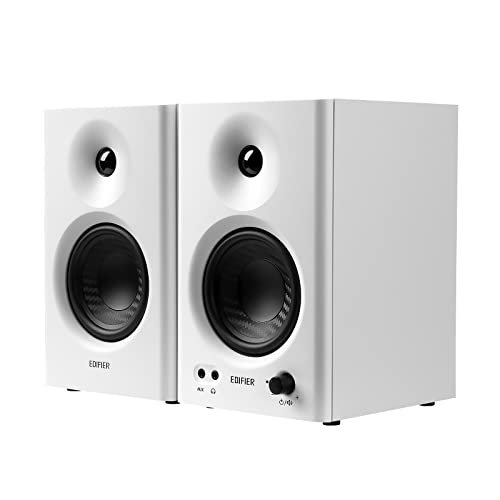
- Near-flat tuning for music creation
- Balanced TRS and multiple unbalanced inputs
- Monitor and music listening modes
Best For: Budget-conscious desktop creators
Best Compact Yamaha Option

- Includes a matched pair of powered monitors
- Room-control and high-trim adjustments
- XLR/TRS, RCA, and stereo mini inputs
Best For: Compact music-production and editing workstations
Best Higher-Headroom Choice

- 80-watt Class AB bi-amplification
- 5.25-inch woofer for near-field monitoring
- Acoustic tuning and balanced inputs
Best For: Mixers needing extra output headroom
Best Value for Accuracy

- DSP-tuned flat response
- 80W bi-amped output
- XLR, TRS, and RCA inputs
Best For: Accurate home and project-studio monitoring
Best Compact Pair

- Pair of compact 4.5-inch monitors
- 50W Class AB amplification
- Room-tuning and headphone controls
Best For: Desktop production and multimedia reference
Best for Large Rooms

- Pair of 8-inch powered monitors
- 38Hz–30kHz stated response
- 120W bi-amped amplification per monitor
Best For: Studio recording in larger monitoring spaces
Wide-Sweet-Spot Value – JBL 305P MkII Pair
For creators seeking studio monitors with flat response, the JBL 305P MkII pair offers room-adjustment controls, balanced inputs, and a wide listening sweet spot. Its 5-inch woofer and 41-watt-per-channel Class-D amplification suit compact production, podcasting, and sound-design setups.
Best For: Home producers, podcasters, and creators who want clear stereo imaging in a small-to-medium desktop studio.
Pros:
- Image Control Waveguide provides precise imaging and a wide sweet spot.
- Boundary EQ and HF Trim help adapt the monitors to the room.
- Includes XLR and 1/4-inch TRS inputs for balanced connections.
- Sold as a pair with 5-inch woofers and dual Class-D amplification.
Cons:
- There is no wireless connectivity listed.
- The 5-inch design may offer less low-frequency output than larger monitors.
The 305P MkII is a practical choice when accurate monitoring, flexible placement controls, and broad stereo imaging matter more than maximum bass extension. The included pair also makes it easy to build a matched stereo setup.
Purist Mixing Choice – Yamaha HS5 Pair
The Yamaha HS5 pair is aimed at listeners who want studio monitors with flat response and minimal coloration. Its bi-amplified 5-inch two-way design covers a stated 54 Hz to 30 kHz range and accepts both balanced and unbalanced XLR or TRS connections.
Best For: Music producers and mixers who prioritize a straightforward, uncolored monitoring presentation.
Pros:
- Designed to emphasize sonic purity without altering the original sound.
- Bi-amplified system provides 45 watts for low frequencies and 25 watts for highs.
- 5-inch woofer and 1-inch dome tweeter support near-field monitoring.
- Includes a matched pair with XLR and TRS inputs.
Cons:
- The supplied notes do not list room-correction controls.
- The compact 5-inch woofer may not suit users needing extended bass output.
The HS5 is a focused option for mix decisions where an uncolored presentation is the priority. Its balanced inputs and bi-amplified architecture make it well suited to a conventional wired studio setup.
Large Near-Field Detail – PreSonus Eris E7 XT
PreSonus Eris E7 XT 2-Way Active Studio Monitor with EBM Waveguide (Pack of 1)
Check Price On AmazonThe PreSonus Eris E7 XT combines a 6.5-inch woven-composite driver with a 1.25-inch silk-dome tweeter for fuller near-field monitoring. For buyers comparing studio monitors with flat response, its EBM waveguide, wide sweet spot, and multiple acoustic-tuning controls offer useful tools for accurate mixing in different rooms.
Best For: Producers who want a larger active monitor with broad imaging and flexible acoustic adjustment.
Pros:
- 100° horizontal by 60° vertical EBM waveguide supports a wide sweet spot.
- Acoustic Space, LF Trim, HF Trim, high-pass filter, and level controls help tailor the monitor.
- 6.5-inch woofer and 1.25-inch silk-dome tweeter provide a larger two-way platform.
- Includes RCA, TRS, and XLR connectivity plus Studio One Prime and Studio Magic software.
Cons:
- This listing is for one monitor, so a stereo pair requires two units.
- The larger cabinet may need more desk or stand space than a 5-inch monitor.
The Eris E7 XT stands out when room adaptation and a broad listening area are more important than a compact footprint. Its larger driver and extensive tuning controls make it a strong candidate for a developing production room.
Desktop Versatility – M-Audio BX4 Pair
The M-Audio BX4 pair brings studio-monitor functionality to smaller desktop setups. While choosing studio monitors with flat response requires careful room and EQ setup, these wired speakers add high- and low-EQ controls, multiple consumer-friendly inputs, and a front headphone connection for production, podcasting, streaming, and gaming.
Best For: Desktop creators who need flexible connections and convenient headphone monitoring alongside basic studio work.
Pros:
- 4.5-inch Kevlar woofers and silk-dome tweeters provide two-way stereo monitoring.
- Rear high- and low-EQ dials allow basic sound tailoring.
- Includes 1/4-inch, 1/8-inch, and RCA inputs for varied desktop sources.
- Front headphone access and included cables support convenient everyday use.
Cons:
- The smaller 4.5-inch woofer is less suited to deep bass monitoring than larger models.
- Its broader multimedia feature set may be less focused than a dedicated pro monitor.
- The supplied notes do not specify a full frequency-response range.
The BX4 is a practical entry point for a compact workstation rather than a specialized large-room mixing monitor. Its connectivity, included accessories, and front-panel convenience make it especially adaptable for hybrid creative setups.
Best Budget Flat-Response Pick – Edifier MR4
The Edifier MR4 is a practical entry point for anyone seeking studio monitors with flat response for music creation, editing, or general desktop listening. Its near-flat tuning, 4-inch composite woofer, and silk-dome tweeter aim for clear, smooth sound in a compact active-speaker setup.
Best For: Budget-conscious creators who need flexible connections and selectable monitor or music modes.
Pros:
- Professionally fine-tuned near-flat response for monitoring.
- Includes balanced TRS, RCA, AUX, and front headphone connections.
- Separate high- and low-frequency controls plus monitor and music modes.
Cons:
- Its 4-inch woofer is smaller than those in the other options here.
- The supplied specifications list a maximum output of 42 watts, so it may offer less headroom for larger spaces.
The MR4 stands out as an accessible desktop monitor with useful connectivity and straightforward controls. Choose it when affordability, compact sizing, and flexible everyday use matter most.
Best Compact Yamaha Option – Yamaha HS4
The Yamaha HS4 is a compact powered pair designed for music production and video editing. For shoppers comparing studio monitors with flat response, it offers a stated 60 Hz–22 kHz frequency range, room-control and high-trim adjustments, and several standard input options.
Best For: Home-studio users who want a matched, compact pair with Yamaha monitoring features.
Pros:
- Sold as a pair with a 4.5-inch woofer and 1-inch dome tweeter.
- Provides XLR/TRS combo, RCA, and stereo mini inputs.
- Includes room-control and high-trim response controls.
Cons:
- The listed 60 Hz lower response limit may not satisfy users needing deep bass monitoring.
- Output is specified at 26 watts and above 26 watts, offering less stated power than the PreSonus option.
The HS4 balances small dimensions with practical connection choices and acoustic adjustment controls. It is a sensible fit for compact workstations where a complete stereo pair is preferred.
Best Higher-Headroom Choice – PreSonus Eris E5
The PreSonus Eris E5 is a 5.25-inch near-field monitor built for users who want balanced monitoring and additional output headroom. Its woven composite woofer, silk-dome tweeter, Class AB bi-amplification, and acoustic tuning controls make it a strong candidate among studio monitors with flat response.
Best For: Home-studio mixers who need more output and flexible acoustic adjustment.
Pros:
- 80-watt Class AB bi-amplification provides substantial near-field headroom.
- 5.25-inch woofer and silk-dome tweeter target solid, balanced monitoring.
- Offers balanced XLR and 1/4-inch inputs, unbalanced RCA, and acoustic tuning controls.
Cons:
- This listing is for one monitor rather than a pair.
- Its larger 5.25-inch design may require more desk space than the smaller models.
- Acoustic tuning controls require setup decisions for the listening environment.
The Eris E5 is the most powerful option in this group on paper and adds useful protection features and room adjustment. Confirm whether you need one speaker or a stereo pair before buying.
Best Value for Accuracy – Kali Audio LP-6 V2
If you want studio monitors with flat response without moving into a higher price tier, the Kali Audio LP-6 V2 is a strong single-speaker option. Its updated DSP is designed to reproduce mixes without added boosts or cuts, while the boundary EQ helps adapt it to a desk, wall, or stand.
Best For: Home recording, music production, and buyers who need accurate sound from a single powered monitor.
Pros:
- DSP supports a flat, uncolored frequency response.
- Front port and noise-reduction upgrades help minimize turbulence, hiss, and distortion.
- 80-watt bi-amped design reaches up to 115dB SPL.
- Offers XLR, TRS, and RCA inputs plus boundary EQ controls.
Cons:
- Sold as a single monitor rather than a stereo pair.
- The 6.5-inch design has a stated frequency range of 47Hz–21kHz.
The LP-6 V2 combines practical placement controls, professional connections, and accurate voicing at a value-oriented price. Add a second unit when you are ready for a stereo monitoring setup.
Best Compact Pair – PreSonus Eris E4.5
The PreSonus Eris E4.5 is a compact pair for listeners seeking studio monitors with flat response in a desktop-friendly format. Its 4.5-inch woven-composite woofers, silk-dome tweeters, and adjustable high- and low-frequency controls support clear monitoring in smaller rooms and varied placements.
Best For: Desktop music production, multimedia reference, gaming, and compact stereo setups.
Pros:
- Includes a pair of monitors with 50 watts of Class AB amplification.
- Woven-composite woofers provide tight bass and clear overall sound.
- Wide listening sweet spot supports stereo imaging from several angles.
- Provides balanced TRS, RCA, front auxiliary, headphone, and room-tuning connections.
Cons:
- The 4.5-inch woofers provide less low-end scale than larger monitors.
- Bluetooth is listed in the supplied specifications, but the primary connections are wired.
With a small footprint and useful front-panel controls, the Eris E4.5 is an approachable choice for accurate near-field listening. Its tuning controls make it easier to balance the sound for a desk, shelf, or turntable setup.
Best for Large Rooms – Yamaha HS8 Pair
For larger spaces and listeners who want studio monitors with flat response plus extended low-end reach, the Yamaha HS8 pair offers an 8-inch woofer and 1-inch dome tweeter in a bi-amped design. The supplied specifications list a 38Hz–30kHz frequency response and 120 watts of total amplification per pair.
Best For: Studio recording and larger monitoring environments that can accommodate full-size 8-inch speakers.
Pros:
- Includes two HS8 powered monitors for stereo monitoring.
- 8-inch woofers extend low-frequency coverage to a stated 38Hz.
- 75W LF and 45W HF amplification provide 120W per monitor.
- Advanced Magnetic Circuit design supports the driver system.
Cons:
- The 8-inch cabinets are substantially larger and heavier than compact monitors.
- XLR cables are not included in the supplied bundle details.
- Placement requires enough room for the larger enclosures.
The HS8 pair is the most capable option here for broad frequency coverage and higher-output monitoring. Choose it when your room and workspace can support larger cabinets, rather than prioritizing compact desktop placement.
How We Picked the Best Studio Monitors with Flat Response
We focused on powered near-field monitors suited to music production, mixing, editing, and critical listening. Our selection considers frequency balance, driver size, cabinet design, connectivity, placement flexibility, output capability, and value. Because room acoustics strongly affect perceived accuracy, we included compact models for desks and smaller rooms alongside larger monitors for users who have more space and appropriate acoustic treatment.
Specifications such as frequency range and power ratings are useful starting points, but they do not tell the whole story. A monitor’s voicing, listening distance, placement, and room interaction matter just as much. The right choice is the model that delivers an appropriately balanced presentation at your normal working volume.
Quick Comparison
- Compact desktop options: M-Audio BX4, Edifier MR4, and PreSonus Eris E4.5 are practical for smaller workspaces and short listening distances.
- Versatile 5-inch class: JBL 305P MkII, Yamaha HS5, and PreSonus Eris E5 suit many home studios and near-field setups.
- More low-end and headroom: PreSonus Eris E7 XT, Kali Audio LP-6 V2, and Yamaha HS8 are better suited to larger rooms or listeners who need greater bass extension.
- Space-conscious Yamaha option: The Yamaha HS4 pair offers a compact format for users who want a familiar reference-monitor approach in a smaller setup.
Key Buying Factors for Studio Monitors with Flat Response
Room Size and Listening Distance
Choose monitor size according to your room, not simply your desire for more bass. Larger speakers can overload small rooms and make low frequencies harder to judge. Compact monitors are often easier to place accurately on a desk or small stand.
Frequency Balance and Bass Extension
A flat response does not mean every model sounds identical. Look for a balanced midrange, controlled treble, and enough low-frequency extension for your work. If you produce bass-heavy music, consider a larger monitor only when your room can support it.
Placement and Acoustic Treatment
Position monitors symmetrically, form an approximate equilateral triangle with your listening position, and aim the tweeters toward your ears. Isolation pads or stands can reduce desk reflections. Basic acoustic treatment may improve accuracy more than upgrading between similarly priced models.
Inputs, Controls, and Output
Check whether the monitor accepts the connections provided by your audio interface. Rear-panel level, high-frequency, or acoustic-space controls can help compensate for placement, while adequate headroom reduces distortion during louder sessions.
Who Should Buy Which Studio Monitors with Flat Response?
For small desks and beginner setups: Choose the M-Audio BX4, Edifier MR4, or PreSonus Eris E4.5 for accessible near-field monitoring.
For general home-studio mixing: The JBL 305P MkII, Yamaha HS5, and PreSonus Eris E5 are strong all-purpose choices when placed correctly.
For a larger room or fuller low end: Consider the Kali Audio LP-6 V2, PreSonus Eris E7 XT, or Yamaha HS8, provided your room is treated and spacious enough.
For compact Yamaha monitoring: The Yamaha HS4 is a sensible option when desk space is limited but you want a dedicated powered-monitor pair.