
The best camera sliders make controlled movement easier, whether you are filming cinematic reveals, product videos, interviews, or time-lapse sequences. The right model depends on your camera weight, available space, shooting style, and need for motorized control.
This roundup compares compact manual rails, carbon-fiber dollies, and app-controlled motorized systems so you can choose a slider that matches your workflow without paying for features you will not use.
Best 10 Camera Sliders Picks for 2026
Best Portable Manual Slider
Zecti 24-Inch Carbon Fiber Camera Slider

- Lightweight 24-inch carbon-fiber design
- Adjustable legs and multiple mounting threads
- Supports cameras, phones, and action cameras
Best For: Traveling creators who need flexible manual camera moves
Best Compact Motorized Slider
IFOOTAGE Shark Slider Pico Pro

- Motorized movement for consistent shots
- 15.7-inch compact track
- Supports devices up to 2.4 pounds
Best For: Lightweight smartphone, action-camera, and compact-camera rigs
Best Tabletop Dolly
NEEWER SD001 Camera Slider Dolly

- Supports straight and circular movement
- Includes ball head and phone clamp
- Pocket-sized 220-gram aluminum design
Best For: Tabletop product videos and compact panoramic moves
Best Long Motorized Slider
GVM 48-Inch Automatic Camera Slider
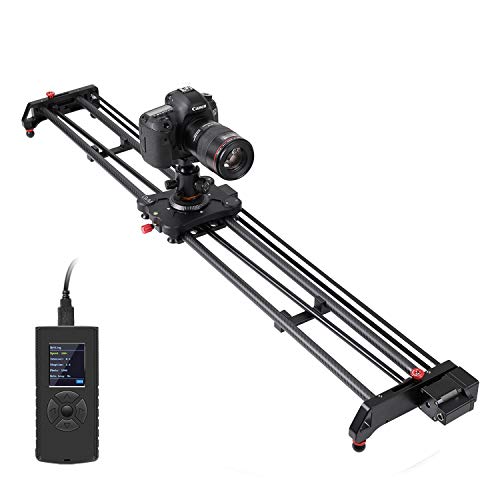
- 48-inch carbon-fiber track
- Programmable tracking, time-lapse, and panorama modes
- Includes battery, remote, cables, and carrying bag
Best For: Long, repeatable camera movements and time-lapse production
Best Portable Camera Slider
NEEWER CS1M 16-Inch Carbon Fiber Slider

- Lightweight 615g design with carrying bag
- Quiet four-bearing motion on a 16-inch rail
- Includes phone and action-camera mounting accessories
Best For: Travel creators and lightweight camera setups
Best Motorized Camera Slider for Time Lapse
NEEWER ER1 31.5-Inch App-Controlled Slider

- 31.5-inch motorized rail with app control
- Supports up to 11 pounds horizontally
- Manual, video, and time-lapse shooting modes
Best For: Automated product videos and time-lapse work
Best Professional Camera Slider
IFOOTAGE Shark Slider Nano II 660

- Supports up to 15.4 pounds horizontally
- Works with DJI RS-series stabilizers
- Offers tracking, keyframes, and five shooting modes
Best For: Professional heavy-camera and multi-axis setups
Best with Extra Features

- Motorized video, time-lapse, and round-trip modes
- Adjustable feet and multiple mounting points
- Supports horizontal, vertical, and 45-degree shooting
Best For: Compact DSLR, video camera, and cellphone setups
Best for Remote-Controlled Tracking
48-Inch GVM Carbon Fiber Slider
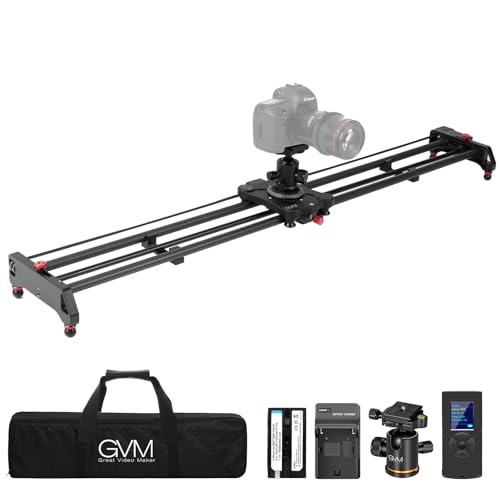
- Long 120 cm rail with tracking and panoramic modes
- Remote control adjusts motion and time-lapse settings
- Includes six shutter cables and an extension
Best For: Detailed video and time-lapse productions
Best App-Controlled Slider
GVM 48-Inch Carbon Fiber Dolly Rail

- iOS and Android app control
- Six shooting modes with programmable movement
- Adjustable legs and included carry bag
Best For: App-based tracking, time-lapse, and panoramic shooting
Best Portable Manual Slider – Zecti 24-Inch Carbon Fiber Camera Slider
For camera sliders that travel easily and support multiple shooting angles, the Zecti 24-inch manual slider is a practical choice. Its carbon-fiber rail system, adjustable legs, bubble level, and multiple mounting threads suit cameras, phones, and action cameras up to 4.4 pounds.
Best For: Travelers and creators who want a lightweight manual slider for horizontal, vertical, diagonal, or sideways moves.
Pros:
- Portable 24-inch design weighs about 1.4 pounds and includes a carrying bag.
- Four precision bearings and dual carbon-fiber rails are designed for smooth, quiet movement.
- Adjustable legs, non-slip feet, bubble level, and 1/4-inch and 3/8-inch mounting holes support flexible setups.
Cons:
- Manual operation requires you to maintain a consistent movement speed.
- If the screws are overtightened, the slider may become noisy or feel less smooth; slight loosening may help.
- It is not water resistant.
The Zecti offers a useful balance of portability and positioning flexibility. It is especially appealing for lightweight camera kits, though users should check and adjust the hardware if movement feels stiff.
Best Compact Motorized Slider – IFOOTAGE Shark Slider Pico Pro
The IFOOTAGE Shark Slider PICO Pro is one of the more compact camera sliders for automated movement. Its motorized design is compatible with smartphones, DJI Osmo Pocket 3/4, action cameras, and cameras weighing up to 2.4 pounds.
Best For: Smartphone, action-camera, and compact-camera users who want smoother cinematic motion without manually pushing the rig.
Pros:
- Motorized movement helps create consistent, smooth tracking shots.
- Works with smartphones, DJI Osmo Pocket 3/4, action cameras, and compatible cameras.
- Compact 15.7-inch format suits smaller shooting setups.
Cons:
- Its 2.4-pound payload limit is lower than that of many full-size camera sliders.
- The shorter track length provides less travel than 24- or 48-inch models.
- Product notes do not specify included accessories or battery details.
This slider prioritizes convenience and compact motorized control over maximum payload or travel distance. It makes the most sense for lightweight cameras and creators who want repeatable movement in a small rig.
Best Tabletop Dolly – NEEWER SD001 Camera Slider Dolly
Unlike rail-based camera sliders, the NEEWER SD001 is a pocket-sized four-wheel dolly that supports straight-line and circular movement. Adjustable wheels, a ball head, and a phone clamp make it useful for tabletop product videos, pans, and compact camera setups.
Best For: Tabletop creators who need portable linear or circular moves with phones, action cameras, or lightweight mirrorless cameras.
Pros:
- Wheels can be adjusted for straight or circular movement and panoramic shots.
- Soft rubber wheel rings are designed for smooth, quiet operation on floors, tables, and sliders.
- Includes a 360-degree rotating, 90-degree tilting ball head and a rotatable phone clamp with cold shoe.
- Compact aluminum-alloy body measures about 3.9 by 3.3 by 0.8 inches.
Cons:
- It is not suitable for telephoto lenses.
- The wheels require a suitable surface and may not provide the same controlled travel as a dedicated rail.
- It is not water resistant.
The SD001 is a flexible alternative to conventional camera sliders when portability and circular movement matter most. Its small footprint is particularly useful for tabletop shooting, though lens and surface compatibility should be considered.
Best Long Motorized Slider – GVM 48-Inch Automatic Camera Slider
For longer, repeatable camera moves, the GVM 48-inch motorized slider provides programmable travel for tracking, time-lapse, and panoramic shooting. It has adjustable start and end points, speed and interval controls, a battery, remote, and multiple tripod-mounting ports.
Best For: Video creators who need long tracking shots, automatic round trips, time-lapses, or repeatable panoramic movement.
Pros:
- 48-inch carbon-fiber track provides substantially more travel than compact sliders.
- Supports motorized and manual operation, with adjustable speed, interval, stop time, and loop settings.
- Includes a battery, charger, remote, shutter cables, extension cable, and carrying bag.
- Multiple 1/4-inch and 3/8-inch ports support tripod mounting.
Cons:
- At 11.8 pounds and 48 inches long, it is less portable than compact camera sliders.
- Its maximum listed load is 5 kilograms, so setup stability is important with heavier cameras.
- It is not water resistant.
The GVM is the strongest fit here for extended, automated camera movement and repeatable sequences. Its size and weight favor studio, event, or planned location work over quick handheld travel setups.
Best Portable Camera Slider – NEEWER CS1M 16-Inch Carbon Fiber Slider
If you need portable camera sliders for travel, outdoor filming, or compact studio setups, the NEEWER CS1M combines a 16-inch carbon-fiber rail with adjustable legs and several mounting options. Its smooth, quiet bearings and included phone and action-camera accessories make it especially flexible for lightweight camera work.
Best For: Travel creators, smartphone filmmakers, action-camera users, and lightweight DSLR or mirrorless setups.
Pros:
- Lightweight 615g carbon-fiber and aluminum construction with a carrying bag.
- Four precision bearings provide smooth, quiet movement along the 16-inch rail.
- Adjustable legs, bubble level, and 360-degree ball head support varied shooting angles.
- Includes a phone clamp and action-camera mount, plus 1/4-inch and 3/8-inch threads.
Cons:
- Maximum capacity is limited to 4.4 pounds horizontally and 2.2 pounds at a tilt or vertically.
- The 16-inch track provides less travel than longer camera sliders.
- It is not water resistant.
The CS1M is a practical choice when portability and device compatibility matter more than maximum rail length or payload. Its adjustable legs also make it easier to level on uneven outdoor surfaces.
Best Motorized Camera Slider for Time Lapse – NEEWER ER1 31.5-Inch App-Controlled Slider
For repeatable camera sliders movements, the NEEWER ER1 adds motorized operation, app control, and programmable shooting modes to a long 31.5-inch rail. It is designed for creators who want consistent slides, tracking shots, panoramas, or time-lapse sequences without manually moving the camera.
Best For: Product videos, time-lapse photography, content creation, and heavier camera setups requiring automated motion.
Pros:
- App-controlled manual, video, and time-lapse modes allow speed, interval, and exposure adjustments.
- Supports up to 11 pounds horizontally and 5.5 pounds at a 45-degree tilt.
- Silent stepper motor and four roller bearings help produce smooth, quiet movement.
- Includes a 4400mAh NP-F750 battery and supports 5V 2A Type-C power.
Cons:
- The optional 2.4G remote control is not included.
- A charger is not included, according to the supplied product information.
- Minor shake may occur during macro photography.
The ER1 is a strong fit when automated, repeatable motion is more important than a compact travel footprint. Its longer rail and higher horizontal load rating expand its usefulness for larger camera rigs and product-focused shooting.
Best Professional Camera Slider – IFOOTAGE Shark Slider Nano II 660
The IFOOTAGE Shark Slider Nano II 660 is built for advanced camera sliders setups that require motorized movement, tracking, and a high payload capacity. With support for DJI RS-series stabilizers, keyframe programming, and multiple creative modes, it is aimed at professional multi-axis production rather than simple manual slides.
Best For: Professional filmmakers using heavier cameras, gimbals, telephoto lenses, macro lenses, or automated tracking workflows.
Pros:
- Supports up to 15.4 pounds horizontally and 7.7 pounds vertically.
- Compatible with DJI RS2, RS2 Pro, RS3 Pro, RS4, and RS4 Pro stabilizers.
- Offers target tracking, facial recognition, and up to eight programmable keyframes.
- Includes video, time-lapse, panorama, stop-motion, and macro modes.
Cons:
- Its professional feature set may be excessive for basic sliding shots.
- Advanced DJI and multi-axis functions require compatible additional equipment.
- It is not water resistant.
The Nano II 660 stands out for demanding rigs that need accurate motion control and substantial load support. Its tracking and stabilization features make it particularly compelling for complex camera movement, though the broader system can require additional compatible hardware.
Best with Extra Features – 27-Inch GVM Aluminum Slider
For creators who want versatile camera sliders without moving up to a 48-inch rail, this 27-inch GVM model offers motorized video, time-lapse, and automatic round-trip shooting. Its aluminum-alloy construction, adjustable feet, and multiple mounting points make it practical for tabletop setups or tripod-based production.
Best For: DSLR, video camera, and cellphone users who need a compact slider with flexible shooting angles.
Pros:
- Supports video, time-lapse, and automatic round-trip shooting.
- Adjustable non-slip feet help with leveling and balance.
- Supports horizontal, vertical, and 45-degree shooting.
- Includes a carrying bag, wire controller, remote cable, and power-bank adapter.
Cons:
- Its 2.5 kg maximum recommended load is lower than the larger models in this roundup.
- At 26.8 inches folded, it may still require dedicated transport space.
- It is not water resistant.
This is a sensible entry point for motorized camera sliders when portability and mounting flexibility matter more than maximum rail length or advanced app control.
Best for Remote-Controlled Tracking – 48-Inch GVM Carbon Fiber Slider
This 48-inch GVM carbon-fiber slider is aimed at more elaborate camera-slider work, with tracking, horizontal, time-lapse, and 120-degree panoramic modes. Its remote control allows detailed adjustments for speed, endpoints, dwell time, pauses, shot count, and automatic looping.
Best For: Professional-style video and time-lapse productions that benefit from a long rail and detailed remote settings.
Pros:
- Offers tracking, horizontal, time-lapse, video, and 120-degree panoramic shooting.
- Remote control provides extensive motion and time-lapse adjustments.
- Includes six shutter cables plus an extension cable for broad camera compatibility.
- Multiple 1/4-inch and 3/8-inch ports support various tripods.
Cons:
- Its 5.42 kg weight makes it less convenient to transport than shorter sliders.
- The 120 cm folded size requires substantial storage and carrying space.
- It is not water resistant.
Choose this model when a longer travel distance and remote parameter control are priorities; its size and weight are the main trade-offs for that added capability.
Best App-Controlled Slider – GVM 48-Inch Carbon Fiber Dolly Rail
Among these camera sliders, this 48-inch GVM model stands out for smartphone and tablet control through its iOS/Android app. The carbon-fiber rail supports tracking, panoramic, time-lapse, and video modes, while adjustable feet and multiple tripod ports help accommodate different shooting positions.
Best For: Creators who prefer app-based control and need a long slider for tracking, time-lapse, or panoramic shots.
Pros:
- App control works with iOS and Android smartphones or tablets.
- Supports tracking, panoramic, time-lapse, and video capture modes.
- Offers adjustable speed, intervals, stop times, photo count, and automatic looping.
- Carbon-fiber construction, adjustable legs, and a carry bag support field use.
Cons:
- The 120 cm rail is less portable than a compact slider.
- Its listed battery average life is approximately two hours.
- It is not water resistant.
This is the strongest fit for app-oriented workflows, especially when you want precise programmable movement without relying on a hardwired controller.
How We Picked the Best Camera Sliders
We evaluated these Camera Sliders by looking at the features that most affect real-world shooting: rail length, construction, supported equipment, motion control, portability, and setup flexibility. The selection includes compact models for small cameras and phones, longer rails for wider movements, and motorized options for repeatable video and time-lapse work.
We also considered useful accessories such as ball heads, phone clamps, action-camera mounts, remote controls, and smartphone apps. These extras can make a slider more versatile, but they should not outweigh basic stability, smooth travel, or compatibility with your camera and tripod system.
Quick Comparison
Manual sliders are generally the simplest and most portable choice. They work well for controlled push-ins, pull-outs, and short product shots, but the operator must maintain consistent speed. Motorized sliders add programmable movement, automatic round trips, time-lapse capability, and sometimes panning or app control. They are better for repeatable sequences but usually cost more, weigh more, and require batteries or additional setup.
Key Buying Factors for Camera Sliders
Length and Portability
A 15- to 24-inch slider suits tabletop work, interviews, and compact travel kits. Rails around 31.5 to 48 inches provide more dramatic movement but need greater support and transport space. Check the folded or packed dimensions before buying.
Load Capacity and Stability
Match the slider to the complete camera setup, including the camera body, lens, cage, microphone, and accessories. A higher capacity does not guarantee smooth footage if the slider is mounted on an unstable surface, so use sturdy legs or a properly rated tripod system.
Manual or Motorized Motion
Choose manual operation for quick, quiet, low-maintenance shooting. Select a motorized model if you need consistent speed, automated repeat passes, panoramic movement, or time-lapse control. App and remote features are especially useful when the camera must move without hands-on operation.
Mounting and Compatibility
Look for standard mounting points and verify whether the included head, phone clamp, or action-camera adapter fits your equipment. A slider that supports both camera and smartphone setups can be more useful for mixed content creation.
Who Should Buy Which Camera Sliders?
Travel creators and tabletop filmmakers should prioritize compact carbon-fiber or short manual models. Beginners and occasional users may prefer a straightforward manual slider with included mounting accessories. Videographers producing commercial, interview, or product content should consider a motorized model with adjustable speed and repeatable movement.
For demanding time-lapse and automated production, focus on motorized sliders with app or remote control, programmable travel, and dependable support. Longer 48-inch systems are best when you have room for a full-length move and a stable mounting setup; smaller rails are easier to transport and faster to deploy.