
Accurate color depends on more than a calibrated screen. The right measurement tool can help photographers, designers, printers, manufacturers, and paint professionals create repeatable color across displays, substrates, and production workflows.
This roundup compares 10 spectrophotometer color calibration tools, from complete display-and-print systems to portable instruments built for paint matching and quality control.
Best 10 Spectrophotometer Color Calibration Tools Picks for 2026
Complete Workflow Pick

- Profiles cameras, displays, printers, scanners, and projectors
- Includes ColorChecker Classic Mini target
- Ambient light measurement supports print matching
Best For: Photographers managing capture-to-print color
Industrial Measurement Pick

- Measures CIE-LAB, reflectance, opacity, and more
- Offers nearly 40 selectable light sources
- Designed for manufacturing and materials analysis
Best For: Industrial color measurement and quality control
Print QC Specialist

- Designed for print control-strip measurements
- Requires the included targeting jig
- Works with Nix Toolkit; optional Pro software
Best For: Print and packaging color professionals
Portable Measurement Workhorse

- Supports automatic calibration and SCI/SCE testing
- Offers 30-plus test parameters
- Includes touchscreen and USB data storage
Best For: Portable, multi-parameter color measurement
QC Color Matching Option

- Uses the widely adopted D/8 lighting method
- Provides reflectance curves and electronic color cards
- Supports app, PC software, and ΔE QC decisions
Best For: Color matching and quality-control workflows
Best Handheld Analyzer
Portable Colorimeter Spectrophotometer

- 30+ color and measurement indexes
- Multiple evaluation light sources
- Camera-assisted sample positioning
Best For: Versatile handheld color difference and reflectance testing
Best for Professional Color QC

- CMYK, RGB, HEX, and density detection
- M0, M1, and M2 measurement modes
- App library with 200,000+ paint shades
Best For: Portable color quality control and professional matching
Best Combined Color and Gloss Tool
Spectro 3 Mobile Spectrophotometer
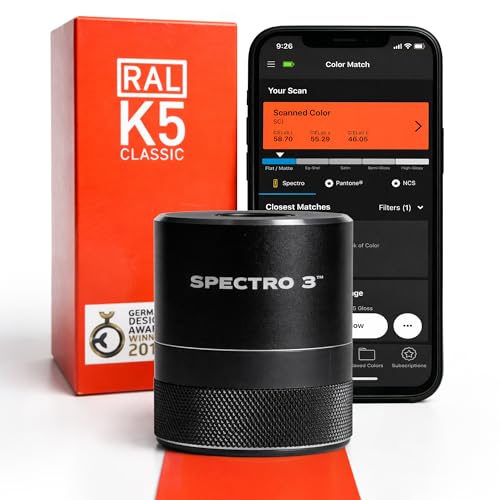
- Combines color and 60° gloss measurement
- Dual optical geometries for real materials
- 1,000+ measurements per charge
Best For: Field and production QC involving color and gloss
Complete Workflow Pick – ColorChecker Studio
For photographers who need spectrophotometer color calibration tools across the entire capture-to-print workflow, the Calibrite ColorChecker Studio is an unusually broad option. It profiles displays, projectors, printers, paper, cameras, and scanners through Calibrite PROFILER software.
Best For: Photographers and studios seeking one device for camera profiling, display calibration, print matching, and scanner workflows.
Pros:
- Supports camera-to-print color control across multiple devices.
- Includes a ColorChecker Classic Mini for custom camera profiling.
- Ambient light measurement helps match display luminance to printed output.
- Adaptive iterative profiling is designed to improve repeat calibration results.
Cons:
- Its broad feature set may be more than needed for monitor-only calibration.
- The supplied notes do not specify supported display brightness limits.
This is the most comprehensive choice in the group for users who need consistent color from camera capture through editing and physical output, rather than a tool focused solely on screens.
Easy Monitor Calibration Pick – Spyder Monitor Calibrator
The Datacolor Spyder is a straightforward choice among spectrophotometer color calibration tools for photographers and creators who primarily need an accurate monitor starting point. Its software supports newer OLED, mini-LED, and Apple Liquid Retina XDR displays, with calibration designed to take about 90 seconds.
Best For: Users who want fast, approachable monitor calibration with automatic or guided adjustments for changing room light.
Pros:
- Designed to complete calibration in about 90 seconds.
- Supports OLED, mini-LED, and Apple Liquid Retina XDR displays.
- Preset and customizable modes accommodate beginners and experienced users.
- Ambient light sensing can warn about changes or adjust profiles automatically.
Cons:
- Its listed focus is display calibration rather than printer, scanner, or camera profiling.
- It requires a nonstandard battery according to the supplied details.
Choose the Spyder when speed and simplicity matter most. It is a practical monitor-focused tool, especially for users who want help managing calibration as room lighting changes.
Industrial Measurement Pick – Portable Color Spectrometer
This portable color spectrometer is aimed at industrial color analysis rather than everyday monitor calibration. It combines a nano spectroscopic device with more than 30 measurement indicators and nearly 40 selectable evaluation light sources for manufacturing, materials, coatings, and quality-control work.
Best For: Manufacturing and laboratory teams measuring color difference, reflectance, opacity, whiteness, yellowness, and related material properties.
Pros:
- Offers a stated dexab value of ≤0.02 for consistent measurements.
- Provides more than 30 measurement indicators, including CIE-LAB and reflectance.
- Nearly 40 selectable light sources support varied industry measurement conditions.
- Integrated positioning features and a low-center design help stabilize readings.
Cons:
- Its industrial orientation may be excessive for simple display calibration.
- At 3.89 pounds, it is less lightweight than the other listed devices.
- The supplied notes do not identify included software or computer connectivity.
This model makes the most sense when color measurement involves physical materials and formal quality-control metrics. It is not the natural first choice for calibrating a photo-editing monitor.
HDR Display Pick – Calibrite Display Pro HL
The Calibrite Display Pro HL is a display-focused colorimeter for modern high-brightness screens. As spectrophotometer color calibration tools go, it stands out for measuring up to 3000 nits and supporting LCD, mini-LED, OLED, Apple XDR displays, and compatible projectors through Calibrite PROFILER.
Best For: Photo, video, and design professionals calibrating bright HDR displays or matching multiple monitors in a studio.
Pros:
- High-luminance sensor measures displays up to 3000 nits.
- Supports LCD, mini-LED, OLED, Apple XDR, and compatible projectors.
- Includes validation, uniformity, flare-correction, and quick-check tools.
- Advanced software supports custom presets, patch sets, and multi-display workflows.
Cons:
- Its advanced controls may be unnecessary for basic monitor calibration.
- It is intended for displays and projectors rather than camera, printer, or scanner profiling.
For creators working with bright modern panels, the Display Pro HL offers the most specialized display capability here. Its validation and multi-monitor features also make it a strong fit for professional workstations.
Print QC Specialist – Nix Spectro 2 (2mm)
The Nix Spectro 2 (2mm) is a targeted choice among spectrophotometer color calibration tools for print professionals who need measurements from control strips. Its targeting jig is essential for operation, while optional Nix Print Pro software can help connect readings to a print-quality workflow.
Best For: Print and packaging professionals measuring color on print control strips.
Pros:
- Purpose-built 2mm targeting jig supports precise control-strip measurements.
- Includes a ceramic tile, case, USB-C cable, pouch, and lanyard.
- Works with the free Nix Toolkit app on Android and iOS.
- Offers compatibility with Pantone, RAL, and NCS libraries through Premium Access.
Cons:
- The device will not function without using the targeting jig.
- The 2mm version is recommended only for color professionals in the print industry.
- Nix Print Pro software is sold separately, and enhanced library access requires a subscription.
This is a focused, cost-conscious option for print workflows rather than a general-purpose color tool. Confirm that your process supports the required jig and account for optional software or subscription costs.
Portable Measurement Workhorse – 4mm Spectrocolorimeter
This portable spectrocolorimeter offers a broad feature set for buyers comparing spectrophotometer color calibration tools. It combines 4mm measurement, automatic calibration, SCI/SCE testing, a touchscreen, and onboard data storage for flexible color analysis.
Best For: Users who need portable measurements with multiple test parameters and illuminant choices.
Pros:
- Supports both SCI and SCE testing for comparison with visual methods.
- Measures opacity, whiteness, yellowness, and more than 30 test parameters.
- Provides 26 illuminants to choose from.
- Includes an IPS full-color touchscreen, USB data storage, and automatic calibration.
Cons:
- The package weighs 3.31 pounds, so it may be less convenient than smaller handheld tools.
- Requires two AA batteries, although they are included.
- The supplied details do not specify included software or app connectivity.
Choose this model when measurement flexibility matters more than minimizing equipment size. Its wide parameter and illuminant selection makes it adaptable, while the touchscreen and storage functions support on-site use.
QC Color Matching Option – LS176 D/8 Colorimeter
The LS176 is a high-precision D/8 spectrophotometer suited to color matching and quality checks. As spectrophotometer color calibration tools go, it stands out for spectral reflectance curves, electronic color cards, software connectivity, and configurable pass/fail evaluation.
Best For: Color-matching and QC workflows that need standards-based evaluation and data transfer.
Pros:
- Uses the widely adopted D/8 international lighting method.
- Displays spectral reflectance curves for assessing hue, saturation, and shade.
- Includes multiple electronic color cards for quick nearest-match identification.
- Supports mobile app and PC software connectivity, plus data import and export.
Cons:
- The supplied notes do not specify the included accessories or package contents.
- Users may need to configure ΔE thresholds before using the QC pass/fail function.
- Its broader QC and software features may be more than needed for basic spot checks.
The LS176 is a strong fit when matching and repeatable QC decisions are central to the workflow. Its configurable ΔE judgment and software support can streamline review, provided your process benefits from those added controls.
Best Handheld Analyzer – Portable Colorimeter Spectrophotometer
For buyers comparing spectrophotometer color calibration tools, this portable handheld colorimeter emphasizes broad color analysis and repeatable readings. It combines a 6mm test aperture, IPS touchscreen, camera-based sample positioning, and optical monitoring designed to help reduce measurement interference.
Best For: Users who need a versatile handheld instrument for color difference testing, reflectance measurements, and varied evaluation-light workflows.
Pros:
- Provides more than 30 measurement indexes, including RGB, reflectance, LCh, CIELuv, XYZ, whiteness, yellowness, and color difference.
- Supports nearly 40 evaluation light sources, including A, B, C, D50, D55, and D65.
- Camera positioning helps identify the measured area and avoid regional sampling errors.
- Optical-road monitoring is designed to improve measurement stability.
Cons:
- The extensive measurement options may be more than casual users need.
- The listed 6mm aperture may not suit every sample size or surface.
- At 2.31 pounds, it is less lightweight than some pocket-sized color tools.
This is a feature-rich choice when measurement flexibility and guided sample positioning matter more than minimal size. Its broad index and illuminant support make it practical for users who want one device for multiple color-analysis tasks.
Best for Professional Color QC – Nix Spectro L
The Nix Spectro L is a compact option among spectrophotometer color calibration tools, with features aimed at print, packaging, and graphic-arts workflows. It pairs color and density detection with Delta-E analysis, multiple measurement modes, and app-based access to a large paint-color library.
Best For: Print, packaging, graphic-arts, automotive, fashion, and laboratory users who need portable color quality control and matching support.
Pros:
- Recognizes CMYK, ink density, RGB, HEX, and other color information.
- Delta-E functionality supports detailed color comparison and production analysis.
- Its sensor expands from 9 to 31 channels and includes M0, M1, and M2 measurement modes.
- The Nix Toolkit app provides access to more than 200,000 paint shades and supports cloud libraries.
Cons:
- Enhanced Pantone, RAL, and NCS compatibility requires a subscription.
- App and cloud-library features may add workflow complexity for simple measurements.
- The supplied notes do not specify battery runtime or measurement aperture.
Choose this model when color quality control, digital organization, and professional matching features are central to the workflow. Its small 110-gram format also makes it convenient for on-site checks.
Best Combined Color and Gloss Tool – Spectro 3 Mobile Spectrophotometer
The Spectro 3 stands out among spectrophotometer color calibration tools by combining color measurement with a 60° gloss meter. Its portable design, dual optical geometries, UV illumination, and mobile-app connectivity make it suited to field checks and production quality workflows.
Best For: Manufacturing, quality-control, and field professionals measuring color and gloss across paints, plastics, fabrics, leather, and printed materials.
Pros:
- Measures color and 60° gloss in one device.
- Supports dual 45/0° and d/8° optical geometries for readings on complex materials.
- Built-in UV illumination supports fluorescence detection, with more than 1,000 measurements per charge.
- The Spectro by Variable app supports data capture and color comparison, while an optional QC Module tracks color drift.
Cons:
- The QC Module is optional rather than included as standard.
- Its specialized gloss and optical features may be unnecessary for color-only tasks.
- The supplied notes do not identify included app subscription terms or measurement aperture.
This is a strong fit for teams that need color and surface-finish information together. The long stated battery capacity and app-based QC options make it especially practical for repeated measurements away from a lab.
How We Picked These Spectrophotometer Color Calibration Tools
We selected products across the main color-management use cases: monitor calibration, printer and scanner profiling, paint matching, print inspection, packaging quality control, and industrial color analysis. We considered measurement capability, supported surfaces, aperture or targeting size, calibration process, software compatibility, portability, and the type of user each tool is designed to serve.
Because these devices are not interchangeable, the best option depends on whether you need spectral measurements, display profiling, color-difference testing, or a broader end-to-end workflow. Product claims and specifications should be checked against your operating system, software, materials, and required color standards before purchase.
Quick Comparison
| Best For | Look For | Typical Picks |
|---|---|---|
| Monitor calibration | Display support, luminance range, profiling software | Spyder, Display Pro HL |
| Complete color management | Display, projector, printer, and scanner profiling | ColorChecker Studio |
| Paint matching | Color libraries, mobile workflow, portable design | Nix Spectro L, Spectro 3 |
| Print and packaging QC | Repeatable targeting, densitometry, spectral data | Nix Spectro 2 |
| Industrial measurements | Test aperture, auto-calibration, on-device controls | Portable colorimeters and spectrocolorimeters |
Key Buying Factors
Measurement Type and Workflow
A colorimeter is usually intended for displays, while a spectrophotometer measures reflected or transmitted light and can provide more detailed spectral information. If you need printer profiling, substrate analysis, or paint matching, prioritize a true spectrophotometer and confirm that the included software supports your workflow.
Target Size and Accuracy
A 2mm, 4mm, or 6mm aperture affects how precisely you can measure small samples, textured materials, or uneven surfaces. Smaller targets are useful for detail; larger apertures can provide a more representative reading on variable surfaces. Positioning jigs and physical guides also help improve repeatability.
Software, Libraries, and Compatibility
Check support for Windows or macOS, mobile devices, editing applications, printer drivers, and professional color-management software. Paint professionals should verify the available brand libraries, while production teams should confirm support for spectral data, color-difference values, and their preferred standards.
Calibration and Portability
Auto-calibration can reduce setup errors, but the device still needs proper reference tiles, clean measurement surfaces, and consistent lighting conditions. Portable instruments suit field work and retail consultations; larger systems may be better for controlled studio or production environments.
Who Should Buy Which Spectrophotometer Color Calibration Tools?
Photographers, designers, and video professionals should start with a display-focused colorimeter or a complete system that also profiles printers and scanners. Print shops and packaging teams should prioritize spectral data, densitometry, repeatable targeting, and software that supports quality-control records. Paint retailers, decorators, and contractors will benefit most from a portable device with a broad color library, fast readings, and a practical mobile workflow. Manufacturers and laboratories should focus on aperture size, calibration stability, color-difference reporting, and compatibility with established production standards.
Before ordering, define the surfaces you will measure, the smallest target you need to read, the software that must connect to the instrument, and whether you need display calibration, material matching, or both. Those requirements will narrow the field more reliably than price alone.