
The best powered studio monitors make it easier to hear balance, detail, and mix problems without relying on headphones alone. This lineup covers compact desktop speakers, Bluetooth-friendly options, and larger monitors for serious home studios.
Use the buying guide below to compare size, connectivity, placement needs, and sound priorities before choosing the right pair for your room and workflow.
Best 10 Powered Studio Monitors Picks for 2026
Compact Control
Yamaha HS4 Powered Studio Monitor Pair

- 4.5-inch woofer and 1-inch dome tweeter
- XLR/TRS, RCA, and stereo-mini inputs
- Room Control and High Trim adjustments
Best For: Compact desktop production and video-editing setups
Wide Sweet Spot

- Image Control Waveguide for precise imaging
- Dual 41-watt Class-D amplifiers
- Boundary EQ and HF Trim controls
Best For: Production, podcasting, and sound-design work
Extended Response
Yamaha HS5 Powered Studio Monitor Pair

- 5-inch woofer and 1-inch dome tweeter
- 70-watt bi-amplified system per monitor
- XLR and TRS inputs support balanced or unbalanced signals
Best For: Neutral music production and studio monitoring
Flexible Desktop Value
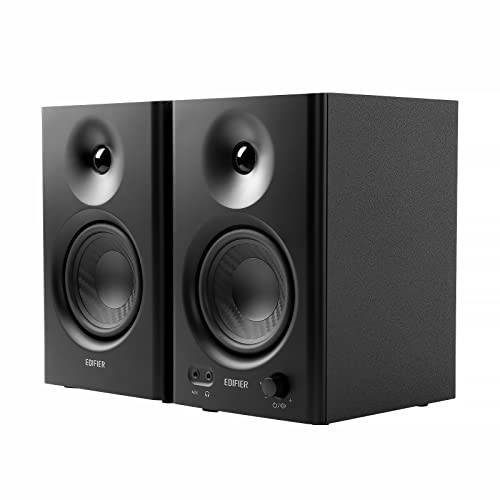
- 4-inch woofer with 1-inch silk-dome tweeter
- Balanced TRS, RCA, AUX, and headphone output
- Switchable Monitor and Music modes
Best For: Desktop production and everyday computer listening
Best Compact Wired Pick
M-AUDIO BX3 3.5-Inch Studio Monitors

- 3.5-inch Kevlar woofers with silk-dome tweeters
- 1/4-inch, RCA, and 1/8-inch wired inputs
- Front headphone output and rear EQ controls
Best For: Compact desktop production, podcasting, gaming, and multimedia
Best Connected Option
Edifier MR3 Powered Studio Monitor

- Hi-Res Audio with a stated 52Hz–40kHz response
- Bluetooth multipoint plus balanced TRS, RCA, and AUX
- App-controlled EQ and three listening modes
Best For: Flexible home studios and everyday listening
Best Simple Desktop Pair

- Compact 3-inch powered monitor design
- Silk-dome tweeters and polypropylene woofers
- Built-in 20-watt A/B amplifier with speaker cable
Best For: Simple desktop, computer, podcast, and indoor multimedia setups
Balanced Nearfield Workhorse

- 73-watt self-powered two-way monitor
- Front-firing port eases near-wall placement
- High- and low-frequency room controls
Best For: Home studios and flexible tabletop placement
Connected Compact Monitor
Ortizan C7 Bluetooth Studio Monitors

- Bluetooth 5.3 plus USB, RCA, AUX, and TRS
- Built-in 24-bit DAC for USB audio
- Compact 3.5-inch two-way speaker design
Best For: Small desks with varied audio sources
Large-Driver Studio Reference
Yamaha HS8 Powered Monitor Pair

- 8-inch woofer with 1-inch dome tweeter
- 120-watt bi-amped amplification
- 38Hz–30kHz stated frequency response
Best For: Studio recording with fuller low-frequency monitoring
Compact Control – Yamaha HS4 Powered Studio Monitor Pair
The Yamaha HS4 is a compact pair of powered studio monitors for music production, video editing, and other desktop setups. Its 4.5-inch woofer, 1-inch dome tweeter, room-control and high-trim adjustments, and multiple analog inputs make it practical when space is limited.
Best For: Desktop music production, video editing, and compact DAW workstations.
Pros:
- Includes a matched pair with anti-slip pads and speaker cables.
- Offers XLR/TRS combo, RCA, and stereo-mini inputs.
- Room Control and High Trim controls help tailor the sound to the room.
- Compact 4.5-inch two-way bass-reflex design suits smaller workspaces.
Cons:
- 26-watt output and a 4.5-inch woofer provide less headroom than larger monitors.
- No wireless connectivity is listed.
The HS4 is a sensible choice for buyers who want Yamaha’s studio-monitor format in a smaller, ready-to-use pair. Its included accessories and flexible wired inputs simplify a desktop installation.
Wide Sweet Spot – JBL 305P MkII Monitor Pair
The JBL 305P MkII pair is designed for powered studio monitor setups that benefit from broad, precise listening coverage. Its Image Control Waveguide, 5-inch woofer, dual 41-watt Class-D amplification, and rear adjustment options suit production, podcasting, and sound-design work.
Best For: Music production, podcasting, and cinematic sound design in small to medium studios.
Pros:
- Image Control Waveguide provides precise imaging and a wide sweet spot.
- Dual 41-watt Class-D amplifiers support dynamic playback.
- Boundary EQ and HF Trim help adapt the monitors to the room.
- Includes XLR and 1/4-inch TRS connectivity in a sturdy MDF enclosure.
Cons:
- The monitors use wired connections rather than wireless audio.
- The 5-inch design may not deliver the low-end reach of larger monitors.
Choose the 305P MkII if listening position flexibility and room-tuning controls matter to your workflow. The included pair offers a capable monitoring foundation with professional balanced inputs.
Extended Response – Yamaha HS5 Powered Studio Monitor Pair
The Yamaha HS5 pair is aimed at buyers seeking powered studio monitors with a larger 5-inch woofer and extended stated frequency response. Its bi-amplified two-way design, 70-watt total amplification per monitor, and balanced XLR/TRS inputs support focused studio monitoring.
Best For: Music production and studio monitoring where a neutral, uncolored presentation is a priority.
Pros:
- Includes two HS5 studio monitors.
- Bi-amplified design uses 45 watts for low frequencies and 25 watts for high frequencies.
- 5-inch woofer and 1-inch dome tweeter cover a stated 54 Hz–30 kHz range.
- XLR and TRS inputs accept balanced or unbalanced signals.
Cons:
- Wireless technology is listed, but the supplied notes specify wired monitor connectivity.
- The larger cabinet may require more desk or stand space than compact models.
The HS5 is a strong fit for creators who want Yamaha’s stated emphasis on sonic purity and more output than a compact 4.5-inch monitor. Plan for suitable placement and a wired studio connection.
Flexible Desktop Value – Edifier MR4 Studio Monitors
The Edifier MR4 is a compact active near-field option for buyers comparing powered studio monitors for a desk, computer, or small creative setup. It combines a 4-inch composite woofer, 1-inch silk-dome tweeter, multiple inputs, adjustable high and low controls, and switchable monitor and music modes.
Best For: Personal computer use, entry-level production, and flexible desktop listening.
Pros:
- Provides balanced 1/4-inch TRS, RCA, AUX, and front headphone connections.
- Monitor and Music modes support production and casual listening.
- Separate high- and low-frequency controls offer basic tonal adjustment.
- MDF construction is intended to reduce resonance.
Cons:
- The 4-inch woofer has less physical low-end capability than larger monitors.
- The supplied notes describe a 42-watt maximum output, so headroom is more limited for larger rooms.
The MR4 stands out for convenience: it can connect to computers, tablets, mixers, and other sources while remaining suitable for everyday listening. It is best suited to near-field desktop work rather than high-volume room coverage.
Best Compact Wired Pick – M-AUDIO BX3 3.5-Inch Studio Monitors
The M-AUDIO BX3 is a practical choice for shoppers seeking powered studio monitors for a desktop setup. Its 3.5-inch Kevlar woofers, silk-dome tweeters, multiple wired inputs, and front headphone access make it flexible for music production, podcasting, gaming, and everyday multimedia.
Best For: Desktop creators who want compact, low-latency wired monitoring with broad connection options.
Pros:
- 3.5-inch Kevlar woofers and silk-dome tweeters provide detailed stereo sound.
- Includes 1/4-inch, RCA, and 1/8-inch inputs for flexible wired connections.
- Front-panel headphone output and auxiliary input support convenient private listening.
- Rear high- and low-EQ controls allow basic sound customization.
Cons:
- Wired connectivity may be less convenient than Bluetooth for casual listening.
- The compact 3.5-inch woofer is designed for desktop use rather than very large rooms.
- It is not water resistant.
The BX3 stands out when you need a versatile, latency-free desktop pair with useful inputs and controls. It is especially well suited to small workspaces where headphone access and easy source switching matter.
Best Connected Option – Edifier MR3 Powered Studio Monitor
The Edifier MR3 combines powered studio monitors with modern wireless convenience. It offers Hi-Res Audio certification, Bluetooth multipoint, balanced TRS and analog inputs, plus app-based EQ adjustments, making it suitable for both monitoring tasks and everyday listening.
Best For: Home-studio users who want flexible wired and Bluetooth connectivity with customizable listening modes.
Pros:
- Hi-Res Audio certification and a stated 52Hz–40kHz response support detailed listening.
- Bluetooth multipoint works alongside balanced TRS, RCA, and AUX inputs.
- Music, Monitor, and Custom modes provide convenient listening flexibility.
- EDIFIER ConneX app enables detailed EQ adjustments and personalization.
Cons:
- The pair is listed with 18 watts RMS per speaker, so it may not suit users seeking high-output room filling.
- Bluetooth and app features add complexity compared with a strictly wired monitor pair.
- It is not water resistant.
The MR3 is a strong all-around option for buyers who move between production, video editing, guitar practice, and casual listening. Its connection variety and app control make it more adaptable than a basic wired-only setup.
Best Simple Desktop Pair – SAMSON MediaOne M30
The SAMSON MediaOne M30 is a straightforward pair of powered studio monitors for desktop and multimedia use. Its compact cabinets combine 3-inch polypropylene woofers, 3/4-inch silk-dome tweeters, and a built-in 20-watt Class A/B amplifier.
Best For: Buyers who want compact, uncomplicated powered monitors for a desk, computer, podcast setup, or general indoor listening.
Pros:
- Compact 3-inch design fits desktop and multimedia applications.
- Polypropylene woofers provide tight low frequencies, while silk-dome tweeters add smooth highs.
- Internal 20-watt studio-grade A/B amplification delivers a dedicated powered setup.
- Speaker cable is included.
Cons:
- The supplied notes identify auxiliary connectivity, offering fewer input options than some competing models.
- Its 3-inch woofers are intended for compact setups rather than powerful bass-heavy playback.
- It is not water resistant.
The M30 keeps the feature set focused and the footprint compact. It is a sensible pick for a basic desktop monitoring system when you value a simple powered pair over extensive connection options or app controls.
Balanced Nearfield Workhorse – KRK Classic 7
The KRK Classic 7 is a practical choice for creators who want powered studio monitors with a 7-inch woofer and dedicated amplification. Its front-firing port supports more flexible placement, while separate high- and low-frequency controls help you adapt the response to your room.
Best For: Home studios, music production, and near-wall tabletop placement.
Pros:
- 73-watt, self-powered two-way design eliminates the need for an external amplifier.
- Matched Class A/B bi-amplification is designed for high headroom and low distortion.
- Front-firing port offers placement flexibility near walls.
- Dedicated high- and low-frequency controls help tailor the monitor to room acoustics.
Cons:
- Wired tabletop monitors do not provide wireless connectivity.
- The 7-inch woofer may be less suitable when you specifically want the larger low-frequency presentation of an 8-inch monitor.
Choose the Classic 7 when adjustment flexibility and straightforward powered operation matter more than wireless features. It is a focused, durable option for a conventional two-channel studio setup.
Connected Compact Monitor – Ortizan C7 Bluetooth Studio Monitors
The Ortizan C7 brings powered studio monitors into a compact, versatile setup. Along with Bluetooth 5.3, RCA, AUX, USB, and balanced 6.35mm TRS connectivity, it uses a 3.5-inch carbon-fiber mid-bass driver and 0.75-inch silk-dome tweeter for detailed monitoring in smaller spaces.
Best For: Compact content-creation desks, casual monitoring, gaming, and mixed wired or wireless sources.
Pros:
- Offers Bluetooth 5.3, RCA, AUX, USB, and 6.35mm TRS balanced input connectivity.
- Built-in 24-bit DAC supports digital audio through USB.
- Electronic two-way crossover pairs the carbon-fiber driver with a silk-dome tweeter.
- Front-panel headphone output supports convenient headphone monitoring.
Cons:
- The 3.5-inch woofer is more compact than the drivers used in larger studio monitors.
- Its feature-rich design may be more than needed for a strictly traditional wired studio setup.
The C7 is a strong fit when connectivity is a priority. Its compact driver size favors smaller workspaces, while balanced input and USB audio add useful flexibility for a modest production system.
Large-Driver Studio Reference – Yamaha HS8 Powered Monitor Pair
The Yamaha HS8 pair is designed for creators who want powered studio monitors with a larger 8-inch woofer and substantial bi-amped power. Its stated 38Hz–30kHz frequency response and 120-watt LF/HF amplification make it a compelling option for studio recording and fuller low-frequency monitoring.
Best For: Studio recording setups that benefit from an 8-inch woofer and high amplification.
Pros:
- 8-inch cone woofer and 1-inch dome tweeter provide a larger two-way format.
- 75-watt LF plus 45-watt HF bi-amp system delivers 120 watts of amplification per monitor.
- 38Hz–30kHz frequency response supports broad monitoring coverage.
- Pair includes two HS8 monitors and power cables.
Cons:
- XLR cables are not included.
- The larger 8-inch format and listed 56-pound pair weight may require more substantial placement space.
- Connectivity is listed as wired XLR rather than a broad selection of consumer inputs.
The HS8 pair makes the most sense when low-frequency reach and output capacity are central to your monitoring needs. Plan for adequate desk or stand space and supply your own XLR cables.
How We Picked the Best Powered Studio Monitors
We focused on powered, near-field designs that combine the amplifier and speaker in the same cabinet, making them practical for home recording, music production, content creation, and everyday critical listening. The selection spans compact 3.5- and 4-inch models, versatile 5-inch monitors, and larger 7- and 8-inch options.
We also considered the features that most affect real-world use: driver size, stereo pairing, input options, Bluetooth availability, cabinet size, and suitability for small or larger rooms. Established studio-monitor lines are represented alongside affordable desktop speakers for buyers working with different budgets.
Quick Comparison
| Best For | Recommended Type | Why It Matters |
|---|---|---|
| Small desks and bedrooms | 3.5- to 4-inch monitors | They take up less space and are easier to manage at close range. |
| General home production | 5-inch monitors | A useful balance of bass extension, detail, and room compatibility. |
| More low-end and larger rooms | 7- to 8-inch monitors | They can deliver greater output and deeper bass but need more placement space. |
| Casual listening and wireless sources | Bluetooth-equipped models | Convenient for phones, tablets, and non-studio playback. |
Key Buying Factors for Powered Studio Monitors
Driver Size and Room Dimensions
Larger woofers generally produce deeper bass and higher output, but they are not automatically better in a small room. For a desk or compact bedroom, 3.5- to 5-inch monitors are often easier to position and less likely to overwhelm the space. Seven- and 8-inch models make more sense when you have adequate distance from the speakers and room for acoustic treatment.
Inputs and Connectivity
Check whether the monitor accepts balanced TRS or XLR connections from an audio interface, as well as unbalanced RCA or auxiliary inputs for consumer devices. Bluetooth is useful for convenience, but wired connections remain preferable for dependable studio monitoring and low-latency work.
Placement and Controls
Place each speaker at ear height, form an approximate equilateral triangle with your listening position, and aim the tweeters toward your ears. Rear ports need breathing room from the wall. Volume, bass, and treble controls can help adapt a monitor to a desk or imperfect room, but they cannot replace proper placement.
Sound and Output Goals
Choose monitors with a balanced presentation if mixing accuracy is the priority. If you also want enjoyable everyday listening, look for a model with practical tone controls or flexible connectivity. Confirm that the pair provides enough headroom for your listening distance without forcing you to run the speakers near their limits.
Who Should Buy Which Powered Studio Monitors?
Choose compact monitors if you are building a desktop setup, working in a small room, or upgrading from laptop speakers. Choose 5-inch Powered Studio Monitors if you want the most adaptable option for recording, mixing, and general production. Choose larger 7- or 8-inch models when you need stronger low-end authority and have the space to position them correctly.
Choose Bluetooth models if wireless playback is important alongside basic production work. For the most reliable results, prioritize a matched stereo pair, an audio interface with suitable outputs, and stands or isolation pads that keep vibrations from reaching the desk.