
Compact studio monitors make it easier to build a capable listening setup when desk space, budget, or room size is limited. The best models balance accurate sound with practical connections, useful controls, and enough output for nearfield listening.
This roundup compares 10 compact options, from straightforward wired monitors to Bluetooth-equipped speakers, so you can choose the right fit for production, content creation, casual listening, or a versatile desktop setup.
Best 10 Compact Studio Monitors Picks for 2026
Best Compact Pick
Yamaha HS3 Powered Studio Monitors

- 3.5-inch woofer and 0.75-inch tweeter
- XLR/TRS, RCA, and stereo mini inputs
- Room-control and high-trim adjustments
Best For: Small home studios and desktop monitoring
Best Wireless Value
Sanyun SW208 Bluetooth Speakers

- Bluetooth 5.0 and USB connectivity
- Built-in 24-bit DAC
- Side-mounted bass, treble, and volume controls
Best For: Computer desks and casual multimedia listening
Best Connectivity
M-AUDIO BX3 3.5-Inch Monitor Pair

- RCA, 1/4-inch, and 1/8-inch inputs
- Kevlar woofers and silk-dome tweeters
- Front headphone output and rear EQ controls
Best For: Desktop creators with multiple wired sources
Best Feature Set
Edifier MR3 Powered Studio Monitors

- Hi-Res Audio and 52 Hz–40 kHz response
- Balanced TRS, RCA, AUX, and Bluetooth
- App-based EQ with three listening modes
Best For: Hybrid home studios and flexible near-field listening
Desk-Friendly Value

- Complete pair with isolation pads and cables
- Tone Knob and Location Switch for easy setup adjustments
- RCA and TRS inputs for desktop sources
Best For: Home studios and compact desktop listening
Premium Desktop Detail
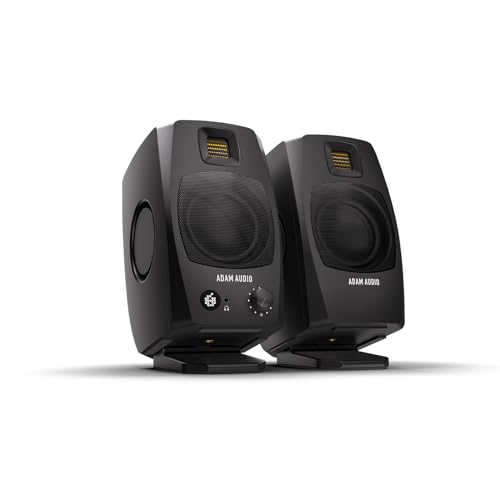
- 45 Hz extension from woofers and passive radiators
- D-ART tweeter and 80-watt active system
- USB-C, balanced inputs, headphone output, and stands
Best For: Computer-based production and detailed desktop monitoring
Flexible All-Rounder

- 50-watt stereo pair for production and multimedia
- Adjustable high- and low-frequency acoustic controls
- TRS, RCA, aux, headphone, and Bluetooth connectivity
Best For: Versatile desktop audio, gaming, and music production
Best Bluetooth Desktop Pick
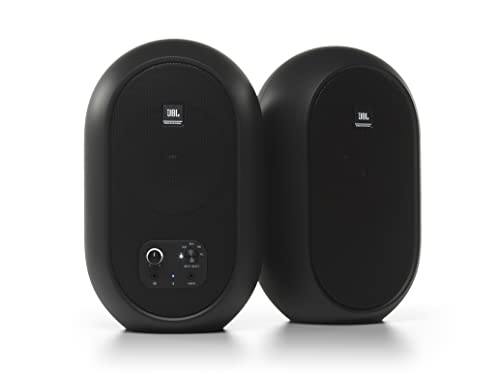
- Coaxial 4.5-inch driver design
- Bluetooth 5.0 plus flexible wired inputs
- 60W Class D stereo amplification
Best For: Desktop producers and creators needing flexible connectivity
Best Compact Studio Starter

- 50W stereo pair with 3.5-inch woofers
- High- and low-frequency tuning controls
- TRS, RCA, aux, and headphone connections
Best For: Home studios and versatile desktop listening
Best Feature-Packed Value

- Bluetooth 5.3, USB, RCA, aux, and TRS
- Built-in 24-bit USB DAC
- 3.5-inch driver with silk-dome tweeter
Best For: Creators needing many input options in a compact system
Best Compact Pick – Yamaha HS3 Powered Studio Monitors
The Yamaha HS3 pair is a practical choice when you need compact studio monitors for a small desk or near-field setup. Its 3.5-inch woofers, 0.75-inch dome tweeters, 70 Hz–22 kHz response, and room-control and high-trim controls provide useful adjustment for different listening spaces.
Best For: Small home studios, desktop monitoring, and music production setups that need flexible wired inputs.
Pros:
- Compact 3.5-inch two-way monitor design.
- Includes XLR/TRS, RCA, and stereo mini inputs.
- Room-control and high-trim controls help tailor the sound.
- Includes speaker cable, stereo mini-to-RCA cable, and anti-slip pads.
Cons:
- 70 Hz low-frequency response may leave the deepest bass underrepresented.
- Wired operation offers no Bluetooth convenience.
The HS3 stands out for its compact footprint and studio-oriented connectivity. It is a sensible option for accurate near-field work where desk space is limited, though bass-focused users may want a subwoofer.
Best Wireless Value – Sanyun SW208 Bluetooth Speakers
The Sanyun SW208 is a convenient alternative for shoppers seeking compact studio monitors with everyday wireless flexibility. These small bookshelf-style speakers combine Bluetooth 5.0, USB audio through a built-in 24-bit DAC, and side-mounted volume, bass, and treble controls.
Best For: Computer desks, casual music listening, gaming, and multimedia setups that benefit from Bluetooth and USB connectivity.
Pros:
- Bluetooth 5.0 supports convenient wireless playback.
- Built-in 24-bit DAC enables direct USB audio.
- Adjustable volume, bass, and treble controls are easy to access.
- Small wood-and-carbon-fiber bookshelf design fits compact desks.
Cons:
- Its bookshelf-speaker design is less specifically studio-focused than dedicated monitors.
- Wireless range is listed at up to 10 meters, so wired placement may still be preferable for critical work.
The SW208 prioritizes versatility and convenience over a strictly production-oriented feature set. It makes sense for a compact computer setup where monitoring, entertainment, and wireless playback share the same speakers.
Best Connectivity – M-AUDIO BX3 3.5-Inch Monitor Pair
The M-AUDIO BX3 pair is a strong fit for compact studio monitors when connection flexibility matters. Its 3.5-inch Kevlar woofers, silk-dome tweeters, MDF cabinets, and bi-amplified design support desktop music production, podcasting, gaming, and general multimedia use.
Best For: Desktop creators who need multiple wired inputs, front headphone access, and adjustable EQ controls.
Pros:
- Includes RCA, 1/4-inch TRS, and 1/8-inch connections.
- 3.5-inch Kevlar woofers provide a dedicated low-frequency driver.
- Front headphone and auxiliary access supports quiet listening.
- Rear high- and low-EQ controls allow sound customization.
Cons:
- Wired-only operation does not provide Bluetooth.
- The compact 3.5-inch design may not deliver the lowest bass frequencies.
With its broad input selection and convenient front-panel controls, the BX3 is especially practical for mixed desktop setups. It offers more connection options than many compact alternatives while retaining a manageable footprint.
Best Feature Set – Edifier MR3 Powered Studio Monitors
The Edifier MR3 combines compact studio monitors with modern wireless and app-based features. Its 3.5-inch mid-low drivers, 1-inch tweeters, balanced TRS input, Bluetooth multipoint, and Monitor, Music, and Custom modes make it adaptable for production and everyday listening.
Best For: Home studios and near-field listeners who want wired monitoring plus Bluetooth and app-based EQ control.
Pros:
- Hi-Res Audio certified with a stated 52 Hz–40 kHz response.
- Offers balanced TRS, RCA, AUX, Bluetooth, and headphone connectivity.
- Monitor, Music, and Custom modes suit different listening tasks.
- EDIFIER ConneX app provides detailed sound adjustments.
Cons:
- Bluetooth and app features may be unnecessary for a strictly wired studio workflow.
- The supplied dimensions indicate a larger footprint than some ultra-compact options.
The MR3 is a versatile choice for users who want compact studio monitors without giving up consumer-friendly features. Its multiple input types and selectable sound modes make it useful beyond production, while balanced TRS keeps it relevant for studio setups.
Desk-Friendly Value – Mackie CR3.5
The Mackie CR3.5 is a practical entry point for anyone building a compact studio monitors setup. Its 3.5-inch woofers, included isolation pads, and selectable placement correction make it well suited to desks and small studios.
Best For: Home studios, desktop music production, and casual listening.
Pros:
- Sold as a complete stereo pair with isolation pads and cables included.
- Tone Knob lets you adjust the voicing from the desk.
- Location Switch helps correct bass when placed against a wall or in free space.
- Offers RCA and TRS connectivity for common desktop audio sources.
Cons:
- The 3.5-inch woofers are aimed at compact setups rather than large-room playback.
- Connectivity is wired, with no wireless option listed.
Choose the CR3.5 if you want straightforward controls and a ready-to-use pair of compact studio monitors without adding much gear to your desk.
Premium Desktop Detail – ADAM Audio D3V
The ADAM Audio D3V brings a more feature-rich approach to compact studio monitors, combining 3.5-inch woofers, passive radiators, and a D-ART tweeter in a fully active desktop pair. USB-C connectivity and angled stands make it especially convenient for computer-based work.
Best For: Songwriters, producers, and music lovers seeking an advanced desktop monitoring system.
Pros:
- 3.5-inch aluminum woofers and dual-sided passive radiators extend response as low as 45 Hz.
- 1.5-inch D-ART tweeters are designed for precise high-frequency reproduction.
- Includes detachable 15-degree monitor stands and microphone-stand mounting points.
- Provides USB-C, balanced 1/4-inch inputs, headphone output, and placement-focused DSP switches.
Cons:
- The feature set may be more than needed for basic casual listening.
- Its desktop-focused design still requires corded power.
The D3V stands out among compact studio monitors for its connectivity, positioning flexibility, and stated low-frequency extension, making it a strong choice for a more capable desk setup.
Flexible All-Rounder – PreSonus Eris 3.5
The PreSonus Eris 3.5 is a versatile pair of compact studio monitors for production, gaming, movies, and everyday audio. Adjustable high- and low-frequency controls help tailor the sound to your room, while its broad input selection fits easily into a mixed desktop setup.
Best For: Multimedia desks, gaming, music production, and users connecting several audio sources.
Pros:
- 50 watts of built-in amplification support clear, dynamic playback.
- Woven-composite woofers and silk-dome tweeters cover a stated 80 Hz–20 kHz range.
- High- and low-frequency controls allow room-specific tuning.
- Includes balanced TRS, RCA, front aux, and front headphone connections.
Cons:
- The stated 80 Hz low-end response may leave deeper bass to a separate subwoofer.
- It is a corded system rather than a wireless-only solution.
For buyers who want compact studio monitors that also handle gaming, streaming, and multiple wired sources, the Eris 3.5 offers a particularly adaptable feature set.
Best Bluetooth Desktop Pick – JBL 104-BT
The JBL Professional 1 Series 104-BT is a practical choice when you want compact studio monitors with Bluetooth and several wired inputs. Its coaxial driver design, desktop-optimized cabinet, and included stereo-pair setup suit small workspaces where flexibility and minimal cable clutter matter.
Best For: Desktop producers, content creators, and listeners who want Bluetooth alongside balanced and unbalanced connections.
Pros:
- Coaxial 4.5-inch woofer and 0.75-inch soft-dome tweeter provide a wide sweet spot.
- Bluetooth 5.0 works alongside RCA, 3.5mm aux, and balanced 1/4-inch TRS inputs.
- Built-in 60-watt Class D amplification, front volume control, and headphone output simplify a desktop setup.
Cons:
- The larger 4.5-inch drivers may take more desk space than smaller desktop monitors.
- Bluetooth streaming is convenient, but wired connections remain preferable for critical mixing.
Choose the 104-BT if connection flexibility is a priority. The master-speaker electronics and included speaker cable help reduce wiring, while the coaxial layout is well suited to close-range desktop listening.
Best Compact Studio Starter – PreSonus Eris 3.5
The PreSonus Eris 3.5 is a compact studio monitor pair designed for small studios, dorm rooms, and everyday desktop listening. Its 3.5-inch woven-composite woofers, silk-dome tweeters, acoustic tuning controls, and 50 watts of built-in amplification offer a straightforward way to add studio-oriented sound without extra equipment.
Best For: Home recording, gaming, streaming, and general desktop audio in space-conscious setups.
Pros:
- Sold as a complete stereo pair with 50 watts of built-in amplification.
- High- and low-frequency controls help tailor the response to the room.
- Balanced TRS, RCA, front aux, and front headphone connections support varied sources.
- 3.5-inch woofers and 1-inch silk-dome tweeters cover a stated 80 Hz–20 kHz range.
Cons:
- The 3.5-inch woofers may provide less low-end reach than larger monitors.
- The supplied notes emphasize wired inputs, so wireless playback should not be assumed despite the listed Bluetooth protocol.
The Eris 3.5 stands out as an accessible all-purpose option among compact studio monitors. Its front-panel controls and headphone output are especially useful when the speakers need to serve both production and everyday listening roles.
Best Feature-Packed Value – Ortizan C7
The Ortizan C7 combines compact studio monitor features with broad connectivity, including Bluetooth 5.3, USB, RCA, aux, and balanced TRS. Its 3.5-inch carbon-fiber speaker, 0.75-inch silk-dome tweeter, and built-in 24-bit DAC make it a flexible option for a small music-production or multimedia setup.
Best For: Budget-conscious creators who want multiple digital, wireless, consumer, and professional input options.
Pros:
- Bluetooth 5.3, USB, RCA, 3.5mm aux, and 6.35mm balanced TRS inputs support varied sources.
- Built-in 24-bit DAC accepts digital audio directly over USB.
- 3.5-inch carbon-fiber driver and 0.75-inch silk-dome tweeter use a two-way crossover.
- Front headphone output makes private monitoring convenient.
Cons:
- The supplied notes do not specify amplifier power or frequency-response limits.
- Its numerous connection and feature claims may require more setup attention than a simpler desktop pair.
The C7 is appealing when connectivity matters as much as compact size. It can bridge professional gear and everyday devices in one system, although buyers seeking fully documented monitoring specifications may prefer a model with more published technical detail.
How We Picked These Compact Studio Monitors
We focused on powered nearfield speakers that suit desks, small studios, bedrooms, and compact editing spaces. Our comparison considers cabinet and woofer size, connectivity, amplifier design, frequency controls, stereo pairing, Bluetooth support, and the practical needs of close-range listening. We also included options across several price and feature levels rather than treating every speaker as a professional mixing reference.
Because specifications and included accessories can vary by seller or revision, confirm the exact model, pair configuration, warranty, and included cables before ordering.
Quick Comparison
| Best For | What to Prioritize | Models to Consider |
|---|---|---|
| Entry-level music production | Wired inputs, balanced voicing, front-panel controls | Yamaha HS3, M-AUDIO BX3, PreSonus Eris 3.5 |
| Desktop versatility | Bluetooth, multiple inputs, easy volume control | Edifier MR3, Mackie CR3.5, JBL 104-BT |
| Smallest workspaces | Compact cabinets and nearfield clarity | ADAM Audio D3V, Sanyun SW208 |
| Casual listening on a budget | Simple setup, wireless playback, strong value | Ortizan C7 and Bluetooth-equipped models |
Key Buying Factors for Compact Studio Monitors
Size and Listening Distance
Three- to four-inch woofers are usually well suited to desktop listening and small rooms. They take up less space and can sound balanced at close range, but they will not move as much air or produce the same low-end authority as larger monitors. Leave room behind rear-ported speakers and avoid placing them tightly against a wall.
Accuracy Versus Convenience
For mixing, prioritize a consistent stereo image, controlled midrange, and predictable response over extra bass or exaggerated detail. Bluetooth is convenient for reference listening, but wired connections are generally the better choice for critical work because they avoid wireless latency and compression.
Inputs, Controls, and Output
Check whether you need balanced connections, RCA, TRS, AUX, USB, or Bluetooth. A front-panel volume control and headphone output can make a monitor much easier to use on a busy desk. Also check the quoted wattage carefully: amplifier ratings are not directly comparable across brands, so real-world placement and listening distance matter more than headline numbers alone.
Room Setup
Place the speakers at ear height, form an approximately equilateral triangle with your listening position, and angle the tweeters toward you. Isolation pads or stands can reduce desk vibration and improve imaging. Even the best Compact Studio Monitors benefit from sensible placement and modest listening levels.
Who Should Buy Which Compact Studio Monitors?
Choose a compact, wired pair if accurate editing and music production are the priority. Pick a Bluetooth model if the speakers must also handle phones, tablets, streaming, or casual entertainment. Buyers who need the smallest footprint should focus on compact desktop designs, while listeners wanting fuller bass may prefer the largest cabinets that their desk and room can accommodate. If you are unsure, prioritize input flexibility and a neutral nearfield presentation; those traits keep the speakers useful as your setup evolves.