
Unstable venue power, crowded racks, and limited outlets can put expensive audio equipment at risk. The best compact stage power conditioners help organize connections while adding practical protection and control for live setups.
This roundup compares 10 compact options across outlet count, sequencing, voltage monitoring, portability, and rack compatibility so you can choose the right fit for your stage rig.
Best 10 Compact Stage Power Conditioners Picks for 2026
Compact Protection Pick

- SMP surge and spike protection
- LiFT AC filtering
- 10-amp compact chassis
Best For: DJ, recording, and remote equipment setups
Outlet-Rich Rack Alternative

- Nine AC outlets
- Noise filtering and surge protection
- 15-amp capacity with LED illumination
Best For: Pro-audio racks and multi-device setups
Sequenced Rack Control Pick

- Ten total outlets
- 1U rack-mount chassis
- Voltage readout and 3,100-watt rating
Best For: Stage, studio, and home theater racks
High-Capacity Outlet Pick

- Eleven AC outlets
- Noise filtering and surge protection
- Stainless-steel enclosure
Best For: Larger pro-audio equipment racks
Rack-Ready Sequencing
Monoprice Stage Right 15A Power Conditioner
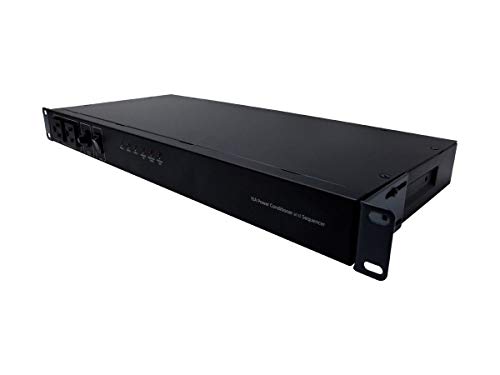
- Eight outlets with three sequencing zones
- 15A capacity and surge protection
- 1U metal rack-mount enclosure
Best For: Rack-based stage rigs needing controlled startup
Portable Audio Filtering
Black Lion Audio PG-P Power Conditioner

- Six outlets with audio filtration
- Nine-foot power cable for flexible placement
- 540-joule surge protection in a stainless-steel enclosure
Best For: Portable indoor professional-audio setups
High-Capacity Rack Protection
Furman M-8z Merit Z Series Power Conditioner

- Twelve outlets with front and rear access
- Extreme Voltage Shutdown and surge protection
- USB-C/USB-A charging and RFI/EMI filtering
Best For: Busy racks needing capacity and voltage protection
High-Output Sequencing Pick

- 8 outlets with 1-second sequencing
- Real-time voltage display
- 1U rack mount; 2,200W per channel
Best For: Stage and studio racks needing sequenced power and voltage monitoring
Noise-Filtering Rack Essential

- Seven outlets in a 1U rack format
- Built-in RFI/EMI AC noise filter
- 10A breaker and surge protection
Best For: 120V racks needing practical distribution and audio noise filtering
Flexible Multi-Control Power Hub

- 10 outlets with 8 independent controls
- 110–230V support and LCD voltage display
- Bypass mode and external remote switch
Best For: Complex audio racks needing flexible sequencing and remote control
Compact Protection Pick – Furman AC-215A
Furman AC-215A Compact Power Conditioner with Auto-Resetting Voltage Protection - Black
Check Price On AmazonThe Furman AC-215A is a compact stage power conditioner for setups that need surge protection, voltage monitoring, and AC filtering without a large rack unit. Its 10-amp capacity and compact chassis suit projectors, DJ equipment, recording rigs, and other remote installations.
Best For: Compact pro-audio, DJ, home recording, and home entertainment setups.
Pros:
- SMP surge and spike protection with Auto-Reset EVS voltage monitoring
- LiFT filtering is designed to provide cleaner AC power
- Compact stainless-steel chassis can attach to a flat-screen mount or remote location
- 10-amp, 1,200-watt capacity with a circuit breaker
Cons:
- Its 10-amp rating provides less capacity than the 15-amp Radial models
- The notes do not specify the number of AC outlets
The AC-215A is a strong choice when protection and filtering matter more than maximizing outlet count. Its automatic shutdown circuitry adds useful protection for sensitive equipment, while the compact design keeps installation flexible.
Outlet-Rich Rack Alternative – Radial Power-2
The Radial Power-2 is a compact stage power conditioner for users who need nine outlets, noise filtering, surge protection, and a 15-amp supply. It also adds LED illumination and a USB port for compatible equipment and accessories.
Best For: Pro-audio racks, office equipment, and mixed electronics needing multiple outlets.
Pros:
- Provides nine outlets for connected equipment
- Combines noise filtering and surge protection
- 15-amp capacity offers more current than the Furman AC-215A
- Includes LED illumination and one USB port
Cons:
- The supplied notes do not include rack dimensions or mounting details
- At 12.4 pounds, it is heavier than the listed Pyle and Furman units
The Power-2 is a practical choice when outlet availability is a priority. Its 15-amp rating and nine-outlet layout make it better suited to fuller equipment setups than especially minimal installations.
Sequenced Rack Control Pick – Pyle PCO875 Power Sequencer
The Pyle PCO875 is a compact stage power conditioner and sequencer built for rack-mounted audio, studio, and home theater systems. It offers 10 outlets, a digital voltage readout, one-button operation, and up to 3,100 watts of stated power handling.
Best For: Rack-mounted stage, studio, and home theater systems that need centralized power control.
Pros:
- Ten outlets include eight rear outlets and two front always-on outlets
- 1U rack-mount design helps conserve equipment space
- Digital voltage readout and one-button operation simplify monitoring and control
- Includes built-in protection against noise interference and voltage fluctuations
Cons:
- Its stated 13-amp rating is lower than the Radial models’ 15-amp rating
- The one-year warranty is shorter than the Furman’s three-year warranty
The PCO875 stands out for centralized rack control rather than bare-bones power distribution. Its front always-on outlets, voltage display, and sequencing-style controller make it useful when a stage or studio rig needs convenient access and monitoring.
High-Capacity Outlet Pick – Radial Power-1
The Radial Power-1 is a compact stage power conditioner for equipment racks that need 11 outlets, noise filtering, and surge protection. Its stainless-steel construction provides a durable enclosure for a larger connected setup.
Best For: Larger pro-audio and equipment-rack installations needing additional outlets.
Pros:
- Offers 11 outlets for connecting multiple devices
- Includes noise filtering and surge protection
- Uses a stainless-steel enclosure material
- Provides more outlets than the Radial Power-2
Cons:
- The supplied notes do not specify its amperage or maximum wattage
- Its listed 23-inch length may require more installation space than the Furman
- The notes do not mention LED illumination or a USB port
The Power-1 is the straightforward choice for users who value outlet count and a stainless-steel build. Verify available rack or mounting space and electrical requirements before choosing it for a particular system.
Rack-Ready Sequencing – Monoprice Stage Right 15A Power Conditioner
For compact stage power conditioners in a rack-based setup, the Monoprice Stage Right combines 15-amp power handling with eight outlets and three sequencing zones. Its metal enclosure and 1U rack-mount design suit audio, video, and amplification equipment where controlled startup is useful.
Best For: Rack-mounted stage rigs needing outlet sequencing across three zones.
Pros:
- Eight outlets provide power for multiple connected devices.
- Three zones support staged equipment startup.
- 15-amp capacity and surge protection are suitable for many electronic and audio setups.
- Metal 1U rack-mount enclosure saves space in a touring or installed rack.
Cons:
- Its rack-oriented design is less convenient for small portable setups.
- The supplied information does not specify the surge-protection rating or sequencing delay.
This is a practical choice when compact rack space and controlled power-up matter more than portability. It is especially well suited to systems with amplifiers, speakers, or other equipment that benefits from organized startup.
Portable Audio Filtering – Black Lion Audio PG-P Power Conditioner
The Black Lion Audio PG-P is a portable option among compact stage power conditioners, offering six outlets, audio filtration, and a nine-foot power cable. Its stainless-steel enclosure and 540-joule surge rating make it a practical fit for indoor professional-audio setups that need flexible placement.
Best For: Portable professional-audio rigs and indoor setups that need a long reach and filtration.
Pros:
- Six outlets accommodate several pieces of professional audio equipment.
- Audio filtration is designed to help provide cleaner power for connected gear.
- Nine-foot power cable makes placement more flexible on stage or in a studio.
- 540-joule surge protection and a stainless-steel enclosure add useful protection and durability.
Cons:
- It has fewer outlets than the rack-style Furman and Monoprice options.
- The supplied details list indoor use rather than a weather-resistant design.
- It does not include the rack-mount and sequencing features of the Monoprice model.
Choose the PG-P when portability and audio-focused filtration are priorities. The long cable is particularly useful when outlets are not close to the equipment, while six outlets keep the unit manageable for smaller rigs.
High-Capacity Rack Protection – Furman M-8z Merit Z Series Power Conditioner
The Furman M-8z is a strong candidate for compact stage power conditioners when a rack system needs extensive connectivity and monitoring. It provides 12 outlets, Extreme Voltage Shutdown, surge protection, RFI/EMI noise filtering, and front USB charging in a steel rack-mount chassis.
Best For: Rack systems with many devices, bulky adapters, and a need for voltage monitoring.
Pros:
- Twelve outlets are split between eight rear outlets and four front outlets.
- Extra rear spacing accommodates bulky wall-wart power supplies.
- Extreme Voltage Shutdown disconnects equipment during substantially low or high incoming voltage.
- Front USB-C and USB-A ports provide convenient device charging.
Cons:
- Its 12-outlet rack format may be more capacity than smaller rigs require.
- The listed surge rating is 126 joules, lower than the Black Lion Audio PG-P’s 540 joules.
- It is intended for rack installation rather than maximum portability.
For a busy rack, the M-8z offers the most outlet capacity in this group along with clear protection-status monitoring and voltage shutdown. Its front and rear outlet arrangement also makes it easier to manage mixed equipment and bulky power supplies.
High-Output Sequencing Pick – Depusheng D328
For compact stage power conditioners that combine rack efficiency with orderly startup, the Depusheng D328 offers eight outlets, a real-time voltage display, and one-second channel delays. Its 1U metal chassis is suited to stage, studio, classroom, conference-room, and KTV setups.
Best For: Rack users who need sequenced power, voltage monitoring, and up to 2,200W per channel.
Pros:
- Eight outlets with a 30A relay and overload/short-circuit protection.
- One-second staggered switching helps reduce startup and shutdown current impact.
- Real-time voltage display and space-saving 1U rack-mount design.
- Aluminum and metal construction supports a stable installation.
Cons:
- Rated for 10A output current.
- Manufacturer warranty is limited to 90 days from purchase.
- The unit is relatively deep at 18.89 inches.
The D328 is a strong fit when sequenced power and clear voltage readouts matter more than a front-heavy outlet layout. Confirm your rack depth and electrical requirements before choosing it.
Noise-Filtering Rack Essential – Pyle PCO850.5
The Pyle PCO850.5 is a straightforward option among compact stage power conditioners for powering rack gear without daisy-chaining strips. It provides seven outlets, surge and spike protection, AC noise filtering, and a resettable 10A circuit breaker in a 1U chassis.
Best For: Studio, stage, and install racks with amplifiers, mixers, and other 120V equipment.
Pros:
- Six rear outlets plus one front-panel convenience outlet.
- Built-in RFI and EMI filtering supports cleaner, quieter audio output.
- 10A push-to-reset circuit breaker avoids fuse replacement after an overload.
- Aluminum front panel and steel chassis suit rack installation.
Cons:
- Provides 120V operation and a 10A maximum current rating.
- Does not list sequenced outlet switching or voltage display.
- Seven outlets may be limiting for larger systems.
Choose the Pyle when simple rack power distribution and AC noise filtering are your priorities. It is less suited to setups that specifically require sequential startup or live voltage monitoring.
Flexible Multi-Control Power Hub – MICNAUX 20A Sequencer
For compact stage power conditioners with expanded control, this MICNAUX rack unit combines 10 outlets, eight independent rear switches, sequencing, and a front LCD voltage display. Its 110–230V compatibility and external dry-contact switch make it adaptable to varied audio and installation environments.
Best For: Larger audio racks requiring independent outlet control, sequencing, voltage monitoring, and remote operation.
Pros:
- Eight sequenced rear outlets with dedicated switches and indicators.
- Two always-on front outlets provide convenient additional power.
- 110–230V compatibility supports international setups.
- Includes bypass mode, external remote switching, and a large LCD voltage display.
Cons:
- Maximum power output is listed as 2,000W.
- Its 20A rating may require appropriate circuit planning.
- At 18.86 inches deep, it needs sufficient rack clearance.
The MICNAUX stands out for systems where outlet-by-outlet control and remote flexibility are worth the added feature set. Check local voltage, current, and rack-clearance requirements before installation.
How We Picked These Compact Stage Power Conditioners
We focused on features that matter in real performance and installation environments: rack-friendly designs, outlet capacity, surge or voltage protection, sequencing controls, monitoring, and ease of use. The selection includes straightforward power distribution units, portable conditioners, and sequencers for systems that need controlled startup and shutdown.
Because electrical standards and protection claims vary, confirm the unit’s input voltage, current rating, plug type, and documentation before connecting your equipment. A power conditioner cannot correct every venue wiring problem or replace a properly installed electrical circuit.
Quick Comparison
| Best For | Look For | Typical Advantage |
|---|---|---|
| Small mobile rigs | Compact size and simple controls | Easy transport and setup |
| Rack-based systems | 1U mounting and front-panel access | Clean, organized installations |
| Sequenced systems | Delayed zones or independent switches | Controlled equipment startup |
| Voltage-sensitive gear | Voltage display or automatic protection | Better visibility and added safeguards |
Key Buying Factors for Compact Stage Power Conditioners
Current Rating and Outlet Layout
Check the total amperage and wattage limits, then estimate the combined draw of amplifiers, powered speakers, mixers, processors, and accessories. Count both rear and front outlets, and verify whether all outlets are switched, filtered, or independently controlled.
Protection and Voltage Monitoring
Look for clearly stated surge protection, overvoltage or undervoltage response, and circuit-breaker details. A real-time voltage display is useful for spotting questionable venue power, while automatic reset or shutdown features may help protect connected equipment. Treat filtering claims realistically: conditioning may reduce certain line noise, but it does not guarantee quieter audio.
Sequencing and Installation
Sequencing is valuable when a system should power on in stages, reducing startup surges and speaker thumps. Confirm the delay pattern, zone arrangement, switch behavior, and whether the unit fits your rack depth. Portable users may prefer a lighter model without complex controls.
Compatibility and Everyday Handling
Confirm the unit’s voltage standard, connector type, rack hardware, cable reach, and ventilation needs. Leave headroom below the maximum load, avoid daisy-chaining high-draw equipment, and use properly rated extension cables when required.
Who Should Buy Which Compact Stage Power Conditioners?
Choose a basic compact conditioner if you mainly need organized outlets and basic surge protection for a small pedalboard, mixer, or mobile rack. Choose a model with voltage monitoring if you frequently play unfamiliar venues and want immediate visibility into incoming power. A sequencer is the better choice for larger rack systems, powered speakers, or installations where controlled startup matters. If portability is the priority, select the smallest unit that meets your current rating and outlet needs; if the system is semi-permanent, prioritize rack fit, switching access, and expansion headroom.