
The best wireless trackballs make precise pointer control easier while reducing the need to move your entire hand across a desk. They are especially useful for compact workspaces, long office sessions, and users who prefer thumb or finger-based navigation.
Our 2026 roundup covers ergonomic thumb-operated models, finger-operated designs, rechargeable options, and trackballs with Bluetooth or 2.4GHz connectivity. Use the guide below to narrow your choice by comfort, control style, features, and value.
Best 10 Wireless Trackballs Picks for 2026
Best Ergonomic Upgrade

- 20-degree tilt with a contoured, ergonomic grip
- Bluetooth and Logi Bolt wireless connectivity
- Up to 120 days on a full charge
Best For: Medium- to large-handed users prioritizing comfort and productivity
Best Ambidextrous Premium Pick

- Bluetooth, 2.4GHz, and wired connection options
- Ambidextrous low-profile design
- Up to four months of battery life
Best For: Users wanting flexible connectivity and left- or right-hand use
Best Value Thumb-Control Model

- Ergonomic thumb control with four DPI levels
- Connects with up to three devices
- Rechargeable battery and six buttons
Best For: Right-handed users needing versatile control in small spaces
Best Scroll-Ring Design

- Dedicated scroll ring for documents and web pages
- Ambidextrous design with four DPI settings
- Bluetooth LE and 2.4GHz wireless
Best For: Users wanting simple scrolling and left- or right-hand flexibility
Best Adjustable Wireless Trackball
Ergonomic Adjustable-Angle Trackball

- 0° or 18° adjustable tilt
- Bluetooth and 2.4GHz for three devices
- Rechargeable with quiet clicks and five DPI levels
Best For: Right-handed users seeking adjustable comfort and multi-device control
Best Premium Wireless Trackball

- Bluetooth wireless connectivity
- Six-button ergonomic design
- Rechargeable lithium-polymer battery included
Best For: Office users wanting a simple Bluetooth trackball
Best Large Trackball Alternative
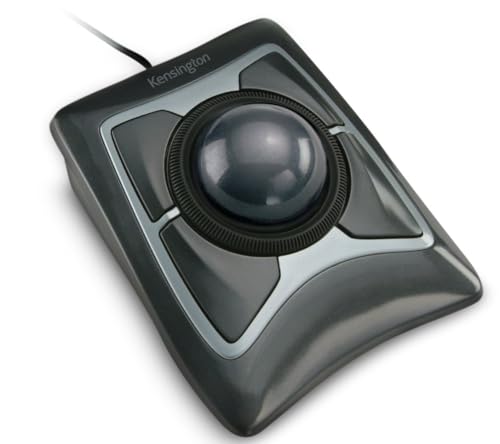
- Large 55mm ball with optical tracking
- Dedicated scroll ring and wrist rest
- Ambidextrous wired USB-A design
Best For: Stationary workstations prioritizing large, precise control
Best Ergonomic Pick

- Thumb control reduces hand movement
- Bluetooth and Logi Bolt connectivity
- Up to 18 months of battery life
Best For: Right-handed office users and compact desks
Best Large-Ball Option

- Large 55mm ball with optical tracking
- Ambidextrous design and detachable wrist rest
- Bluetooth LE and 2.4GHz wireless options
Best For: Dedicated desks and users wanting a full-size trackball
Best Compact Ambidextrous Pick

- Compact 32mm trackball design
- Ambidextrous for left- or right-handed use
- Touch scrolling with Bluetooth or USB receiver
Best For: Small desks, shared workspaces, and smaller hands
Best Ergonomic Upgrade – Logitech MX Ergo S
The Logitech MX Ergo S is a premium choice among wireless trackballs for users who want thumb control, a tilted ergonomic design, and flexible device connectivity. Its rechargeable battery and quiet clicks also make it practical for extended office use.
Best For: Medium- to large-handed users seeking an ergonomic, productivity-focused trackball for Windows or macOS.
Pros:
- 20-degree tilt and contoured grip support a more comfortable forearm posture.
- Switchable speed and high-precision tracking help adapt cursor control to different tasks.
- Bluetooth and included Logi Bolt receiver provide dual wireless connectivity.
- Fast USB-C charging offers up to 24 hours of use from a one-minute charge.
Cons:
- Right-hand-only design limits its suitability for left-handed users.
- USB-C charging cable is not included.
- Advanced customization requires the Logi Options+ app.
The MX Ergo S stands out for its combination of posture-conscious design, customizable controls, and long battery life. It is a strong fit when comfort and productivity features matter more than a compact or ambidextrous shape.
Best Ambidextrous Premium Pick – Kensington SlimBlade Pro
The Kensington SlimBlade Pro is a versatile option among wireless trackballs, offering Bluetooth, 2.4GHz wireless, and wired connection modes. Its low-profile ambidextrous design and large 55mm ball make it well suited to shared workspaces and extended sessions.
Best For: Right- or left-handed users who want flexible connectivity, a rechargeable battery, and a low-profile trackball.
Pros:
- Supports Bluetooth, 2.4GHz wireless, and wired USB-C connections.
- Ambidextrous low-profile design accommodates both hand orientations.
- Dual sensors track the large 55mm ball for responsive cursor control.
- Rechargeable battery provides up to four months of use per charge.
Cons:
- Its four physical buttons may be limiting for users seeking extensive onboard controls.
- Personalized button functions require KensingtonWorks software.
- The included wireless dongle uses USB-A, with an adapter supplied for USB-C connection.
With three connection options and a long-lasting battery, the SlimBlade Pro is one of the most flexible wireless trackballs in this group. Its ambidextrous design further broadens its appeal for multi-user or nonstandard desk setups.
Best Value Thumb-Control Model – Nulea M501 Wireless Trackball
The Nulea M501 is a practical wireless trackball for users who want thumb-based control, adjustable DPI, and multi-device pairing without disposable batteries. Its trackball can also be useful where desk space is limited, such as on a couch, bed, or small writing surface.
Best For: Right-handed users seeking an affordable rechargeable trackball for compact or flexible work areas.
Pros:
- Ergonomic thumb control reduces the need to move the wrist and arm.
- Four DPI levels support different cursor-speed preferences.
- Can connect with up to three devices through Bluetooth or the USB dongle.
- Rechargeable battery eliminates the need for dry-cell batteries.
Cons:
- All buttons are non-programmable.
- Right-hand-only design is not suitable for left-handed users.
- Charging should use the included cable, a computer USB port, or a 5V charger rather than a fast charger.
The M501 focuses on core wireless trackball features rather than extensive software customization. Its multi-device switching, rechargeable battery, and compact-surface usability make it a sensible choice for everyday productivity.
Best Scroll-Ring Design – Kensington Orbit Wireless
The Kensington Orbit Wireless is a straightforward choice among wireless trackballs, pairing a precise 40mm ball with a dedicated scroll ring. Dual wireless connectivity, adjustable DPI, and an ambidextrous design make it suitable for everyday browsing and document work.
Best For: Left- or right-handed users who prioritize easy scrolling, simple controls, and adjustable cursor speed.
Pros:
- Scroll ring makes moving through web pages and documents easy.
- Ambidextrous design supports both right- and left-handed use.
- Four DPI settings range from 400 to 1,600 for precision or faster navigation.
- Offers Bluetooth LE and 2.4GHz wireless connectivity.
Cons:
- Uses two AA batteries rather than a rechargeable battery.
- Only two buttons are listed, limiting direct control options.
- KensingtonKonnect software does not currently support Windows ARM-based computers.
The Orbit Wireless is appealing when scrolling comfort and uncomplicated operation are more important than a large button layout. Its ambidextrous shape and four DPI choices add useful flexibility for general office tasks.
Best Adjustable Wireless Trackball – Ergonomic Adjustable-Angle Trackball
This SABLUTE wireless trackball is designed for users who want a more flexible hand position during extended computer use. Its selectable 0° or 18° tilt, thumb-operated ball, quiet buttons, and three-device wireless connectivity make it a practical option for compact desks, study areas, and shared workspaces.
Best For: Right-handed users who want adjustable ergonomics, rechargeable power, and wireless switching between multiple devices.
Pros:
- 0° and 18° tilt options support different wrist positions.
- Bluetooth and 2.4GHz connectivity support up to three devices.
- Rechargeable USB-C battery, five DPI levels, and quiet-touch buttons.
- Trackball control works well in tight or cluttered workspaces.
Cons:
- Right-hand-only design.
- New trackball users may need one to two weeks to adjust.
- The customization driver is not compatible with Mac OS.
Among these wireless trackballs, this model stands out for its adjustable angle and multi-device flexibility. It is especially appealing if comfort features matter more than a compact, minimalist design.
Best Premium Wireless Trackball – Logitech MX Ergo S
The Logitech MX Ergo S is a streamlined wireless trackball for office users who prefer Bluetooth connectivity and an ergonomic design. Its six-button layout and included rechargeable lithium-polymer battery provide a straightforward setup for compatible computers.
Best For: Office users who want a recognizable wireless trackball with Bluetooth connectivity and rechargeable power.
Pros:
- Wireless Bluetooth connection keeps the desk free of a USB cable.
- Ergonomic design is suited to office use.
- Six buttons provide more controls than a basic four-button trackball.
- Rechargeable battery is included.
Cons:
- Supplied notes list compatibility primarily with personal computers, Windows 10, and ChromeOS 134.
- The notes do not specify adjustable DPI, multi-device switching, or a wrist-rest feature.
- At 200 g, it is relatively substantial compared with lighter mice.
The MX Ergo S is a sensible choice for shoppers who prioritize a familiar brand, Bluetooth operation, and a rechargeable design. It offers fewer documented customization details than some alternatives, but keeps the feature set focused for office work.
Best Large Trackball Alternative – Kensington Expert Trackball
Kensington Expert Trackball Mouse (K64325), Black Silver, 5"W x 5-3/4"D x 2-1/2"H
Check Price On AmazonThe Kensington Expert Trackball is a wired model rather than one of the wireless trackballs in this roundup, but its large 55mm ball and scroll ring make it worth considering for users who value precise, stable control. The ambidextrous design and detachable wrist rest also suit shared workstations.
Best For: Users who prefer a large, ambidextrous trackball with reliable wired USB-A connectivity and dedicated scrolling.
Pros:
- Large 55mm ball and Diamond Eye optical tracking support precise cursor control.
- Patented scroll ring makes navigating long pages convenient.
- Ambidextrous design and detachable wrist rest accommodate different users.
- Four buttons and software allow customization of cursor and scroll settings.
Cons:
- Wired USB-A connection does not provide wireless convenience.
- ChromeOS users cannot customize the device through KensingtonKonnect.
- Windows ARM-based computers are not currently supported by the software.
This Kensington is the strongest fit for a permanent desk setup where dependable USB connectivity and a large control surface matter more than portability. Choose it over wireless trackballs if you want an ambidextrous design and dedicated scroll ring.
Best Ergonomic Pick – Logitech ERGO M575S
The Logitech ERGO M575S is a practical choice among wireless trackballs for users who want thumb control, a compact footprint, and an ergonomic right-handed shape. Its Bluetooth and Logi Bolt connectivity make it suitable for desks where reducing hand movement matters.
Best For: Right-handed users seeking an ergonomic wireless trackball for office work and small setups.
Pros:
- Thumb-operated 2,000 DPI trackball lets you control the cursor without moving your hand.
- Ergonomic shape is designed to support hand and forearm posture, with quiet clicks.
- Bluetooth and Logi Bolt receiver connectivity, plus up to 18 months of battery life.
- Three customizable buttons and cursor-speed adjustments through Logi Options Plus.
Cons:
- Right-handed design is not suited to left-handed users.
- Requires Logitech software for customization and Smart Actions.
The M575S stands out when comfort, low desk movement, and long battery life are more important than a large ball or ambidextrous design. It is especially well suited to compact workspaces and everyday productivity.
Best Large-Ball Option – Kensington Expert Wireless
The Kensington Expert Wireless is one of the more substantial wireless trackballs, pairing a large 55mm ball with optical tracking and a built-in scroll ring. Its ambidextrous layout and detachable wrist rest make it a flexible choice for shared workstations.
Best For: Users who prefer a large trackball, ambidextrous control, and wrist support.
Pros:
- Large 55mm ball provides precise cursor control.
- Patented scroll ring makes navigating long pages and documents convenient.
- Ambidextrous design works for right- or left-handed users.
- Four customizable buttons and wireless Bluetooth LE or 2.4GHz USB connectivity.
Cons:
- Its larger 8-inch length and 1.4-pound weight require considerable desk space.
- Linux is not supported according to the supplied compatibility details.
- Uses two AA batteries rather than a rechargeable battery.
The Expert Wireless is a strong fit if you want a full-size control surface and scroll ring instead of a compact mouse-style trackball. Choose it for a dedicated desk where its size and detachable wrist rest are advantages.
Best Compact Ambidextrous Pick – Kensington Orbit Wireless
Kensington Orbit Wireless Trackball Mouse with Touch Scroll Ring (K72352US),Black
Check Price On AmazonThe Kensington Orbit Wireless is a compact option among wireless trackballs, featuring a 32mm ball and touch scrolling in a space-saving design. It connects through Bluetooth LE or a USB nano receiver and is shaped for both left- and right-handed users.
Best For: Small to average-sized hands, shared workspaces, and users who want touch scrolling.
Pros:
- Compact footprint suits smaller desks and portable setups.
- Ambidextrous design accommodates left- and right-handed users.
- Touch scroll ring provides smooth navigation through web pages and documents.
- Plug-and-play setup with Bluetooth LE and USB nano receiver options.
Cons:
- The 32mm ball is smaller than the Kensington Expert’s 55mm ball.
- Two-button layout offers fewer controls than four-button alternatives.
- Rated sensitivity is 1,000 DPI.
The Orbit Wireless prioritizes simplicity and desk space over extensive button customization. It is a sensible pick for everyday browsing and document work, particularly when an ambidextrous, compact design is preferred.
How We Picked the Best Wireless Trackballs
We focused on the factors that most affect daily use: ergonomic design, tracking precision, connection reliability, battery or rechargeable power, button layout, scrolling controls, and compatibility. The lineup includes both thumb-operated and finger-operated models so shoppers can compare different control styles rather than choosing from nearly identical designs.
We also considered practical details such as adjustable sensitivity, USB receiver storage, Bluetooth support, charging convenience, and desk footprint. Because comfort is highly personal, no single trackball is ideal for everyone; the best choice depends on how you work and how you prefer to control the cursor.
Quick Comparison
| Best For | Look For | Typical Advantage |
|---|---|---|
| Office productivity | Ergonomic thumb control and programmable buttons | Comfortable everyday navigation |
| Large-screen precision | Finger-operated ball and adjustable sensitivity | Fine cursor control with less thumb fatigue |
| Flexible connectivity | Bluetooth plus 2.4GHz receiver | Easy switching between computers |
| Compact desks | Low-profile design and wireless operation | More usable workspace |
| Long sessions | Contoured support and rechargeable power | Less hand movement and fewer battery changes |
Key Buying Factors for Wireless Trackballs
Thumb or Finger Control
Thumb trackballs typically feel familiar to mouse users and keep cursor control close to the palm. Finger-operated models use a larger central ball, which can provide broader movement and precise control but may require a short adjustment period. Try to match the design to your preferred hand position and the type of work you do.
Connection and Compatibility
Bluetooth is convenient for laptops and devices without many USB ports, while a 2.4GHz receiver can offer simple plug-and-play performance. Models supporting both options are useful if you switch between a desktop, laptop, or tablet. Check operating-system compatibility and whether all extra buttons work with your setup.
Comfort, Size, and Angle
Look for palm support, a shape that fits your hand, and controls that do not require excessive reaching. Adjustable tilt can help some users find a more natural wrist position. Measure your available desk space, especially for larger finger-operated designs.
Power and Maintenance
Rechargeable models reduce disposable battery use and are convenient when charging over USB. Replaceable-battery designs may run longer between changes. Trackballs also collect dust, so a removable ball and accessible sensor area make routine cleaning easier.
Who Should Buy Which Wireless Trackballs?
Choose a thumb-operated ergonomic model if you want the quickest transition from a conventional mouse and primarily handle documents, browsing, email, or general office work. Choose a finger-operated design if you value precise movement, use large displays, or want to control the ball with multiple fingers.
Buy a rechargeable model for a regular workstation where convenient charging matters. Choose Bluetooth and 2.4GHz connectivity if you use multiple computers or need a receiver-based fallback. For a small desk, prioritize a compact wireless design; for long daily sessions, prioritize palm support, a comfortable angle, and easily reachable buttons over the lowest price.