
Wireless DMX controllers can simplify stage, DJ, theater, and event lighting by reducing cable runs between your console and fixtures. The right system depends on more than wireless range: channel capacity, receiver count, compatibility, latency, and wired fallback all affect setup reliability.
We selected 10 options ranging from compact 192-channel controllers to multi-receiver kits and MIDI-capable consoles. Use the guide below to match your lighting setup, venue size, and preferred control workflow.
Best 10 Wireless Dmx Controllers Picks for 2026
Best Compact Wireless DMX Kit

- 126-channel frequency hopping
- 16 wireless ID groups
- Adjustable four-level output power
Best For: DJs, parties, discos, and compact wireless lighting setups
Best Ready-to-Use Multi-Receiver System

- Includes one transmitter and three receivers
- 2.4GHz long-range wireless operation
- Metal housings with external antennas
Best For: Larger venues needing wireless DMX to three receiver points
Best Full-Featured Wireless Console
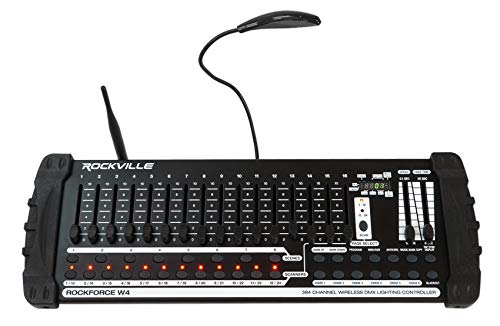
- 384-channel control for up to 24 lights
- Built-in 2.4GHz transmitter
- Scenes, chases, MIDI, and music sync
Best For: Professional and mobile operators managing programmed light shows
Best Large Receiver Bundle
CHINLY 8-Piece Wireless DMX System

- One transmitter with seven receivers
- 400-meter visible-distance range
- 126-channel hopping with seven ID groups
Best For: Large stage and party-light layouts with multiple DMX fixtures
Best Dual-Mode Console
384-Channel Wireless DMX Controller

- 384-channel DMX512 control for up to 12 intelligent lights
- 2.4G wireless and 3-pin XLR wired modes
- 30 banks and 240 programmable static scenes
Best For: DJs and indoor event stages needing flexible wireless or wired control
Best Wireless DMX Kit
2.4G Transmitter and Two Receivers

- Includes one transmitter and two receivers
- 126-channel frequency hopping for anti-interference performance
- Seven group IDs for separate lighting rigs
Best For: Mobile events needing quick, cable-free DMX distribution
Best Compact Controller
Portable 192-Channel DMX Console
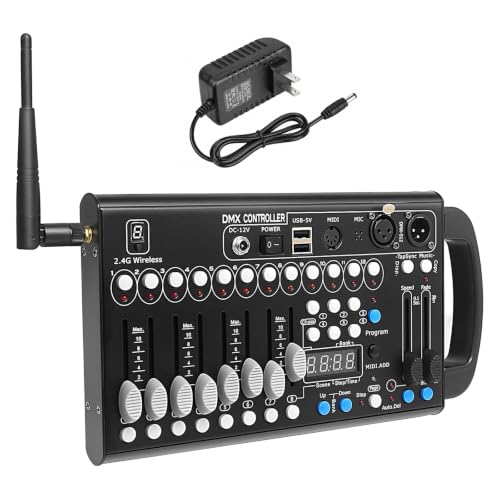
- 192 channels for up to 12 smart lights
- 240 scenarios across 23 banks
- MIDI, microphone, tap-sync, and automatic modes
Best For: DJs and small events using portable wired DMX control
Best Multi-Receiver Coverage
1 Transmitter, 7 Receivers Wireless DMX Kit

- Seven receivers included for multi-fixture setups
- Seven independent ID groups
- 126-channel frequency hopping
Best For: Larger stage, club, DJ, and event lighting layouts
Best for 500 m Wireless Links
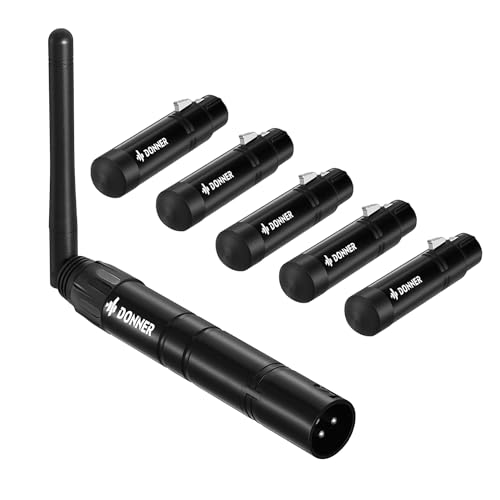
- 500 m visible-distance specification
- Five receivers plus one transmitter
- Seven groups and 126-channel frequency hopping
Best For: Longer-distance stage, disco, party, and bar lighting
Best Metal-Shell Option
Donner 7-Receiver DMX Controller Set
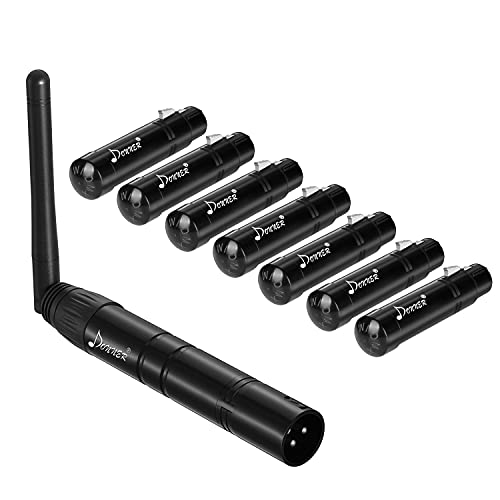
- Seven wireless ID groups
- 2.4 GHz GFSK communication
- Metal shell with 126-channel hopping
Best For: DMX512 stage, disco, party, and bar lighting systems
Best Compact Wireless DMX Kit – Lixada 2.4G DMX512 Controller
The Lixada DMX 512 Controller is a compact option for wireless dmx controllers when you need to connect lighting fixtures without long cable runs. It supports standard DMX512 data, automatic frequency hopping, adjustable output power, and multiple wireless network groups.
Best For: DJs, parties, discos, and small-to-medium lighting setups that need flexible wireless control.
Pros:
- Supports standard DMX512 wireless transmission with real-time signal delivery.
- 126 frequency channels and 16 selectable ID groups help reduce interference.
- Four power-rate settings provide flexibility for different operating conditions.
- Compact, lightweight design with an LCD display.
Cons:
- The supplied notes do not specify transmission distance or the number of supported receivers.
- Its compact controller format may offer less fixture-management capacity than a full lighting console.
Choose the Lixada when simple, cable-free DMX512 transmission and interference management matter more than advanced scene programming. Its adjustable power and group coding make it a practical fit for mobile entertainment setups.
Best Ready-to-Use Multi-Receiver System – JERRAY DMX512 Wireless Set
The JERRAY DMX512 Wireless Transmitter and Receivers Set is a convenient choice among wireless dmx controllers for users who want multiple fixtures connected out of the box. The package includes one transmitter and three receivers, with 2.4GHz operation, standard DMX512 compatibility, and real-time signal processing.
Best For: Stage, church, bar, and concert-hall setups requiring one transmitter to serve three receivers.
Pros:
- Complete 1-transmitter and 3-receiver package.
- Designed for long-range wireless DMX transmission in larger venues.
- Supports standard DMX512 equipment for broad fixture compatibility.
- Metal housings and external antennas are intended to support durability and signal reliability.
Cons:
- The supplied notes do not provide a specific transmission distance.
- It is a transmission system rather than a standalone console with built-in scene programming.
The JERRAY set makes sense when the main goal is distributing DMX512 wirelessly to several fixtures. Its included receivers reduce the need to assemble a system component by component.
Best Full-Featured Wireless Console – Rockville ROCKFORCE W4
The Rockville ROCKFORCE W4 is a substantial choice for wireless dmx controllers, combining a 384-channel lighting console with a built-in 2.4GHz transmitter. It offers programmable banks, scenes, chases, MIDI, music synchronization, manual override, and wired DMX connections for more involved event setups.
Best For: Professional or mobile lighting operators controlling multiple intelligent fixtures and programmed scenes.
Pros:
- 384 channels control up to 24 intelligent lights with 16 channels each.
- Includes 30 banks, 240 scenes, six chases, and 16 physical sliders.
- Wireless control supports up to seven groups and 25 receivers, with a stated 1,968-foot range.
- MIDI, music sync, manual override, wired DMX in/out, and rack-mountable construction add versatility.
Cons:
- At 20.7 inches wide and 6.2 pounds, it is less compact than simple wireless transmitter kits.
- The larger feature set may be more than needed for basic plug-and-play wireless DMX transmission.
For operators who need programming depth rather than just wireless signal conversion, the ROCKFORCE W4 is the strongest fit in this group. Its combination of wireless groups, scene storage, MIDI, and wired fallback supports demanding event workflows.
Best Large Receiver Bundle – CHINLY 8-Piece Wireless DMX System
The CHINLY 8-piece system is designed for wireless dmx controllers setups that need one transmitter and multiple receiver locations. It uses standard DMX512 over the 2.4GHz band, includes seven receivers, and provides automatic frequency hopping, selectable network groups, and a stated 400-meter visible-distance range.
Best For: Stage and party-light installations connecting several DMX fixtures across a broad, unobstructed area.
Pros:
- Includes one transmitter and seven receivers for extensive fixture coverage.
- Stated communication distance reaches 400 meters in visible conditions.
- 126 automatically hopping channels support interference resistance.
- Seven selectable ID groups allow separate wireless networks in the same location.
Cons:
- The listed range is specified for visible-distance conditions and may vary with obstacles.
- Built-in antennas may offer less placement flexibility than external-antenna designs.
- The supplied notes do not describe onboard scene or chase programming.
Pick the CHINLY bundle when receiver quantity and coverage are the priorities. It is especially useful for larger stage or party-light layouts where running DMX cable to every fixture would be inconvenient.
Best Dual-Mode Console – 384-Channel Wireless DMX Controller
Among wireless DMX controllers, this 384-channel console stands out for combining 2.4G wireless transmission with a traditional 3-pin XLR connection. Its faders, display, sound activation, MIDI support, and programmable scenes make it a flexible option for DJs and indoor event lighting.
Best For: DJs, weddings, bars, discos, churches, and small-to-medium indoor stage setups needing wireless or wired control.
Pros:
- Offers 384 channels and supports up to 12 intelligent lights.
- Provides both 2.4G wireless and 3-pin XLR wired operation.
- Stores 30 banks and 240 preset static scenes, with scene editing functions.
- Includes sound-activated, automatic, manual, and MIDI control modes.
Cons:
- Requires a 9V battery according to the supplied specifications.
- Its feature set may be more than needed for very simple lighting setups.
This is a strong all-around choice when you want a programmable lighting console with wireless flexibility but still need wired DMX compatibility as a backup or alternative.
Best Wireless DMX Kit – 2.4G Transmitter and Two Receivers
This three-piece wireless DMX kit is designed to replace XLR runs with a 2.4G transmitter-and-receiver system. With automatic frequency hopping, seven group IDs, and included power adapters, it is a practical option for quickly deploying compatible lighting rigs.
Best For: Mobile DJs, weddings, discos, and stage events where fast setup and multiple independent lighting groups matter.
Pros:
- Includes one transmitter and two receivers for connecting multiple lighting fixtures.
- Uses 126-channel automatic frequency hopping to help reduce interference and delay.
- Supports seven independent group IDs for separate lighting rigs.
- Includes power adapters for all three units.
Cons:
- The units are not battery-powered and require power adapters during operation.
- This is a wireless DMX transmission kit rather than a standalone lighting console with onboard scene programming.
Choose this system if your priority is simplifying DMX signal distribution. Its included receivers and group selection are especially useful for mobile setups that need repeatable, cable-free deployment.
Best Compact Controller – Portable 192-Channel DMX Console
For buyers comparing wireless DMX controllers with compact wired consoles, this 192-channel DMX board offers a portable control surface for DJ and stage lighting. It supports up to 12 smart lights, includes MIDI and sound activation, and provides extensive scene and chase programming.
Best For: DJs, bands, bars, clubs, house parties, and weddings using compatible DMX fixtures with 3-pin DMX cabling.
Pros:
- Controls up to 12 smart lights with 192 DMX channels.
- Provides 240 scenarios across 23 banks of eight scenarios.
- Includes six chases and allows multiple chases to run simultaneously.
- Supports built-in microphone activation, MIDI beat activation, tap synchronization, and automatic operation.
Cons:
- The supplied specifications identify it as corded electric rather than a wireless transmission system.
- It uses 3-pin DMX cabling, so a separate cable-based setup is required.
This controller is a sensible fit when portability and programmed show control are more important than eliminating DMX cables. Its scene, chase, MIDI, and audio-triggering features give smaller performances plenty of control options.
Best Multi-Receiver Coverage – 1 Transmitter, 7 Receivers Wireless DMX Kit
For buyers comparing wireless DMX controllers, this kit stands out when one transmitter needs to serve several lighting fixtures. It includes seven receivers, seven selectable ID groups, and 126 automatic frequency-hopping channels for flexible, cable-reducing stage, club, DJ, or event setups.
Best For: Multi-fixture lighting systems that need seven wireless receiver connections and independent group options.
Pros:
- Includes one transmitter and seven receivers.
- Supports seven independent ID groups.
- Uses 126 automatic frequency-hopping channels for anti-interference performance.
- Designed for plug-and-play connection between a controller and DMX fixtures.
Cons:
- The supplied notes do not specify an exact operating distance.
- It requires powered transmitter and receiver units; battery operation is not listed.
This is a practical choice for larger wireless DMX layouts where receiver count matters most. Its group selection and frequency hopping add flexibility, while the included seven receivers reduce the need to purchase expansion units separately.
Best for 500 m Wireless Links – Donner 5-Receiver DMX Kit
Among wireless DMX controllers, this Donner set is a useful option for installations that need a stated long-distance connection. The package pairs one transmitter with five receivers and supports standard DMX512 data, seven wireless groups, and 126-channel automatic frequency hopping.
Best For: Stage, disco, party, bar, and LED lighting setups requiring up to five wireless receivers and a listed 500 m visible-distance range.
Pros:
- Lists a communication distance of 500 m in visible conditions.
- Includes one transmitter and five receivers.
- Offers seven selectable wireless ID groups.
- Uses 126 automatic jumping-frequency channels and is described as having no transmission delay.
Cons:
- Receivers do not have built-in batteries and need a power adapter during operation.
- Compatible only with devices marked for DMX512.
- Provides five receivers, fewer than the seven-receiver kits in this roundup.
The stated 500 m visible-distance specification makes this set especially relevant for spacious venues. Confirm that every fixture is DMX512-compatible and plan power access for each receiver before installation.
Best Metal-Shell Option – Donner 7-Receiver DMX Controller Set
This Donner set is one of the more substantial wireless DMX controllers for buyers who want a metal-black-shell system with seven selectable wireless groups. It uses 2.4 GHz ISM-band communication, GFSK modulation, and 126 automatic frequency-hopping channels to transmit standard DMX512 data in real time.
Best For: DMX512 stage, disco, party, and bar lighting systems that need a metal-shell transmitter/receiver setup with seven-group networking.
Pros:
- Supports seven individual wireless ID groups.
- Uses 2.4 GHz ISM communication with GFSK modulation.
- Provides 126 automatic frequency-hopping channels and real-time data transmission.
- Metal black shell offers a sturdier housing than an unspecified plastic enclosure.
Cons:
- Receivers require power adapters because they have no built-in batteries.
- It only supports devices marked DMX512.
- The supplied specifications contain conflicting package details, listing seven receivers in the title but three receivers under included components.
This model offers useful interference-management features and a durable-looking metal housing, but buyers should verify the actual receiver count with the seller before ordering. That detail is important because the listing information is inconsistent.
How We Picked the Best Wireless Dmx Controllers
We compared these Wireless Dmx Controllers by looking at the features that matter during real installations and live shows: DMX channel capacity, 2.4GHz transmission, transmitter and receiver quantities, stated range, wired and wireless operating modes, MIDI or sound-activation support, portability, and compatibility with common DMX lighting fixtures.
Because product specifications can vary by seller and revision, verify connector type, channel limits, included accessories, and fixture compatibility before ordering. A wireless adapter cannot correct an incorrect DMX address, overloaded universe, or incompatible signal chain.
Quick Comparison
| Setup type | Best fit | What to prioritize |
|---|---|---|
| Compact single-console setup | Small DJ rigs and mobile performers | Portability, simple controls, and enough channels |
| Multi-fixture wireless system | Stages, venues, and installations | Receiver count, grouping, range, and stable pairing |
| Hybrid wired/wireless control | Users needing backup connectivity | Dual-mode operation and conventional DMX ports |
| Performance-oriented console | DJs and lighting operators | MIDI, sound activation, faders, and scene control |
Key Buying Factors for Wireless Dmx Controllers
Channel Capacity
Choose capacity based on the total channels used by your fixtures, not simply the number of lights. A basic PAR may use a few channels, while moving heads, pixel fixtures, and effects can consume many more. Leave headroom for future expansion.
Transmitter and Receiver Quantity
A transmitter sends the console signal, while receivers connect to individual fixtures or fixture groups. Multi-receiver bundles can reduce extra purchases for distributed rigs. Confirm whether each receiver supports the same frequency, ID, and DMX mode as the transmitter.
Range, Interference, and Pairing
Most products in this category use the 2.4GHz band. Advertised range is measured under favorable conditions, so walls, metal structures, Wi-Fi traffic, and crowded venues may reduce performance. Look for clear pairing or group-ID controls and test the system at show distance before relying on it.
Wired Fallback and Control Features
Dual-mode controllers are useful when wireless conditions are unpredictable or when a venue requires a conventional DMX connection. MIDI support benefits users triggering scenes from keyboards or software, while sound activation can help with simple automated DJ lighting.
Connectors and Fixture Compatibility
Check whether the system uses 3-pin or 5-pin DMX connectors, whether adapters are included, and whether the fixture chain requires termination. Wireless transmission does not remove the need for correct DMX addressing and signal practices.
Who Should Buy Which Wireless Dmx Controllers?
For Mobile DJs and Small Parties
Choose a compact controller with straightforward faders, sound activation, or MIDI support. A smaller channel count may be preferable when portability and quick setup matter more than advanced programming.
For Larger Stages and Venues
Prioritize higher channel capacity, multiple receivers, adjustable grouping, and dependable range. A kit with one transmitter and several receivers can be more practical than buying separate wireless links for each fixture.
For Flexible Professional Setups
Select a dual-mode controller that supports both wired and wireless DMX. This gives you a backup connection and makes the system easier to integrate into existing venue infrastructure.
For Buyers Expanding Later
Choose a system with spare channels, expandable receiver support, and clearly documented pairing settings. Confirm replacement receiver availability before committing to a proprietary wireless ecosystem.