
The right DMX controller can turn a collection of stage lights into a coordinated, repeatable show. Whether you need simple fixture control for a DJ setup or deeper programming for a venue, the best choice depends on channel count, scene storage, connectivity, and workflow.
Our roundup covers compact 192-channel boards, larger 384-channel consoles, computer-assisted systems, MIDI-compatible options, and wireless DMX solutions. Use the guide below to narrow the field based on your fixtures, venue, and experience level.
Best 10 Dmx Controllers Picks for 2026
Best Value 192-Channel Board
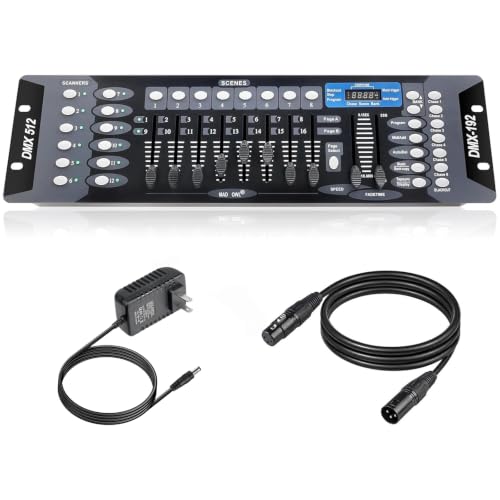
- Controls up to 12 fixtures with 192 channels
- Stores scenes and six programmable chases
- Includes DMX cable and rack-mountable metal housing
Best For: Small to mid-sized stage and DJ lighting setups
Best Feature Set

- Controls 12 fixtures across 192 DMX channels
- Stores 240 scenes and six chase sets
- Adds fog, strobe, MIDI, and reversible-slider control
Best For: Complex DJ and stage setups with integrated effects
Best Compact 384-Channel Option

- Provides 384 channels for detailed control
- Stores 30 banks of eight programmable scenes
- Includes side handles and an LED gooseneck light
Best For: Portable club, bar, and live-show lighting consoles
Best for MIDI and Music Mode

- Controls up to 24 fixtures with 384 channels
- Adds MIDI and built-in microphone music mode
- Includes programmable scenes, chases, and universal power
Best For: DJs and venues needing MIDI or sound-responsive lighting
Best Standalone Pick

- Standalone DMX control
- Supports up to four universes
- 37 buttons and four encoders
Best For: Hands-on control of larger lighting setups
Best Wireless Extension
Donner DMX512 Wireless Controller
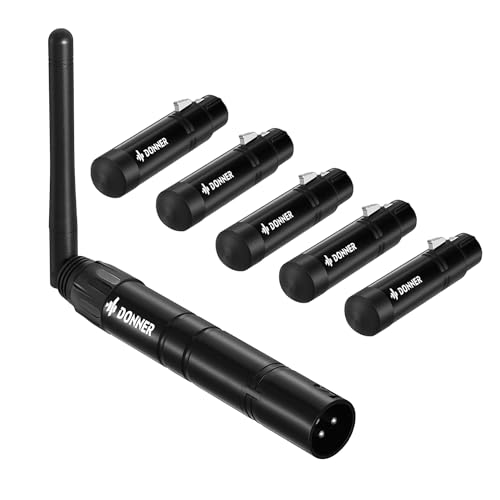
- One transmitter with five receivers
- Seven selectable wireless groups
- Up to 500 m visible-distance range
Best For: Cable-free DMX512 links for compatible stage fixtures
Best for DJ Software Integration

- Two DMX universe inputs and outputs
- Engine DJ plug-and-play support
- Tactile controls for live lighting effects
Best For: DJs syncing customized lighting to performances
Versatile Pick
CO-Z 192-Channel DMX Controller

- Controls up to 12 intelligent lights
- Stores up to 240 scenes
- Voice control and 3-pin compatibility
Best For: DJs and small event lighting setups
Wireless Upgrade

- 384-channel DMX512 control
- 2.4G wireless and wired modes
- Sound, auto, manual, and MIDI control
Best For: Flexible DJ and indoor stage setups
Programming Pick
DMX512 192-Channel Lighting Console

- Programs scenes with up to 40 steps
- Adjustable pause and fade timing
- Voice control and 3-core XLR output
Best For: Custom stage scenes and lighting transitions
Best Value 192-Channel Board – Programmable DMX Controller
This 192-channel DMX controller is a practical choice for stage and DJ setups that need hands-on control without moving to a larger console. It can manage up to 12 fixtures with 16 channels or fewer and includes a 6.6-foot DMX cable.
Best For: Small to mid-sized stages, clubs, and performance venues using up to 12 compatible fixtures.
Pros:
- Controls 192 channels across up to 12 fixtures.
- Stores 23 banks of eight programmable scenes.
- Supports six programmable chases with up to 240 steps.
- Includes a 6.6-foot DMX cable and rack-mountable metal housing.
Cons:
- Limited to fixtures with 16 channels or fewer.
- Offers fewer banks than some comparable 384-channel controllers.
Choose this model if you want straightforward fader-and-button control and enough programming capacity for a typical smaller lighting rig.
Best Feature Set – CHAUVET DJ OBEY40 Controller
The CHAUVET DJ OBEY40 is a versatile DMX controller for users who need scene storage, chase playback, and extra effect controls. Its 192 channels support up to 12 fixtures with as many as 16 channels each.
Best For: More complex DJ, stage, and fog-machine lighting systems that benefit from MIDI and dedicated effect controls.
Pros:
- Controls up to 12 fixtures and 192 DMX channels.
- Provides 30 banks with eight scenes each, for up to 240 scenes.
- Includes six chase sets and fog and strobe controls.
- Offers MIDI compatibility and reversible sliders.
Cons:
- Heavier than the 192-channel alternative at 6.7 pounds.
- Its feature set may be more than needed for very simple lighting rigs.
With extensive scene storage and MIDI integration, the OBEY40 is a strong fit when your lighting show requires organized playback and broader effect management.
Best Compact 384-Channel Option – DMX512 DJ Controller
This 384-channel DMX controller gives lighting operators expanded capacity for bar, club, and live-show programming. It combines 30 banks of eight scenes with a compact console design, LED gooseneck light, and side handles.
Best For: Live performances and club lighting systems that need 384 channels and extensive scene programming in a portable console.
Pros:
- Provides 384 DMX channels for detailed lighting control.
- Offers 30 banks with eight programmable scenes each.
- Compact, lightweight design includes protective side handles.
- LED gooseneck light supports operation in darker environments.
Cons:
- The supplied notes do not specify the maximum number of fixtures.
- Does not list MIDI, fog, or music-triggered control features.
This controller is worth considering when channel capacity and scene organization matter more than specialized integrations or automatic music modes.
Best for MIDI and Music Mode – Rockville ROCKFORCE 384
The Rockville ROCKFORCE is a 384-channel DMX controller designed for larger intelligent-lighting rigs. Along with scene and chase programming, it adds MIDI control, a built-in microphone for music-triggered modes, and a universal power supply.
Best For: DJs, clubs, and stages controlling up to 24 intelligent lights with MIDI or music-responsive operation.
Pros:
- Controls up to 24 fixtures with 16 channels each.
- Stores 30 banks of eight scenes and six programmable chases.
- Includes MIDI control and a built-in microphone for music mode.
- Features a metal housing, LED display, gooseneck lamp, and 110–240V power support.
Cons:
- Its larger feature set may require more setup than a basic controller.
- Does not include the dedicated fog and strobe controls listed for the CHAUVET model.
For operators who want high channel capacity plus MIDI and sound-responsive options, the ROCKFORCE offers a flexible control center for expanded lighting systems.
Best Standalone Pick – ADJ WMX1 Mk2
The ADJ WMX1 Mk2 is a strong choice among DMX controllers for users who want hands-on control without relying on a computer. Its 37 backlit silicone buttons, four rotary encoders, and support for up to four universes suit more involved lighting setups.
Best For: DJs, performers, and lighting operators who need a standalone controller with multiple-universe support.
Pros:
- Standalone operation for direct lighting control
- Supports up to four DMX universes
- 37 backlit buttons and four rotary encoders provide tactile control
- Includes four output sockets
Cons:
- Its larger feature set may be more than needed for simple lighting rigs
- Does not include wireless operation in the supplied specifications
Choose the WMX1 Mk2 if you value physical controls and room to expand. At 2.36 pounds and measuring 10 x 9.25 x 3.5 inches, it remains reasonably portable while offering substantial control capacity.
Best Wireless Extension – Donner DMX512 Wireless Controller
The Donner DMX512 Wireless Controller is a practical option for extending DMX lighting control without running signal cables. This six-piece kit includes one transmitter and five receivers, with support for seven separate wireless groups and a stated communication distance of up to 500 meters in visible conditions.
Best For: Stage, disco, party, and bar lighting installations using compatible DMX512 equipment.
Pros:
- Includes one transmitter and five receivers
- Seven selectable wireless network groups
- 126-channel frequency hopping helps support reliable communication
- Transmits standard DMX512 data wirelessly
Cons:
- Requires power adapters because the units have no built-in battery
- Compatible only with devices marked for DMX512 use
- Wireless performance depends on visible-distance conditions and the installation environment
This kit is best viewed as a wireless DMX link rather than a standalone lighting console: the transmitter sends DMX512 data generated by a console. It is a convenient way to reduce cable runs when your fixtures and control system are compatible.
Best for DJ Software Integration – SoundSwitch Control One
The SoundSwitch Control One stands out among DMX controllers for DJ-focused lighting workflows. It provides 1:1 control for SoundSwitch software, two DMX universe inputs and outputs, tactile performance controls, and direct compatibility with Engine DJ devices for computer-free operation.
Best For: DJs and performers who want to trigger, adjust, and customize lighting alongside music.
Pros:
- Offers two DMX universe inputs and outputs with a thru option
- Works directly with compatible Denon DJ and Numark Engine DJ hardware
- Includes a touch strip, encoders, and customizable RGB performance pads
- Supports live audio BPM detection with external audio sources
Cons:
- Many software-based features depend on SoundSwitch or compatible DJ hardware
- PRO DJ LINK Bridge use requires a laptop running SoundSwitch
- It is designed around DJ and performance workflows rather than broad standalone console use
Control One is a focused choice for music-synchronized lighting. Its combination of tactile controls, two-universe connectivity, and support for effects such as color, brightness, strobe, moving heads, and gobos makes it well suited to live performance control.
Versatile Pick – CO-Z 192-Channel DMX Controller
The CO-Z 192 DMX controller is a practical choice for DJs, small venues, and event setups that need hands-on control over multiple fixtures. It supports up to 12 intelligent lights with up to 16 channels each, plus up to 240 scenes for building more involved shows.
Best For: DJs, weddings, church gatherings, family events, and small stage-lighting systems.
Pros:
- Controls up to 12 fixtures and 192 channels.
- Stores up to 240 scenes for customized lighting shows.
- Includes a 3-pin connection for compatible fog machines and other fixtures.
- Organized control layout and voice control support make operation approachable.
Cons:
- Limited to 192 channels.
- Uses corded electric power rather than wireless operation.
- Its 3.9-pound console may require dedicated placement.
With clearly separated control sections, upgraded buttons, and precision control sticks, this is one of the more approachable dmx controllers for users who want programmable scenes without an overly complicated setup.
Wireless Upgrade – DMX512 384-Channel Controller
This 384-channel DMX controller adds wireless flexibility to a conventional lighting console. Its 2.4G wireless and 3-pin wired modes, sound activation, MIDI support, and programmable scene banks make it a strong option for DJs and indoor stage applications.
Best For: Weddings, bars, discos, live stages, banquet halls, churches, and users who want wireless or wired control.
Pros:
- Provides 384 channels for control of up to 12 intelligent lights.
- Supports both 2.4G wireless transmission and 3-pin XLR wired connections.
- Offers sound-activated, automatic, manual, and MIDI control modes.
- Stores 30 banks and 240 preset static scenes.
Cons:
- Requires a 9V battery according to the supplied details.
- Wireless performance may depend on the venue and layout.
- Its broader feature set may take longer for beginners to learn.
Among these dmx controllers, this model stands out for connection flexibility and expanded channel capacity. Choose it when wireless placement, rhythm-based effects, or MIDI integration matters as much as traditional fader control.
Programming Pick – DMX512 192-Channel Lighting Console
This 192-channel DMX console focuses on accessible programming and detailed scene timing. It controls up to 12 fixtures, supports up to 240 scenes, and lets users create scenes with up to 40 steps and adjustable pause and fade speeds.
Best For: Amateur users, DJs, event organizers, and stage setups needing customized lighting transitions.
Pros:
- Controls up to 12 intelligent lights with up to 16 channels each.
- Programs up to 40 steps per scene with adjustable timing.
- Includes voice control and a 3-core XLR DMX512 output.
- Upgraded buttons and control sticks support smooth operation.
Cons:
- Does not list wireless connectivity.
- Channel capacity is lower than the 384-channel alternative.
- Its many timing controls may require practice to master.
This model is a good fit for buyers who want more control over transitions than a basic scene-based console provides. The organized layout and programmable step timing make it a capable choice for repeatable shows and custom lighting sequences.
How We Picked the Best Dmx Controllers
We focused on the features that matter most in real lighting setups: DMX channel capacity, fixture and scene support, programming controls, live-access usability, connectivity, and compatibility with common DJ and stage lights. We also considered whether each controller is better suited to basic manual operation, programmed shows, MIDI integration, or wireless installations.
Because product specifications and included accessories can vary, confirm the exact channel count, connector type, wireless receiver compatibility, and software requirements before buying. A controller with more channels is not automatically better if your fixtures and show style are simple.
Quick Comparison
- For basic DJ lighting: A 192-channel controller is often enough for a small collection of par cans, moving heads, strobes, or fog machines.
- For larger programmed shows: A 384-channel model provides more room for fixtures, banks, scenes, and complex cue layouts.
- For computer-based control: SoundSwitch Control One is designed for users who want software-assisted lighting synchronized with DJ performance.
- For MIDI workflows: The Rockville ROCKFORCE 384 and compatible MIDI-equipped models can fit more advanced performance rigs.
- For fewer cables: Wireless DMX systems can simplify setup, but all fixtures must support the chosen wireless ecosystem or use compatible receivers.
- For portable operation: Compact standalone boards are practical when you want to program and run shows without a laptop.
Key Buying Factors for Dmx Controllers
Channel and Fixture Capacity
Match the controller to the number of DMX channels your fixtures actually use. A fixture may require several channels for dimming, color, movement, gobo selection, and effects. Leave some headroom for future additions rather than buying exactly to today’s count.
Programming and Live Control
Look for banks, scenes, chases, faders, and dedicated fixture buttons that match your operating style. Scene-based boards work well for repeatable shows, while direct-access controls are useful when you need to adjust lights quickly during a performance.
Connectivity and Compatibility
Check whether the controller uses standard 3-pin or 5-pin DMX connections and whether adapters are needed. If you plan to control fog machines, moving heads, or specialty fixtures, verify that the console can address their required channel profiles.
Wireless, MIDI, and Software Features
Wireless DMX is convenient for temporary installations and difficult cable runs, but wired DMX remains a dependable choice for permanent or high-interference environments. MIDI and software integration are valuable when lighting cues need to follow music, a DJ set, or another performance system.
Who Should Buy Which Dmx Controllers?
Choose a 192-channel board if you are a beginner, mobile DJ, or small-venue operator with a modest fixture inventory. Choose a 384-channel controller if you run multiple moving heads, need more scenes and banks, or expect your rig to grow.
Choose a wireless model for fast setup and reduced cable clutter, provided your fixtures support the required receivers. Choose a MIDI- or software-compatible controller if you want lighting to respond closely to music or an established production workflow. For the most dependable results, prioritize clear controls, adequate channel headroom, and compatibility with every fixture in your rig.