
Digitizing a box of family prints—or creating high-resolution files from slides and negatives—starts with choosing a scanner suited to the job. The best photo scanners balance image quality, scanning speed, size flexibility, software, and ease of use.
We compare 10 options ranging from compact flatbeds and affordable photo scanners to high-volume models designed for large archives. Use the guide below to narrow the field based on your media, workflow, and budget.
Best 10 Photo Scanners Picks for 2026
Best High-Speed Photo Scanner

- Scans photos at up to one per second at 300 dpi
- Batch-scans up to 36 photos and captures backsides
- Includes enhancement tools, Wi-Fi, and OCR
Best For: Large photo collections and family archiving
Best Simple Flatbed Photo Scanner

- Offers optical resolution up to 2400 x 2400 dpi
- Auto Scan Mode detects the item being scanned
- Works with photos, receipts, business cards, and documents
Best For: Occasional home scanning and individual photos
Best Fast Photo Feeder

- Scans 4 x 6 photos in about two seconds at 300 dpi
- Supports common photo sizes through 8 x 10 inches
- Adds automatic cropping, deskewing, and image enhancement
Best For: Quickly digitizing stacks of standard-size prints
Best Professional Photo Scanner
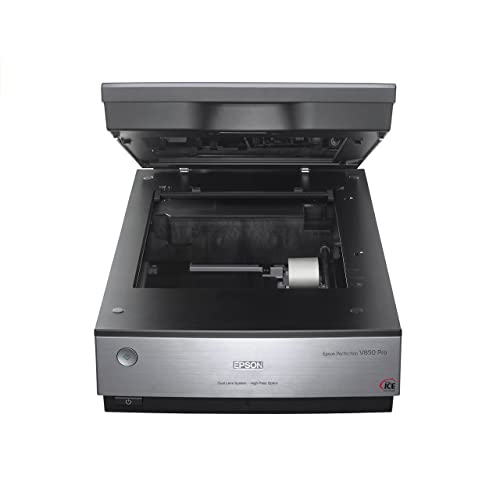
- Provides 6400 dpi scanning and a 4.0 Dmax tonal range
- Uses a dual-lens system for optimized results
- Includes CCD imaging and Digital ICE technology
Best For: Professional photo work and detailed archival scans
Best Standalone Film Converter
DigitPro Photo, Slide & Negative Scanner

- Converts slides, negatives, photos, and business cards
- Operates without a computer or installed software
- Includes a 5-inch screen and 8GB SD card
Best For: Easy offline digitizing of film and printed memories
Best High-Resolution Flatbed

- Scans at up to 4800 x 4800 dpi
- Slim design with USB Type-C power and data
- Includes color restore and dust-removal tools
Best For: Detailed scanning of individual photos and documents
Best for Film and High-Resolution Enlargements

- 6400 x 9600 dpi resolution
- Scans slides, negatives, and medium-format film
- Includes Digital ICE restoration tools
Best For: Film scanning and detailed photo enlargements
Best for Fast Photo Organization

- Scans photos at 300 or 600 dpi
- Supports several print sizes and panoramas
- Includes cleaning kit and organization software
Best For: Quickly digitizing and organizing printed photos
Best Compact Flatbed Value

- 4800 dpi optical resolution
- USB-powered, lightweight, and compact
- Scans photos, documents, books, and artwork
Best For: Everyday photo and document scanning in small spaces
Best High-Speed Photo Scanner – Epson FastFoto FF-680W
If you have boxes of prints to digitize, the Epson FastFoto FF-680W is one of the most capable photo scanners in this roundup. It can batch-scan up to 36 photos and scan a photo in about one second at 300 dpi, while duplex scanning captures handwritten notes on the back in the same pass.
Best For: Large photo collections, family archiving, and users who also need document scanning with OCR.
Pros:
- High-speed batch scanning for up to 36 photos
- Handles photos up to 8 x 10 inches, including Polaroids, panoramas, and postcards
- Automatic enhancement, color restoration, red-eye reduction, cropping, rotation, and de-skewing
- Wi-Fi and USB connectivity plus Dropbox and Google Drive backup options
Cons:
- Bulkier and heavier than simpler flatbed models
- Its automatic document feeder has a listed standard capacity of 10 sheets
The FF-680W is the practical choice when speed and workflow matter more than compact size. Its flexible resolution settings, mobile support, and document features make it useful beyond photo preservation.
Best Simple Flatbed Photo Scanner – Canon CanoScan LiDE 300
The Canon CanoScan LiDE 300 is a straightforward USB photo scanner for digitizing individual photos, documents, receipts, and business cards. Its Auto Scan Mode detects what you place on the scanner, making routine scans simple without a complicated setup.
Best For: Casual home scanning, individual photos, and users who prefer a slim USB flatbed design.
Pros:
- Optical resolution up to 2400 x 2400 dpi
- Auto Scan Mode automatically identifies the scanned material
- Supports photos, receipts, business cards, and paper documents
- Compact 1.7-inch height and low 4.5-watt power specification
Cons:
- Scans one item at a time
- USB connectivity does not offer wireless placement flexibility
The LiDE 300 is a sensible pick for occasional scanning rather than large-scale photo projects. It keeps the process familiar and supports a useful range of everyday media.
Best Fast Photo Feeder – Plustek ePhoto Z300
The Plustek ePhoto Z300 is designed for quickly feeding individual prints through a dedicated photo scanner. It scans a 4 x 6 photo in about two seconds at 300 dpi, supports several common photo sizes, and includes automatic cropping and deskewing.
Best For: Users digitizing a large stack of standard-size photos without using a traditional flatbed scanner.
Pros:
- Scans 4 x 6 photos in about two seconds at 300 dpi
- Supports 3 x 5, 4 x 6, 5 x 7, and 8 x 10 photos plus letter and A4 paper
- Automatic crop and deskew functions simplify processing
- Compatible with Windows and Mac computers
Cons:
- Requires inserting photos one at a time
- USB connection rather than wireless connectivity
- Resolution settings are limited to 300 or 600 dpi
The ePhoto Z300 strikes a useful balance between speed and simplicity. It is more focused than a general flatbed, making it attractive for straightforward print digitization and basic image restoration.
Best Professional Photo Scanner – Epson Perfection V850 Pro
The Epson Perfection V850 Pro is built for users who prioritize scan quality and fine detail. Its 6400 dpi resolution, 4.0 Dmax tonal range, dual-lens system, and Digital ICE technology are aimed at producing smooth gradations and detailed results from photo originals.
Best For: Photographers, serious enthusiasts, and archival work where maximum image detail is more important than scanning speed.
Pros:
- 6400 dpi resolution for high-detail scans
- 4.0 Dmax supports tonal range and shadow detail
- Dual-lens system selects the appropriate lens for the scan
- CCD sensor and Digital ICE support quality-focused photo scanning
Cons:
- Large and heavy at 20.9 pounds
- USB-only connectivity
- More specialized than necessary for basic everyday scanning
The V850 Pro is the quality-first option in this group. Its professional-oriented imaging specifications make it a strong fit for demanding photo work, though its size and specialized design are best suited to a dedicated workspace.
Best All-Around Feeder – Canon imageFORMULA RS40
For shoppers comparing photo scanners that can handle more than occasional snapshots, the Canon imageFORMULA RS40 combines an automatic feeder with photo and document support. It can scan both sides at once, handle varied media sizes, and work with Windows or Mac.
Best For: Families and home offices digitizing batches of photos, receipts, cards, and documents.
Pros:
- Scans up to 40 items per minute through its automatic feeder.
- Handles photos, Polaroids, receipts, cards, driver licenses, and tax documents.
- Bundled software includes photo enhancement, red-eye correction, and face smoothing.
- Supports JPG, TIF, BMP, PNG, PDF, and PPTX output formats.
Cons:
- Uses a USB connection rather than wireless connectivity.
- Its automatic feeder design is less focused on single, flatbed-style scanning.
The RS40 is a practical pick when speed and media flexibility matter more than compact size. Its feeder and included enhancement tools make it especially useful for larger photo collections and mixed household paperwork.
Best Standalone Film Converter – DigitPro Photo, Slide & Negative Scanner
This photo scanner is designed for shoppers preserving older film and printed memories without setting up a computer. The standalone DigitPro converts slides, 135 and 110 negatives, printed photos, and business cards, then saves the results to an SD card.
Best For: Beginners and families digitizing slides, negatives, and small printed-photo collections.
Pros:
- Works without a computer, apps, or drivers.
- Includes a large 5-inch HD viewing screen for previewing and editing.
- Supports 35mm slides, 135 and 110 negatives, 3R/4R/5R photos, and business cards.
- Bundle includes an 8GB SD card, holders, trays, cleaning brush, and USB cable.
Cons:
- Stores scans on an SD card, so transfers require moving files to another device.
- Its listed media focus is narrower than a general document scanner.
The DigitPro stands out for simple, offline operation and broad film-format support. Its included accessories and large screen make it a convenient choice for users who want to start converting family archives with minimal technical setup.
Best High-Resolution Flatbed – Canon CanoScan LiDE 400
Canon CanoScan LiDE 400 Slim Scanner, 7.7" x 14.5" x 0.4", Document & Photo Scanner, Black
Check Price On AmazonFor buyers who want a slim photo scanner for detailed individual images, the Canon CanoScan LiDE 400 offers 4800 x 4800 dpi resolution in a compact flatbed-style design. It connects and powers through USB Type-C and includes enhancement features for restoring the look of older photos.
Best For: Users scanning individual photos and letter-size documents with an emphasis on resolution and compact storage.
Pros:
- Provides 4800 x 4800 dpi resolution and 48-bit color depth.
- Scans in as fast as 8 seconds according to the supplied specifications.
- Includes color restore, dust removal, auto scan mode, and EZ buttons.
- Built-in PDF buttons support editable and searchable multi-page PDFs.
Cons:
- Its standard sheet capacity is one, so it is not intended for batch feeding.
- Uses USB connectivity and requires a computer for operation.
The LiDE 400 is a strong fit for detail-oriented scanning rather than high-volume work. Its slim profile, high resolution, and restoration tools make it appealing for preserving selected photos and documents one at a time.
Best for Film and High-Resolution Enlargements – Epson Perfection V600
For shoppers comparing photo scanners for film, slides, and detailed enlargements, the Epson Perfection V600 is a versatile flatbed option. Its 6400 x 9600 dpi maximum resolution, built-in transparency unit, and Digital ICE dust and scratch removal support high-resolution digitizing of prints and film.
Best For: Digitizing 35mm slides, negatives, medium-format film, and photos when maximum detail and restoration tools matter.
Pros:
- Scans 35mm slides, negatives, medium-format film, photos, and documents.
- 6400 x 9600 dpi resolution supports enlargements up to 17 x 22 inches.
- Digital ICE, Easy Photo Fix, and ArcSoft PhotoStudio support restoration and enhancement.
- ReadyScan LED technology avoids warm-up time and uses less power.
Cons:
- Wired USB 2.0 connectivity may feel less convenient than newer wireless options.
- The larger flatbed design takes more desk space than compact photo scanners.
The V600 is the strongest choice here for mixed photo and film collections, especially if you plan to create large prints or restore aging originals. Its capabilities are broader than those of a basic print-only scanner, though the flatbed format is less portable.
Best for Fast Photo Organization – AMBIR Photo Scanner Bundle
This AMBIR is a practical pick among photo scanners for quickly digitizing loose prints and organizing them afterward. It scans common photo sizes from 1 x 1 inches through 8 x 10 inches, plus panoramic images up to 12 inches, and includes a cleaning kit and photo-management software.
Best For: Families and hobbyists who want fast print scanning, basic restoration, and an organized digital photo library.
Pros:
- Offers 300 dpi and 600 dpi scanning modes.
- Handles multiple photo sizes, including panoramic images up to 12 inches.
- Software provides auto-cropping, deskewing, enhancement, restoration, and album tools.
- Includes a blower, microfiber cloth, anti-static brush, and protective carrier sheet.
Cons:
- Maximum resolution is lower than the Epson V600 and V19 II.
- Designed for photos rather than slides, negatives, or medium-format film.
The AMBIR bundle stands out for convenience rather than extreme resolution. Its included cleaning accessories and Picture Studio software make it especially useful for a large print collection that needs scanning, light editing, and organization in one workflow.
Best Compact Flatbed Value – Epson Perfection V19 II
The Epson Perfection V19 II is a compact choice for shoppers seeking photo scanners that can also handle everyday documents. With 4800 dpi optical resolution, one-touch buttons, color restoration, and USB power, it offers a straightforward setup for home photo and document scanning.
Best For: Home users who want a lightweight, space-saving scanner for photos, artwork, books, and letter-sized documents.
Pros:
- 4800 dpi optical resolution provides detailed photo scans and enlargements.
- Easy Photo Fix can restore color to faded photos with one click.
- USB-powered design weighs 3.1 pounds and includes a built-in kickstand.
- ScanSmart supports searchable PDFs and OCR conversion to editable Office files.
Cons:
- Does not include dedicated holders or a transparency unit for slides and negatives.
- Its single-sheet capacity is better suited to individual scans than batch work.
The V19 II is a well-rounded everyday model when compact storage and simple controls are priorities. It is more versatile for documents than the AMBIR, but film-focused users should consider the V600 instead.
How We Picked the Best Photo Scanners
We selected these Photo Scanners to cover the most common digitizing needs: scanning loose prints, processing large photo collections, capturing documents, and preserving slides or negatives. We considered optical resolution, scanning speed, supported media sizes, automatic feeding, software features, connectivity, and ease of use. The lineup includes flatbed models for careful, flexible scanning and sheet-fed options for faster batch work.
Advertised resolution is only one part of the decision. A scanner’s sensor, color handling, dust and scratch correction, software, and ability to keep photos aligned can have a greater effect on practical results.
Quick Comparison
- Best for large photo collections: Epson FastFoto FF-680W
- Best for quick 4-by-6-inch prints: Plustek ePhoto Z300
- Best for premium photo and film work: Epson Perfection V850 Pro
- Best for mixed documents and photos: Canon imageFORMULA RS40
- Best compact budget flatbeds: Canon CanoScan LiDE 300, LiDE 400, and Epson Perfection V19 II
- Best for slides and negatives: the dedicated photo, slide, and negative scanner
Key Buying Factors for Photo Scanners
Scanner Type and Workflow
Flatbed scanners are the most versatile choice because they handle delicate, thick, oddly shaped, or fragile originals without feeding them through rollers. Sheet-fed models are faster for stacks of loose prints and documents, but they require clean, reasonably flat media and careful loading.
Resolution and Detail
For ordinary reprints and sharing, 300 to 600 dpi is usually sufficient. Higher optical resolution is more useful when enlarging small originals, scanning film, or retaining fine detail for restoration. Avoid choosing solely by an inflated interpolated-resolution number.
Media Support and Color Correction
Check whether the scanner supports the sizes and formats you actually own. If you have slides or negatives, select a model with dedicated film holders and transmission scanning. Dust, scratch, fading, and color-correction tools can also reduce editing time, although no software fully replaces careful preparation.
Speed, Feeding, and Connectivity
For an archive, compare the time per photo and whether automatic feeding, cropping, deskewing, and duplex document scanning are available. USB is common and reliable; Wi-Fi can make shared household workflows more convenient. Confirm operating-system compatibility before buying.
Who Should Buy Which Photo Scanners?
Choose the Epson FastFoto FF-680W if speed and batch scanning are your priorities. The Plustek ePhoto Z300 suits users who mainly have standard 4-by-6-inch prints and want simple automatic processing. Pick the Canon imageFORMULA RS40 when photos and everyday documents share the same workload.
For maximum control, enlargements, or film scanning, consider the Epson Perfection V850 Pro or Epson Perfection V600. Compact flatbeds such as the Canon LiDE 300, Canon LiDE 400, and Epson V19 II are sensible for occasional home use and limited desk space. Finally, choose the dedicated slide-and-negative model if film is central to your project rather than an occasional extra.