
Unstable venue power can create hum, startup surges, and unnecessary risk for mixers, amplifiers, wireless systems, and other live-sound equipment. The right rack-mounted conditioner can organize connections while adding useful monitoring and power-control features.
We selected 10 stage power conditioners for live sound across professional and budget-focused setups, emphasizing outlet capacity, sequencing, protection features, rack fit, and practical operation on stage.
Best 10 Stage Power Conditioners for Live Sound Picks for 2026
Best Overall
Radial Power-2 Power Conditioner

- Nine outlets with noise filtering and surge protection
- 15-amp capacity with one USB port
- LED illumination and two-year warranty
Best For: Live sound rigs needing protected, visible power distribution
Best Power Sequencer

- Ten outlets with two always-on front outlets
- 1U rack mount with voltage readout
- Up to 3100 watts and 13 amps
Best For: Compact racks needing outlet sequencing and accessible connections
Best Outlet Capacity
Radial Power-1 Power Conditioner

- Eleven outlets for larger equipment setups
- Noise filtering and surge protection
- Stainless-steel construction at 7.55 pounds
Best For: Rigs prioritizing maximum stated outlet capacity
Best Zonal Control
Monoprice Stage Right Power Conditioner
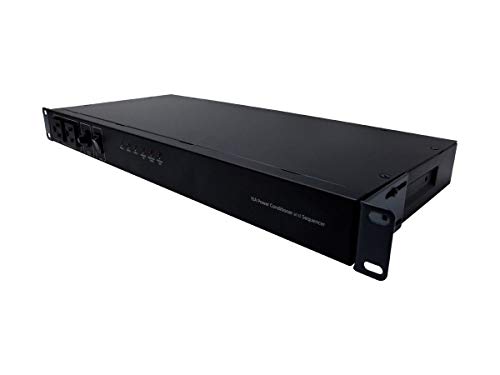
- Three-zone power sequencing
- Eight outlets with surge protection
- 15-amp, 120-volt, 1U rack-mount design
Best For: Amplifier and AV setups needing grouped power control
Heavy-Duty Rack Protection

- 20-amp capacity with a 10-foot, 12-gauge cord
- Nine outlets with wall-wart spacing
- Transient, noise, and overvoltage protection
Best For: Professional racks with a compatible 20-amp receptacle
Feature-Packed 15A Control

- Fourteen protected outlets for rack equipment
- LED voltmeter and circuit-breaker protection
- Two USB ports and three-zone sequencing
Best For: 15-amp audio and DJ setups needing ample outlets
Flexible Sequential Power Management

- Sequential startup helps reduce system noise
- Eight rear outlets have independent switches
- 110V–240V input with voltage monitoring
Best For: Stage and DJ racks needing controlled startup and outlet control
High-Capacity Rack Power

- 10 continuously powered outlets
- 30A/6600W maximum load
- 1U rack design with overload protection
Best For: High-demand stage, studio, and AV rack setups
Voltage-Monitoring Power Control

- LCD real-time voltage display
- 10 sockets with two front always-on outlets
- Surge, overload, and noise protection
Best For: DJ, studio, and stage rigs needing voltage visibility
Sequenced Rack Protection

- Sequential startup with independent switches
- LCD voltage and eight-channel status indicators
- AC noise filtering plus USB and Type-C charging
Best For: Managed audio racks requiring sequencing and channel control
Best Overall – Radial Power-2 Power Conditioner
The Radial Power-2 is a practical choice among stage power conditioners for live sound when you need rack-friendly power distribution with noise filtering, surge protection, and illuminated controls. It provides nine outlets, a 15-amp capacity, and a USB port for compatible devices.
Best For: Live sound rigs needing nine outlets, power protection, and front-panel visibility.
Pros:
- Nine outlets support multiple pro-audio devices.
- Includes noise filtering and surge protection.
- LED illumination helps with visibility in darker racks.
- Backed by a two-year warranty.
Cons:
- At 12.4 pounds, it is relatively heavy.
- Only one USB port is listed.
With its combination of outlet capacity, protection features, and illuminated operation, the Power-2 is a strong all-around option for organized stage and studio power management.
Best Power Sequencer – Pyle PCO875 Power Sequencer
The Pyle PCO875 stands out among stage power conditioners for live sound when outlet sequencing and rack efficiency are priorities. Its 1U metal chassis provides eight rear outlets, two always-on front outlets, a voltage readout, and a USB port for rack illumination.
Best For: Home theaters, studios, and compact stage racks that benefit from sequenced power control.
Pros:
- Ten outlets include eight rear and two always-on front outlets.
- Offers up to 3100 watts and 13 amps of capacity.
- 1U rack-mount format conserves rack space.
- Includes voltage readout and built-in safety protection.
Cons:
- Its 13-amp rating is lower than the 15-amp models here.
- The supplied notes do not specify a warranty longer than one year.
The PCO875 is a flexible, space-conscious choice for systems that need many connection points and simple front-panel control in a single rack space.
Best Outlet Capacity – Radial Power-1 Power Conditioner
The Radial Power-1 is a straightforward option among stage power conditioners for live sound, offering 11 outlets along with noise filtering and surge protection. Its stainless-steel construction and 7.55-pound weight make it suited to organized equipment power distribution.
Best For: Rigs that need more outlets without moving to a separate power distribution unit.
Pros:
- Provides 11 outlets for connected equipment.
- Includes noise filtering and surge protection.
- Stainless-steel construction is specified.
- Weighs 7.55 pounds.
Cons:
- The supplied notes do not list a USB port.
- Voltage and maximum amperage are not specified in the supplied details.
If outlet count is your main concern, the Power-1 offers the highest stated capacity in this roundup while retaining core filtering and surge-protection features.
Best Zonal Control – Monoprice Stage Right Power Conditioner
The Monoprice Stage Right is a useful choice among stage power conditioners for live sound when you want power sequencing across multiple zones. It combines eight outlets, a 15-amp rating, surge protection, and a 1U rack-mount metal enclosure.
Best For: Audio-visual and amplifier setups that need three-zone power sequencing.
Pros:
- Three zones provide organized power sequencing.
- Eight outlets support amplifiers, speakers, and other electronics.
- 15-amp, 120-volt specification suits standard North American power.
- 1U rack-mount metal enclosure saves space.
Cons:
- It has fewer outlets than the Radial Power-1 and Pyle PCO875.
- The supplied notes do not mention noise filtering or a USB port.
The Stage Right is particularly compelling for installations or live rigs where dividing connected equipment into three controlled power groups matters more than maximizing outlet count.
Heavy-Duty Rack Protection – Furman P-8 PRO C
The Furman P-8 PRO C is a strong choice among stage power conditioners for live sound when your rack needs 20-amp capacity and protection against voltage problems. It provides nine outlets, wall-wart spacing, surge suppression, AC noise filtration, and overvoltage shutdown.
Best For: Live-sound racks with compatible 20-amp receptacles and multiple professional audio devices.
Pros:
- 20-amp design includes a 10-foot, 12-gauge power cord.
- Nine outlets, including a front convenience outlet and rear wall-wart spacing.
- SMP transient protection, linear AC noise filtration, and EVS overvoltage shutdown.
- Rear BNC connector supports optional gooseneck rack lights.
Cons:
- Requires a 20-amp female receptacle or a compatible Furman adapter.
- Does not include pull-out lights.
Choose this model when robust rack protection and higher current capacity matter more than plug-and-play compatibility with standard 15-amp outlets.
Feature-Packed 15A Control – PMX-6600 Power Conditioner
The PMX-6600 is a practical option among stage power conditioners for live sound when you want extensive outlet capacity, basic surge protection, and convenient front-panel monitoring. Its 14 protected outlets, LED voltmeter, USB charging ports, and three-zone design suit organized audio setups.
Best For: 15-amp professional audio systems, DJ rigs, and rack setups that benefit from many outlets and USB charging.
Pros:
- Provides 14 protected outlets for connected equipment.
- Includes LED voltage display and circuit-breaker protection.
- Two USB ports allow device charging during operation.
- Three-zone sequencing supports organized power management.
Cons:
- Its maximum current is 15 amps, so it is not a substitute for a 20-amp conditioner.
- The supplied notes do not specify detailed filtering performance.
This is a sensible pick for conventional 120-volt, 15-amp setups where outlet count and operating visibility are priorities.
Flexible Sequential Power Management – 10-Outlet Power Sequencer
This 10-outlet power sequencer stands out among stage power conditioners for live sound by combining staged startup, voltage monitoring, and independently controlled rear outlets. Its broad 110V–240V input range and 3000W maximum total output support a variety of sound and stage equipment configurations.
Best For: Sound systems, DJ equipment, and stage racks that need controlled startup and individually switched outlets.
Pros:
- Sequentially powers equipment on and off to reduce startup noise and impact.
- Eight rear sequence outlets have independent power switches.
- Voltage display monitors input power in real time.
- Supports 110V–240V input and up to 3000W total output.
Cons:
- The supplied notes do not specify the exact outlet count beyond the 10-outlet product description and eight rear sequence outlets.
- Independent switching may require more setup attention during live operation.
Consider this unit when sequencing and hands-on outlet control are central to your workflow, particularly for larger or varied equipment racks.
High-Capacity Rack Power – MU-208FX 30A Conditioner
For stage power conditioners for live sound, the MU-208FX stands out when you need substantial capacity and straightforward rack-mounted distribution. It provides 10 continuously powered outlets, a 30A maximum load, and a metal 1U chassis for mixers, amplifiers, wireless receivers, and other AV equipment.
Best For: Live sound, studio, broadcast, and home AV setups requiring high-capacity 110V power distribution.
Pros:
- Supports up to 30A or 6600W total load.
- Provides eight rear outlets and two front outlets.
- Includes built-in 30A overload protection.
- Fits standard 19-inch racks in a compact 1U design.
Cons:
- All outlets are continuously powered rather than sequenced.
- Designed for 100–120V, 60Hz North American power systems.
The MU-208FX is a practical choice when outlet count, rack efficiency, and high load capacity matter more than advanced monitoring or channel-by-channel control.
Voltage-Monitoring Power Control – FL-1000 DJ Sequencer
Among stage power conditioners for live sound, the FL-1000 is suited to users who want outlet capacity plus front-panel status information. Its LCD displays voltage in real time, while eight rear sockets, two always-on front sockets, surge and overload protection, and a rack-ready 1U housing support organized equipment setups.
Best For: DJs, home theaters, studios, and stage systems that benefit from voltage monitoring and USB-powered accessories.
Pros:
- Offers 10 sockets, including eight rear and two front always-on outlets.
- Provides real-time voltage monitoring through a large LCD screen.
- Includes surge, overload, and noise protection features.
- Adds a USB/international power interface for external devices.
Cons:
- Rated for a 2000W power supply, lower than the higher-capacity options in this roundup.
- The supplied specifications do not identify the USB charging output.
The FL-1000 makes sense for compact production rigs where visual voltage feedback and convenient accessory power are useful alongside basic rack-mounted protection.
Sequenced Rack Protection – ST-368 3300W Conditioner
The ST-368 is a feature-rich option for stage power conditioners for live sound, combining 10 outlets with sequential startup, independent channel switching, AC noise filtering, and front-panel monitoring. Its 1U metal design also adds USB and Type-C charging for convenient access during events or studio sessions.
Best For: Audio racks that need sequenced power control, channel management, and real-time operating-status visibility.
Pros:
- Provides up to 3000W total output with a stated 30A maximum.
- Uses sequential startup and independent channel switches.
- Filters RF and electromagnetic interference through a built-in AC filter circuit.
- Includes LCD voltage monitoring, eight-channel LED indicators, USB, and Type-C charging.
Cons:
- The supplied specifications describe 3000W maximum output despite the product title referencing 3300W.
- At 8.63 pounds, it is heavier than the MU-208FX.
- Maximum output is limited to 10A per channel.
For more involved live or studio racks, the ST-368 offers the strongest control-oriented feature set here, particularly when staged power-up and individual channel access are priorities.
How We Picked the Best Stage Power Conditioners for Live Sound
We compared the selected units by the features that matter most in mobile rigs and installed live-sound systems: rated current, outlet count, power sequencing, surge protection, voltage monitoring, rack format, and control layout. We also considered whether a model is better suited to a compact setup, a larger rack, or users who need multiple independently controlled zones.
A conditioner does not replace a properly grounded venue circuit, a distribution system, or an electrician. Its job is to provide more organized power management and, depending on the design, filtering, surge protection, monitoring, and delayed startup or shutdown.
Quick Comparison
- Best for professional rack systems: Look for robust construction, clear status displays, dependable sequencing, and a reputable protection design.
- Best for multi-zone control: Models with separate switched banks can power digital gear, amplifiers, and accessories in a more controlled order.
- Best for compact rigs: An eight- or 10-outlet 1U unit may provide enough capacity without consuming valuable rack space.
- Best for convenience: USB charging, independent switching, and a front-panel voltage readout can simplify setup and troubleshooting.
Key Buying Factors for Stage Power Conditioners for Live Sound
Current Rating and Load Capacity
Check the unit’s amperage and wattage ratings against the total draw of your equipment. Leave headroom for startup demand, especially when powering amplifiers, powered speakers, or several high-consumption devices. A higher outlet count does not necessarily mean a higher safe load.
Sequencing and Outlet Control
Power sequencing delays groups of outlets so sensitive signal processors and control equipment can start before amplifiers. This can reduce pops and make shutdown safer. If you need flexible routing, choose a model with zones or independent switching rather than one master-controlled bank.
Protection and Monitoring
Look for clearly stated surge-protection specifications, circuit-breaker protection, and a voltage display when venue power is unpredictable. A readout can alert you to low or high incoming voltage, but it is not a substitute for testing the circuit or disconnecting equipment when conditions are unsafe.
Rack Fit and Connectivity
Most options here use a 1U rack format, but confirm depth, mounting hardware, plug orientation, and rear-panel clearance before installation. Count both front and rear outlets, and make sure the layout accommodates bulky adapters and power supplies.
Who Should Buy Which Stage Power Conditioners for Live Sound?
Touring musicians and production crews should prioritize durable construction, clear status information, adequate current capacity, and dependable sequencing. Small bands, DJs, and rehearsal spaces may get better value from an affordable 1U conditioner with enough outlets and basic monitoring. Installers and fixed-rack users should focus on zone control, rear-panel accessibility, and compatibility with the rack’s total electrical load. Users with phones, tablets, or wireless accessories may appreciate integrated USB or USB-C charging, provided charging convenience does not come at the expense of the required mains capacity.