
USB switch boxes with remote button make it easier to share keyboards, mice, printers, scanners, and other USB devices between computers without repeatedly reaching behind your desk.
We compared 10 options across USB speed, port selection, remote-control convenience, compatibility, and setup requirements to help you choose the right switch for your workspace.
Best 10 USB Switch Boxes with Remote Button Picks for 2026
Best 3-Computer USB Selector
THXCDBID USB 3.0 Remote Switch

- Shares four USB-A ports among three computers
- Up to 5Gbps USB 3.0 transfer speeds
- Button and IR remote switching
Best For: Three-computer workstations sharing USB peripherals
Best Heavy-Duty 5V Power Control
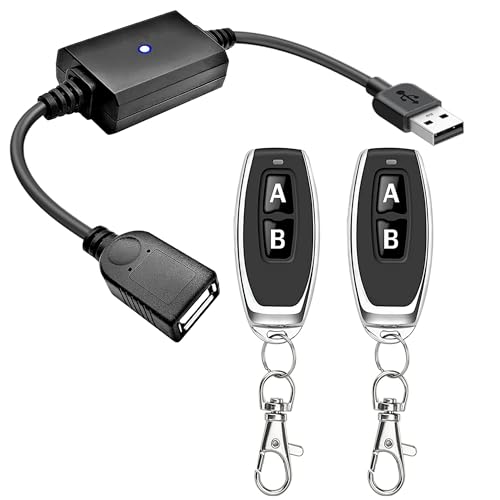
- Handles up to a 3A 5V load
- Pre-paired ON/OFF RF remote control
- Up to 164 feet of open-area range
Best For: Remote control of 5V USB-powered lights and DIY devices
Best High-Speed Multi-Computer Hub

- Shares four USB devices among four computers
- Includes USB-A and USB-C device ports
- Up to 10Gbps transfer with compatible equipment
Best For: Four-computer setups needing fast peripheral sharing
Best Simple 5V Lighting Controller

- Inline USB connection requires no wiring
- Pre-tested with latched ON/OFF operation
- Rated for 3A and 15W at 5V
Best For: Remote power control for 5V lights and small electronics
Best Overall

- Shares four USB peripherals between two computers
- USB 3.0 and USB-C ports support up to 5Gbps
- Includes physical and remote switching
Best For: Two-computer office and home workstations
Best for Simple USB Power Control

- Wireless 433MHz ON/OFF key-fob control
- Designed for compatible 5V-12V USB devices
- Built-in blue LED shows status
Best For: Remote control of USB-powered lights, fans, and lamps
Best for Four Computers

- Shares four USB devices across four computers
- Offers USB 3.2 speeds up to 10Gbps
- Includes USB-C, USB-A, remote, and 12V adapter
Best For: Four-PC workstations and high-speed peripheral sharing
Best Power-Only Pick
USB Wireless Remote Power Switch

- 3.6V–24V DC support with loads up to 2A
- Plug-in USB male-to-female design
- 433MHz remote control with learning function
Best For: USB-powered lights and accessories
Best for Shared Peripherals

- Shares four USB devices across four computers
- Up to 5Gbps USB 3.0 data transfer
- Manual or wireless remote switching
Best For: Multi-computer peripheral sharing
Best for Higher-Load USB Power
433MHz Remote USB Power Switch

- USB male input and female output
- Toggle-style wireless power control
- Learning function supports multiple remotes
Best For: USB-powered home and network equipment
Best 3-Computer USB Selector – THXCDBID USB 3.0 Remote Switch
If you need usb switch boxes with remote button control for a multi-computer desk, this THXCDBID model shares four USB-A peripherals among three computers. Its USB 3.0 ports support up to 5Gbps, while the included IR remote provides switching without reaching for the box.
Best For: Workstations that share a keyboard, mouse, printer, scanner, or other USB-A devices across three computers.
Pros:
- Supports three computers and four shared USB-A ports.
- Offers up to 5Gbps USB 3.0 data transfer.
- Includes both device-button and IR remote switching.
- Works with Windows, Linux, and Mac systems without requiring special drivers.
Cons:
- Does not support monitors because it is not a KVM switch.
- High-power USB devices may need separate power.
- Remote batteries are not included.
This is a practical choice when remote access and three-computer support matter more than display switching. Connect the included Micro USB power cable when stable operation is important.
Best Heavy-Duty 5V Power Control – 3A USB Wireless Remote Switch
For usb switch boxes with remote button operation that control power rather than computer peripherals, this 5V RF switch is a straightforward option. It supports loads up to 3A, arrives pre-paired, and uses a latching two-button remote for separate on and off commands.
Best For: Remotely powering compatible 5V USB lights, fans, LED strips, routers, and DIY electronics.
Pros:
- Supports up to a 3A maximum load.
- Pre-paired receiver and transmitters require no programming.
- 433MHz RF signal reaches up to 164 feet in open areas and can pass through walls.
- Expandable design can pair multiple remotes or receivers.
Cons:
- It controls 5V power, not USB data sharing between computers.
- Plastic construction may be less robust than metal switch boxes.
- Actual range can vary with walls and other obstructions.
This kit fits simple remote power-control projects where Wi-Fi or Bluetooth is unnecessary. Its plug-and-play design and dedicated ON/OFF buttons make it convenient for hard-to-reach USB-powered devices.
Best High-Speed Multi-Computer Hub – USB 3.2 Remote Switcher
This USB 3.2 switcher is one of the more capable usb switch boxes with remote button control for sharing peripherals across four computers. It provides three USB-A ports and one USB-C port, with advertised transfer rates up to 10Gbps when the connected equipment supports that speed.
Best For: Four-computer setups that need shared keyboards, mice, scanners, printers, storage devices, or cameras.
Pros:
- Shares four USB devices among four computers.
- Combines three USB-A ports with one USB-C port.
- Supports up to 10Gbps transfer and backward compatibility with USB 3.0 and 2.0.
- Includes physical-button and wireless remote switching.
Cons:
- It is not a KVM and cannot switch monitors.
- PD charging is not supported.
- 10Gbps performance depends on every connected device and cable.
Choose this model when four-computer support and a USB-C port are priorities. The included power cable can help provide more stable transmission with higher-power peripherals, but it is not intended to power other devices.
Best Simple 5V Lighting Controller – USB RF Remote Switch
If your search for usb switch boxes with remote button control is really about turning a 5V device on and off, this inline RF controller keeps installation simple. Its male and female USB connectors fit between a power source and compatible equipment, avoiding separate wiring.
Best For: Remote ON/OFF control of 5V LED strips, lamps, light fans, bulbs, buzzers, and similar devices.
Pros:
- Inline USB male-to-female design simplifies connection.
- Pre-tested and ready to use without pairing.
- Supports a 3A current rating and 15W output.
- RF signal can pass through walls, floors, and doors within a stated 20–45 meter range.
Cons:
- Designed for power switching rather than computer USB data sharing.
- Plastic housing may not suit demanding installations.
- Range varies according to obstacles and surroundings.
This is a useful low-complexity option for remotely switching compatible 5V lighting and small electronics. The latched A-for-ON and B-for-OFF operation is clear and practical for everyday use.
Best Overall – BENFEI 2-Computer USB Switch
For shoppers comparing usb switch boxes with remote button control, the BENFEI USB 3.0 Switch offers a practical way for two computers to share four USB peripherals. It combines three USB-A 3.0 ports with one USB-C port, supports up to 5Gbps data transfer, and can be switched from the unit or included remote.
Best For: Workstations where two Windows, Mac, Linux, or Chrome OS computers need to share keyboards, mice, storage, printers, or other USB devices.
Pros:
- Shares three USB 3.0 devices and one USB-C device between two computers.
- Supports data rates up to 5Gbps and is backward compatible with USB 2.0.
- Offers physical-button and remote switching with LED status indication.
- Includes optional USB-C power input for higher-consumption peripherals.
Cons:
- Requires BENFEI USB-A-to-USB-A cables for connection.
- Extra power may be needed for devices such as hard drives, cameras, or headphones.
This is a well-rounded choice for a two-computer desk, especially if you want both USB-A and USB-C connectivity without installing drivers. Its 18-month warranty is an additional benefit for everyday office use.
Best for Simple USB Power Control – Wireless USB Remote Switch
Unlike computer peripheral selectors, this compact option is a USB remote power switch for controlling compatible 5V-to-12V DC devices. Its 433MHz wireless key-fob remote provides ON/OFF control, while the built-in blue LED confirms power and connection status.
Best For: Users who need remote control for USB-powered lights, LED strips, reading lamps, fans, and similar low-voltage devices.
Pros:
- Provides convenient wireless ON/OFF control through a 433MHz RF remote.
- Works with compatible 5V-to-12V DC USB-powered devices.
- Uses a straightforward plug-and-play USB interface.
- Includes a compact keychain-style remote and LED indicator.
Cons:
- It is a power-control switch, not a USB data or multi-computer selector.
- Its stated current rating is 3A, so device compatibility should be checked.
- IP20 protection makes it intended for typical indoor use.
This is a better fit for remote power control than for sharing keyboards or storage between computers. Choose it when a simple wireless ON/OFF function matters more than high-speed USB data switching.
Best for Four Computers – USB 3.2 10Gbps Remote Switch
For larger setups needing usb switch boxes with remote button access, this USB 3.2 selector lets four computers share four peripherals. It provides one USB-C and three USB-A ports, supports up to 10Gbps transfer speeds, and includes a 12V power adapter for more consistent operation with higher-power devices.
Best For: Multi-computer workstations, shared storage setups, and users who need to switch USB peripherals among four PCs or laptops.
Pros:
- Allows four computers to share four USB peripherals.
- USB 3.2 Gen 2 supports data rates up to 10Gbps.
- Combines one USB-C port with three USB-A ports.
- Includes a 12V adapter and remote for powered, out-of-the-way installation.
Cons:
- USB-only; it does not switch HDMI, DisplayPort, monitors, or video signals.
- Keyboard hotkey switching is not supported.
- Remote batteries are required but not included.
This model stands out when four computers and high-speed USB storage are part of the same workflow. It is not a full KVM, so display inputs must be selected separately after changing the USB connection.
Best Power-Only Pick – USB Wireless Remote Power Switch
For shoppers comparing usb switch boxes with remote button control for powering USB devices, this plug-in 433MHz relay offers a simple male-to-female connection. It supports 3.6V–24V DC loads up to 2A and controls power only—not USB data or file transfers.
Best For: Remotely switching LED lights, light strips, night-lights, wireless controllers, and other USB-powered devices.
Pros:
- Plug-and-play USB male-to-female design avoids additional wiring.
- 433MHz signal supports wall penetration and anti-interference operation.
- Learning function can pair with multiple compatible remotes.
- Includes a 12-key remote control and manual.
Cons:
- Rated for loads up to 2A.
- Controls power only and does not support USB data transfer.
- Correct wiring and operation within the rated current range are required.
This is a practical choice when you need straightforward wireless power control rather than a computer peripheral selector or data switch. Its inline format is especially convenient for compatible USB lighting and accessories.
Best for Shared Peripherals – 4-Port USB 3.0 Remote Switch
This 4-way USB 3.0 selector is the strongest fit among these usb switch boxes with remote button control for sharing peripherals between computers. It lets four computers share four USB devices, with switching available from the top button or included wireless remote.
Best For: Workstations that share keyboards, mice, printers, scanners, storage devices, webcams, or gamepads across four computers.
Pros:
- Supports four computers and four USB 3.0 peripheral devices.
- Data transfer speeds reach up to 5Gbps and support USB 2.0 and 1.1.
- Offers both manual button and wireless remote switching.
- Optional Micro USB 5V power helps support higher-power devices.
Cons:
- It is not a KVM switch and does not transfer HDMI, DisplayPort, or VGA video.
- The remote control batteries are not included.
- Connected computers may need time to install the USB driver.
Choose this model when your priority is peripheral sharing and USB data transfer between multiple computers. The separate power input is useful for demanding devices, while the remote can keep the selector hidden for a cleaner desk.
Best for Higher-Load USB Power – 433MHz Remote USB Power Switch
For usb switch boxes with remote button control focused on USB power, this 433MHz RF controller provides a male input and female output with toggle-style operation. It is designed for USB-powered equipment and switches the supply only, not data.
Best For: Remotely controlling USB-powered routers, monitors, cameras, optical modems, set-top boxes, night-lights, and similar equipment.
Pros:
- Plug-and-play USB male-input and female-output configuration.
- Fast response and a signal designed to penetrate walls.
- Toggle mode turns power on with one press and off with the next.
- Learning function supports multiple remotes and independently coded sets.
Cons:
- Controls power only and does not support USB data.
- The notes recommend loads of 5A or less; confirm compatibility before use.
- It ships switched off by default and requires a 5V supply for operation.
This controller suits users who want wireless on/off control for fixed USB-powered equipment. Its independently coded RF operation can help prevent multiple units from controlling one another, provided the connected load matches the product’s requirements.
How We Picked the Best USB Switch Boxes with Remote Button
We focused on practical differences that affect everyday use: the number of computers and USB devices supported, USB-A versus USB-C connectivity, advertised transfer speeds, remote-control design, included cables, indicators, and power requirements. We also separated true computer-sharing switches from USB-powered wireless relay products designed to turn lamps, fans, LED strips, or other equipment on and off.
Because product names and specifications can vary by seller, confirm the listing’s supported operating systems, port layout, power input, and included accessories before ordering. A remote button is useful only when the receiver and remote can be positioned reliably in your workspace.
Quick Comparison
- For basic peripheral sharing: USB 3.0 four-port models are a practical choice for sharing a keyboard, mouse, printer, scanner, or similar devices.
- For more computers: Four-computer switches provide broader sharing than two-computer models, but may require more cables and desk space.
- For newer accessories: USB 3.2 models with USB-C and USB-A ports are better suited to mixed modern setups.
- For simple remote power control: 5V wireless USB switches are intended for on/off control, not for switching USB peripherals between computers.
Key Buying Factors for USB Switch Boxes with Remote Button
Port Layout and Device Capacity
Check how many computers the unit supports and how many shared USB ports it provides. A four-port switch is usually more flexible than a three-port model, while a USB-C port can help accommodate newer hubs, drives, and accessories.
Speed and Compatibility
USB 3.0 models commonly advertise up to 5Gbps, while USB 3.2 versions may advertise up to 10Gbps under suitable conditions. Actual performance depends on the computer, cable, device, and workload. These switches are generally intended for peripherals and storage sharing, not for replacing a full network or video switch.
Remote Range and Power
Wireless remotes reduce the need to reach under a desk, but range and reliability depend on interference, placement, and the receiver’s design. Determine whether the switch is bus-powered or needs a separate 5V supply, especially when using several power-hungry devices.
Indicator Lights and Included Cables
LED indicators make it easier to confirm which computer is active. Also verify whether the package includes the required upstream cables, remote batteries, and power adapter; missing cables can add to the real cost.
Who Should Buy Which USB Switch Boxes with Remote Button?
Choose a basic USB 3.0 switch if you want affordable sharing for everyday keyboard, mouse, printer, or scanner use. Select a four-computer model if several systems need access to the same peripherals. A USB 3.2 model with USB-C is the better fit for newer equipment and faster storage, provided every connected component supports the claimed speed.
For a compact two-computer desk, a model with a remote button and clear status indicator can offer the best balance of convenience and simplicity. If your goal is only to remotely power a lamp, fan, LED strip, or charger from a 5V USB source, choose a wireless USB power switch instead of a peripheral-sharing selector. It will not perform the same job as a computer USB switch.