
Sharing one keyboard, printer, scanner, or webcam between two computers does not require constantly reconnecting cables. The best two-port USB switch boxes let you change the active computer with a button while keeping your desk organized.
These picks cover USB 2.0 and USB 3.0 designs, one-device printer switches, multi-port peripheral selectors, and bi-directional models. Choose based on device count, speed, connector type, and whether you need simple manual switching or broader compatibility.
Best 10 Two Port USB Switch Boxes Picks for 2026
Best Multi-Device USB 2.0 Sharing Pick

- Shares four USB 2.0 devices between two computers
- One-button switching with LED status indicator
- Optional power input for demanding device setups
Best For: Two computers sharing up to four USB 2.0 peripherals
Best Compact USB 3.0 Switch
Aluminum Bi-Directional USB Switch

- Works as 1-in-2-out or 2-in-1-out
- Supports USB 3.0 speeds up to 5Gbps
- Compact aluminum design needs no extra power
Best For: Flexible one-device sharing or two-device selection
Best High-Speed Multi-Port Pick
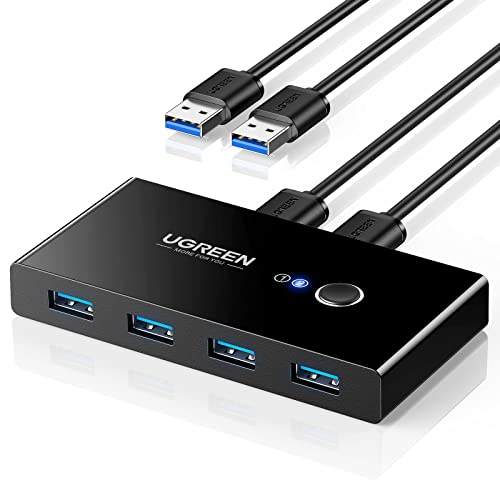
- Shares four USB devices between two computers
- Up to 5Gbps transfers with USB 2.0 backward compatibility
- Includes two USB 3.0 cables and optional power input
Best For: Busy workstations sharing multiple high-speed peripherals
Best Basic Manual Option
OLLGEN 2-Port USB 2.0 Sharing Box

- Shares one USB device between two computers
- Supports USB 1.1 and USB 2.0
- Compact manual push-button design
Best For: Simple printer, scanner, camera, or keyboard sharing
Best All-Around USB Sharing
4-Port USB 3.0 Switch for Two Computers

- Shares four USB devices between two computers
- Up to 5Gbps transfer speed with USB 3.0
- Optional USB-C power for demanding peripherals
Best For: Multi-device home and office workstations
Best Printer Specialist
2-to-1 USB 2.0 Printer Sharing Switch

- Shares one printer between two computers
- Includes two 1.5-meter USB-B cables
- Manual button and LED selection indicators
Best For: Simple two-computer printer setups
Best Flexible Setup
USB 3.0 Switch with USB-C and Remote Controller

- Combines one USB-C and three USB-A ports
- Up to 5Gbps data transfer between two computers
- Includes button and controller switching
Best For: Mixed USB-C and USB-A desktop peripherals
Flexible Bi-Directional Pick

- Supports 2-in-1-out or 1-in-2-out use
- Up to 5Gbps USB 3.0 transfers
- Compact, driver-free, one-button operation
Best For: Flexible home-office and mobile USB switching
Multi-Device Sharing Pick

- Two computers can share two USB devices
- Up to 5Gbps data transfer
- Includes two 5-foot USB 3.0 cables
Best For: Dual-computer desks with multiple shared peripherals
Value Bi-Directional Pick

- Flexible 2-in-1-out and 1-in-2-out modes
- Up to 5Gbps transfer speeds
- Includes two 3.3-foot USB 3.0 cables
Best For: Simple, budget-friendly USB peripheral switching
Best Multi-Device USB 2.0 Sharing Pick – UGREEN 2-in-4 USB Switch
Among two port usb switch boxes, this UGREEN model is a practical choice when two computers need to share several USB 2.0 peripherals. Its one-button switching, four device ports, included cables, and optional power input make it suited to printer, scanner, keyboard, and storage setups, though it does not handle video.
Best For: Two computers sharing up to four USB 2.0 peripherals.
Pros:
- Shares four USB devices between two computers.
- Includes two USB-A-to-A data cables.
- Plug-and-play support for Windows, macOS, Linux, and Chrome OS.
- LED status indicator and optional micro-USB power input.
Cons:
- Does not support monitors or video transmission.
- Power adapter and charging cable are not included.
- Multiple or high-power devices may require external power.
This is a flexible peripheral-sharing box for a two-computer desk, particularly when several accessories must remain connected. Choose another type of switch if monitor sharing is required.
Best Compact USB 3.0 Switch – Aluminum Bi-Directional USB Switch
This compact aluminum option stands out among two port usb switch boxes because it works in either direction: two computers can share one USB device, or one computer can switch between two USB devices. It supports USB 3.0 speeds and requires no additional power supply.
Best For: Users who need flexible one-device sharing or two-device selection with USB 3.0 performance.
Pros:
- Supports 1-in-2-out and 2-in-1-out configurations.
- Data transfers up to 5Gbps and backward compatibility with USB 2.0 and 1.1.
- Compact aluminum enclosure with a blue active-status LED.
- Plug-and-play operation without extra power.
Cons:
- USB 3.0 cable is not included.
- Designed for sharing one peripheral or selecting between two devices, not multiple peripherals simultaneously.
- It is a USB switch rather than a monitor/video KVM.
Its reversible configuration gives it more placement flexibility than a fixed-direction switch. It is a good fit for a simple, fast USB connection, provided you supply the required USB 3.0 cable.
Best High-Speed Multi-Port Pick – UGREEN 2-in-4 USB 3.0 Switch
For shoppers comparing two port usb switch boxes but needing more device capacity, this UGREEN USB 3.0 switch lets two computers share four peripherals. Its 5Gbps transfer rate, included USB 3.0 cables, one-button control, and optional USB-C power input make it well suited to busy workstations.
Best For: Two computers sharing multiple USB 3.0 peripherals and transferring files quickly.
Pros:
- Connects two computers to four shared USB devices.
- Supports transfers up to 5Gbps and works with USB 2.0 devices.
- Includes two USB 3.0 data cables.
- One-button switching with an LED indicator and optional 5V/2A power input.
Cons:
- Does not support monitor or video transmission.
- Power adapter is not included.
- Multiple high-power devices may need supplemental power.
This is the stronger choice when four shared ports and faster transfers matter. It offers convenient desk switching, but video switching still requires separate equipment.
Best Basic Manual Option – OLLGEN 2-Port USB 2.0 Sharing Box
This simple OLLGEN unit is one of the more basic two port usb switch boxes, allowing two computers to share one USB peripheral. Its push-button controls and compact plastic housing keep the setup straightforward for printers, scanners, cameras, and keyboards.
Best For: Basic two-computer sharing of one USB 1.1 or USB 2.0 device.
Pros:
- Lets two computers share one USB device.
- Supports USB 1.1 and USB 2.0 connections.
- Compact, portable design with front push buttons.
- Works with common peripherals including printers, scanners, cameras, and keyboards.
Cons:
- Limited to one shared USB device.
- USB 2.0 transfer rate is up to 480Mbps.
- Listed operating-system support is older and includes Windows 98 through Vista and Mac OS.
This model makes sense for a legacy or low-complexity setup where one peripheral must move between two computers. It is less suitable for modern high-speed storage or newer multi-device workstations.
Best All-Around USB Sharing – 4-Port USB 3.0 Switch for Two Computers
If you need two port usb switch boxes for sharing several peripherals, the BENFEI USB 3.0 Switch offers four USB device ports for two computers. Its push-button control, LED indicator, broad operating-system compatibility, and up to 5Gbps transfer speed make it a practical choice for desks with keyboards, mice, storage drives, printers, or scanners.
Best For: Homes and offices that need to share multiple USB peripherals between a work computer and a personal computer.
Pros:
- Shares up to four USB devices between two computers.
- Supports USB 3.0 transfer speeds up to 5Gbps and is backward compatible with USB 2.0.
- Works with Windows, Mac, Linux, and Chrome OS without drivers.
- Includes an optional USB-C power input for higher-power devices.
Cons:
- Requires BENFEI USB-A-to-USB-A cables for operation.
- The power adapter is not included.
- It switches USB peripherals, not display signals.
Choose this model when capacity and faster data transfers matter more than having a compact printer-only switch. The included 18-month warranty is an additional benefit for a shared-device setup.
Best Printer Specialist – 2-to-1 USB 2.0 Printer Sharing Switch
Among two port usb switch boxes, the QIANRENON model is designed specifically for sharing one USB printer between two computers. Its manual push-button switching, status LEDs, and two included 1.5-meter USB 2.0 printer cables keep the setup simple without requiring external power.
Best For: Small offices or shared workspaces with two computers and one USB-B printer.
Pros:
- Connects two computers to one printer.
- Includes two 1.5-meter USB 2.0 printer cables.
- LED indicators show which computer is selected.
- Plug-and-play operation requires no installation or external power.
Cons:
- Designed for printer sharing rather than multiple USB peripherals.
- Uses USB 2.0 rather than USB 3.0.
- Switching is manual.
This is the focused option for a straightforward two-computer, one-printer arrangement. It is less suitable if you also need to share storage devices, cameras, keyboards, or mice.
Best Flexible Setup – USB 3.0 Switch with USB-C and Remote Controller
The UGREEN USB 3.0 Switch is a flexible alternative to basic two port usb switch boxes, combining one USB-C port with three USB-A ports for two computers. It supports up to 5Gbps data transfers and offers both device-button and wired-controller switching, while an optional USB-C power connection can improve stability with several peripherals.
Best For: Users who want mixed USB-C and USB-A peripheral support plus a controller for switching without reaching behind the desk.
Pros:
- Shares four USB devices between two computers.
- Provides one USB-C and three USB-A device ports.
- Supports USB 3.0 speeds up to 5Gbps and plug-and-play use.
- Offers button and controller switching options.
Cons:
- It is not a KVM and cannot transmit video or connect a monitor.
- Optional power may be needed when several devices are connected.
- The USB-C port does not support video output or display docks.
Consider this model for a modern desk with a mix of connector types and a preference for remote-style control. Confirm that your setup only needs USB data switching, since display functionality is explicitly excluded.
Flexible Bi-Directional Pick – Compact USB 3.0 Switch
This compact option stands out among two port usb switch boxes because it supports both connection directions. Use it to let two computers share one USB peripheral, or switch one computer between two USB devices without repeatedly moving cables.
Best For: Home offices and mobile workstations that need flexible switching between computers and peripherals.
Pros:
- Supports both 2-in-1-out and 1-in-2-out configurations.
- USB 3.0 data transfer speeds up to 5Gbps, with USB 2.0 and USB 1.1 backward compatibility.
- Driver-free setup, one-button switching, LED status indicator, and compatibility with Windows, Mac OS, and Linux.
Cons:
- It is a USB data switch, not a monitor or video switch.
- The listed current rating is 800 milliamps, so power-hungry devices may require separate consideration.
Choose this model when bidirectional flexibility and portability matter most. Its small design and broad operating-system compatibility make it a practical everyday switch for common USB accessories.
Multi-Device Sharing Pick – UGREEN 2-in-2-out USB Switch
For shoppers comparing two port usb switch boxes, the UGREEN 2-in-2-out design is tailored to two-computer setups that share more than one peripheral. It connects two computers and two USB devices, with a button for changing the active computer.
Best For: Users who want two computers to share a keyboard, mouse, printer, webcam, or similar USB devices.
Pros:
- Lets two computers share two USB devices.
- Supports transfer speeds up to 5Gbps and is backward compatible with USB 2.0.
- Includes two 5-foot USB 3.0 A-to-A cables and offers driver-free compatibility with Windows, macOS, Chrome OS, and Linux.
Cons:
- It does not support monitor switching or video transfer.
- The USB output ports are for data transfer only.
This is a strong fit for a dual-computer desk where multiple USB accessories need to move together. Be sure the lack of video support matches your setup, since this is not a KVM switch.
Value Bi-Directional Pick – DUOPURUI USB 3.0 Switch
This DUOPURUI model is a straightforward choice among two port usb switch boxes, offering two-way switching for computers and USB peripherals. It can share one device between two computers or connect two USB devices to one computer, and it includes two USB 3.0 cables.
Best For: Budget-conscious users who need simple, physical switching for printers, scanners, storage devices, or input accessories.
Pros:
- Supports both 2-in-1-out and 1-in-2-out operation.
- Provides up to 5Gbps transfers with USB 2.0 and USB 1.1 backward compatibility.
- Includes two 3.3-foot USB 3.0 A-to-A cables and requires no additional drivers.
Cons:
- It does not switch monitors or transmit video signals.
- The included cables are shorter than the 5-foot cables supplied with some competing models.
Its compact enclosure, physical button, and LED indicator keep operation simple. Consider it when you want flexible USB sharing and included cables without needing display switching.
How We Picked the Best Two Port USB Switch Boxes
We focused on practical two-computer USB sharing rather than generic hubs. The selection considers USB version, supported devices, switching direction, port count, construction, indicator lights, compatibility, and setup requirements. Models that share multiple peripherals are useful for complete desk setups, while simpler printer-sharing switches can be a better value for one USB device.
USB switches generally do not transfer data between computers or act as full KVM systems unless specifically described that way. You may still need separate video and audio switching for a complete workstation changeover.
Quick Comparison
| Best For | Recommended Type | What to Check |
|---|---|---|
| Keyboard, mouse, printer, and scanner | USB 3.0 multi-port switch | Four shared USB ports and included cables |
| One printer or scanner | USB 2.0 manual sharing switch | USB connector type and device compatibility |
| Faster storage or webcams | USB 3.0 switch | Actual USB 3.0 ports and suitable host cables |
| Changing which computer uses one device | Bi-directional switch | 1-in/2-out or 2-in/1-out operating mode |
| USB-C and USB-A equipment | USB-C/A-compatible switch | Native ports, adapters, and power needs |
Key Buying Factors for Two-Port USB Switch Boxes
USB Version and Real-World Speed
USB 2.0 is usually sufficient for keyboards, mice, printers, and many scanners. USB 3.0 is preferable for external drives, high-resolution webcams, and faster peripherals. A USB 3.0 label does not guarantee maximum performance if the computer, cable, or connected device uses an older standard.
Number and Type of Shared Ports
Some switches share one USB device, while others provide four downstream ports for a complete peripheral set. Count what you plan to connect and check whether the switch uses USB-A, USB-B, USB-C, or detachable cables. A multi-port switch may need an external power adapter when several devices draw power simultaneously.
Switching Method and Direction
Manual buttons are simple and reliable, while wired remote buttons can keep the switch within reach. Bi-directional models can often be configured as one computer sharing two devices or two computers sharing one device, but verify the stated mode before buying.
Compatibility and Limitations
Confirm support for your operating systems and peripherals, especially printers with proprietary software, webcams, storage devices, and devices requiring high power. Most switches change USB access only; they do not automatically switch monitors, network connections, or USB audio output.
Who Should Buy Which Two Port USB Switch Boxes?
Choose a USB 2.0 printer-sharing model if you only need to alternate one printer or scanner between two computers and want a compact, inexpensive solution. Pick a USB 3.0 four-port switch for a shared keyboard, mouse, printer, scanner, or webcam setup. A bi-directional model is the better choice when you want flexibility in how computers and peripherals are connected. For mixed modern setups, prioritize USB-C support or plan for reliable adapters. If you need one-button control of displays and USB devices together, consider a full KVM switch instead of a USB-only selector.