
The right external recorder can improve image quality, simplify monitoring, and give your camera a more flexible recording workflow. From compact HDMI monitor-recorders to dedicated studio decks, the best choice depends on your camera, recording format, and production environment.
We selected 10 options covering professional cinema rigs, mirrorless cameras, live production, field audio, streaming, and analog video capture. Use the guide below to narrow the list by connectivity, media, resolution, and portability.
Best 10 Camera External Recorders Picks for 2026
Best ProRes RAW Monitor

- 1500-nit HDR touchscreen
- ProRes and ProRes RAW recording
- Camera control and pro monitoring tools
Best For: Mobile HDMI and mirrorless-camera production
Best 4K Studio Deck
Blackmagic HyperDeck Studio 4K Pro

- 12G-SDI and HDMI 2.0 connectivity
- SSD and SD-card recording
- ProRes, DNxHD, H.264, and H.265 support
Best For: Studio, broadcast, and switcher-based workflows
Best Bright Camera Monitor
VILTROX DC-550 5.5-inch Monitor

- 1200-nit Full HD touchscreen
- Waveform, false color, and focus tools
- Custom 3D LUT support
Best For: Daylight camera monitoring and rig setups
Best All-in-One Creator Camera

- 4K video with 150-degree wide-angle lens
- 120 dB SPL X/Y microphones
- USB streaming and microSD recording
Best For: Musicians, performances, and compact streaming setups
Professional RAW Workflow

- 1500-nit 5-inch touchscreen
- Records up to 6K RAW
- HDMI, Wi-Fi 6E, and NDI support
Best For: Professional HDMI camera workflows and RAW capture
Portable Performance Capture

- 4K video at 30 fps
- Stereo X/Y microphones
- 150-degree wide-angle lens
Best For: Live music, rehearsals, and compact performance recording
Compact HDMI Capture
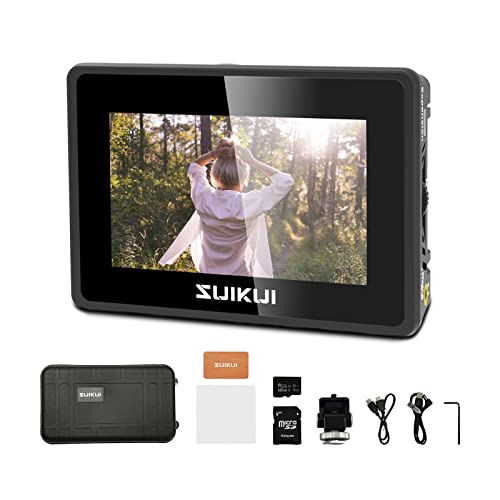
- 1080p30 H.264 recording
- 3.5-inch monitoring display
- Focus and exposure assist tools
Best For: Simple Full HD HDMI camera recording and monitoring
Compact Audio Pro

- 32-bit float audio recording
- Dual XLR/TRS inputs
- Built-in timecode generation
Best For: Videographers needing external audio and timecode
Monitor and Recorder

- 5-inch Full HD LCD touchscreen
- Professional scopes and focus assist
- HDR and 3D LUT support
Best For: Camera operators needing an external production monitor
Analog Capture Choice

- Converts AV/RCA to MP4
- Supports multiple tape formats
- Portable SD recording at up to 60 fps
Best For: Analog video digitization and SD field capture
Best ProRes RAW Monitor – Atomos Ninja RAW
For filmmakers seeking camera external recorders for HDMI or mirrorless-camera setups, the Atomos Ninja RAW combines a bright HDR monitor with direct ProRes and ProRes RAW recording. Its camera-control features and professional monitoring tools make it a strong fit for hands-on production work.
Best For: Mirrorless and HDMI-camera users who need ProRes RAW recording, monitoring tools, and camera control in a mobile setup.
Pros:
- 1500-nit, 5.2-inch HDR touchscreen is designed for clear viewing in bright conditions.
- Records ProRes, ProRes RAW, ProRes RAW HQ, ProRes LT, 422, and 422 HQ.
- Includes waveform, focus peaking, EL Zone false color, and Onion Skin tools.
- Supports CFexpress Type B media and external USB-C storage.
Cons:
- External USB-C storage and network-adapter options are sold separately.
- Its 5.2-inch screen is compact compared with larger production monitors.
The Ninja RAW is especially compelling when image-quality control and recording flexibility matter more than a simple monitor-only workflow. NP-F batteries, USB-C power banks, and a DC adapter support mobile operation.
Best 4K Studio Deck – Blackmagic HyperDeck Studio 4K Pro
The Blackmagic HyperDeck Studio 4K Pro is a rackmount-style choice for buyers comparing camera external recorders for studio, broadcast, and switcher workflows. It combines Ultra HD processing with multiple recording-media options and extensive SDI, HDMI, timecode, reference, and control connections.
Best For: Studio and broadcast users who need a feature-rich 4K deck with SDI, HDMI, SSD, and SD-card recording options.
Pros:
- Supports ProRes, DNxHD, uncompressed, H.264, and H.265 recording, including 10-bit 4:2:2 formats.
- Offers two 2.5-inch SSD slots and two SD-card slots.
- Provides 12G-SDI, HDMI 2.0, reference, timecode, RS-422, and 10Gb/s networking connections.
- Includes a front-panel LCD, speaker, jog wheel, and USB Type-C recording output.
Cons:
- Power cord is not included.
- The 1 RU deck and 8.1-pound weight are better suited to fixed installations than lightweight camera rigs.
Choose this HyperDeck when connectivity, storage flexibility, and integration with professional video systems are priorities. Its streaming support and compatibility with major editing software add useful workflow options.
Best Bright Camera Monitor – VILTROX DC-550 5.5-inch Monitor
The VILTROX DC-550 is a practical option for shoppers considering camera external recorders but primarily needing a bright on-camera monitoring solution. Its 5.5-inch touchscreen, 1200-nit output, exposure tools, and LUT support help with framing, focus, and image evaluation over HDMI.
Best For: Camera operators who want a daylight-viewable HDMI monitor with waveform, false color, focus tools, and custom LUT support.
Pros:
- 1200-nit 5.5-inch Full HD display is designed for visibility in intense lighting.
- Includes waveform, parade, vectorscope, histogram, audio meter, zebra, and false-color tools.
- Supports built-in and custom 3D LUTs, Log-to-Rec.709 viewing, and anamorphic de-squeeze monitoring.
- Includes an NP-F550 battery, cables, sunshade, and cold-shoe adapter.
Cons:
- It is an HDMI monitor rather than a listed video recorder.
- Only one HDMI port is specified in the supplied details.
The DC-550 makes sense when monitoring accuracy and outdoor visibility are more important than recording internally. Its lightweight rig-friendly design and included accessories help simplify camera setup.
Best All-in-One Creator Camera – Zoom Q2n-4K Video Recorder
The Zoom Q2n-4K takes a different approach to camera external recorders by combining a compact 4K camera with built-in X/Y microphones. It is aimed at musicians, streamers, and filmmakers who want a simple standalone recording or USB-streaming setup rather than a separate HDMI recorder.
Best For: Musicians and creators recording performances, rehearsals, concerts, or live streams with a compact camera and integrated stereo audio.
Pros:
- Captures UHD 4K video with a 150-degree wide-angle lens and five field-of-view settings.
- X/Y microphones handle sound levels up to 120 dB SPL.
- HDR and 12 scene presets help accommodate different lighting environments.
- Supports direct streaming through USB and records to microSD media.
Cons:
- It is a self-contained video camera, not a traditional external HDMI recorder.
- Image stabilization is not included.
- Operation requires two AA batteries.
The Q2n-4K is best when portability and fast setup outweigh interchangeable-camera integration. Its wide lens, built-in tripod mount, and integrated microphones make it convenient for performance-focused content.
Professional RAW Workflow – Atomos Ninja TX GO
Atomos Ninja TX GO 5-inch Camera Monitor-Recorder, HDMI CFexpress Wi-Fi HDR Touchscreen ProRes RAW
Check Price On AmazonFor filmmakers who need camera external recorders with serious monitoring and codec flexibility, the Atomos Ninja TX GO combines a bright 5-inch touchscreen with HDMI recording, camera control, and support for ProRes RAW, ProRes, Avid DNx, and H.265/H.264. It can capture up to 6K RAW to CFexpress Type B or compatible USB-C storage.
Best For: Creators building professional HDMI-based video workflows, especially those who need RAW capture, monitoring tools, and editing compatibility.
Pros:
- 1500-nit touchscreen with touch-to-focus and professional monitoring tools.
- Supports up to 6K RAW recording and multiple professional codecs.
- Includes HDMI input/output, Wi-Fi 6E, NDI support, and two USB-C ports.
- Works with leading NLEs including DaVinci Resolve, Premiere Pro, Final Cut Pro, and Avid Media Composer.
Cons:
- CFexpress or compatible USB-C storage is required and may be sold separately.
- Some accessories, including a network adapter and calibration probe, are sold separately.
- Its professional feature set may be more than casual users need.
The Ninja TX GO is the most capable option here for production-focused recording. Its codec range, 6K RAW support, bright display, and connectivity make it a strong choice when a camera’s internal recording is not enough.
Portable Performance Capture – Zoom Q2n-4K Handy Recorder
The Zoom Q2n-4K is a self-contained alternative among camera external recorders, pairing UHD video with built-in stereo audio capture. Its wide-angle lens, scene modes, compact body, and included accessories make it practical for recording performances, rehearsals, and mobile content without assembling a separate camera-and-recorder setup.
Best For: Musicians and performers who want an easy-to-use recorder with wide coverage and high-quality built-in stereo sound.
Pros:
- Records UHD 4K at 30 fps or 1080p at 60 fps with HDR.
- Stereo X/Y microphones support up to 24-bit/96 kHz audio and 120 dB SPL.
- 150-degree f/2.8 wide-angle lens and 12 scene modes suit varied venues.
- Bundle includes batteries, charger, 64GB microSDXC card, cables, reader, and travel accessories.
Cons:
- UHD 4K recording with two AA batteries is listed for up to 30 minutes.
- The 1.77-inch display is relatively small for detailed framing.
- External iOS connectivity requires an adapter.
Rather than serving as a traditional HDMI monitor-recorder, the Q2n-4K is a straightforward all-in-one capture tool. It stands out when sound quality and quick setup matter more than interchangeable lenses or advanced external recording codecs.
Compact HDMI Capture – RH35 Monitor Recorder
The RH35 is a compact choice for shoppers comparing camera external recorders on a simpler 1080p workflow. It accepts and outputs HDMI signals up to 1080p60, records H.264 video at 1080p30, and adds practical exposure and focus tools in a lightweight 3.5-inch monitor.
Best For: Camera operators who need basic HDMI recording, monitoring assistance, and unlimited-length H.264 capture in a small setup.
Pros:
- Supports HDMI input/output up to 1080p60.
- Records H.264 1080p30 video in MP4 format without a stated recording limit.
- Includes peaking, zebra, waveform, focus assist, exposure assist, and false color.
- Lightweight 120g design with recording to microSD cards or USB flash drives.
Cons:
- Limited to 1080p30 recording rather than 4K capture.
- 800×480 display resolution is modest for critical image review.
- Its 3.5-inch screen is smaller than the display on the Atomos option.
The RH35 focuses on essential HDMI monitoring and recording rather than advanced codecs or high-resolution RAW workflows. It is a sensible budget-oriented fit for Full HD camera, computer, meeting, or other HDMI recording applications.
Compact Audio Pro – TASCAM FR-AV2 Field Recorder
For videographers comparing camera external recorders, the TASCAM FR-AV2 is a focused audio solution rather than a video monitor. It combines dual XLR/TRS inputs, 32-bit float recording, and built-in timecode generation in a compact body.
Best For: Videographers who need dependable, high-quality external audio and timecode synchronization.
Pros:
- 32-bit float recording with dual ADCs helps support no-clip audio capture.
- Dual XLR/TRS combo inputs use Ultra HDDA preamps.
- Built-in timecode generation, input, output, and synchronization reduce the need for a separate timecode device.
- Compact 9.5-ounce design and support for 48, 96, and 192 kHz recording.
Cons:
- It records audio, not video, so it is not a complete camera monitor or video recorder.
- Wireless monitoring requires the optional AK-BT2 adapter, which is the only compatible adapter.
- Requires three AA batteries.
The FR-AV2 is a strong choice when clean external audio and synchronized production workflows matter more than on-camera video monitoring. Its compact size and float recording make it practical for fast-moving shoots.
Monitor and Recorder – Blackmagic Video Assist 5" 3G
Blackmagic Design Video Assist 5'' 3G Portable Monitor, Recorder, Scope, and Viewfinder
Check Price On AmazonAmong camera external recorders, the Blackmagic Design Video Assist 5” 3G combines a portable 1080p LCD touchscreen with recording, monitoring, scopes, and viewfinder tools. Its HDMI connectivity and professional focus aids make it useful for production setups that need more than the camera’s built-in display.
Best For: Camera operators who want an external 5-inch monitor with recording and professional viewing tools.
Pros:
- 5-inch 1920 x 1080 LCD touchscreen provides a larger Full HD monitoring surface.
- Includes professional scopes, focus assist, HDR support, and 3D LUTs.
- Combines monitor, recorder, scope, and viewfinder functions in one unit.
- Offers HDMI connectivity and a stated two-year warranty.
Cons:
- At 771 grams, it is substantially heavier than a compact audio recorder.
- The supplied details do not specify the recording formats or storage method.
- Its 2500 cd/m² brightness and Full HD resolution may not meet every specialized monitoring requirement.
The Video Assist is best viewed as a production monitor that also adds recorder functionality. Choose it when framing, focus assistance, scopes, and HDR/LUT tools are central to your workflow.
Analog Capture Choice – PowerPlay DVR Video Recorder
For camera external recorders focused on legacy sources, the PowerPlay DVR converts analog AV/RCA video to digital MP4 files. It supports capture from camcorders, VCRs, and several tape formats while recording to a microSD card with a compact, portable design.
Best For: Users digitizing VHS and other analog footage, or recording SD AV feeds from FPV and camcorder equipment.
Pros:
- Captures VHS, VHS-C, 8mm, MiniDV, Digital8, and other AV sources to microSD.
- Records at up to 60 fps, with NTSC 720 x 480 and PAL 720 x 576 options.
- Compact body includes a 2.4-inch 640 x 480 RGB LCD and clip mount.
- Built-in rechargeable-battery support and approximately three hours of stated battery life.
Cons:
- Video recording is standard definition rather than HD.
- Battery is not included; the product suggests using two 18500 lithium-ion cells.
- It requires AV connections and is not designed for modern HDMI camera workflows.
The PowerPlay DVR makes the most sense for straightforward analog capture and field transfers. Its small screen and clip mount add portability, but SD resolution limits its usefulness for contemporary high-resolution production.
How We Picked the Best Camera External Recorders
We evaluated these Camera External Recorders by looking at the features that affect real-world production: input and output formats, supported resolutions, recording codecs, media compatibility, monitoring tools, power requirements, portability, and ease of use. We also considered whether each device is best suited to a mirrorless camera, cinema camera, studio setup, live stream, field recording, or legacy-video transfer.
Because “external recorder” can describe several types of equipment, this list includes monitor-recorders, studio decks, compact video cameras with built-in recording, field audio recorders, and analog capture hardware. Before buying, confirm that the product’s connections and recording functions match your intended workflow.
Quick Comparison
- Best for ProRes and RAW: Atomos Ninja RAW and Atomos Ninja TX GO.
- Best for studio and broadcast workflows: Blackmagic Design HyperDeck Studio 4K Pro.
- Best portable monitor-recorder value: Blackmagic Design Video Assist 5-inch 3G.
- Best for musicians and simple self-recording: Zoom Q2n-4K models.
- Best for HDMI capture and streaming: VILTROX 5.5-inch and RH35 monitors.
- Best for production audio: TASCAM FR-AV2.
- Best for analog video transfer: PowerPlay DVR.
Key Buying Factors for Camera External Recorders
Inputs, Outputs, and Compatibility
Check whether your camera uses full-size HDMI, micro HDMI, SDI, USB, or analog AV connections. HDMI ports vary in size and capability, and not every recorder accepts every signal. Also verify passthrough, loop-through, and output options if you need to feed a monitor, switcher, or streaming system.
Resolution, Frame Rates, and Codecs
Match the recorder to the camera’s output. A 4K recorder is useful only if the camera and connection can deliver a compatible 4K signal. For editing flexibility, compare ProRes, ProRes RAW, DNx, H.264, or other supported formats. Confirm maximum frame rates and whether recording is limited at higher resolutions.
Media, Storage, and Recording Time
External recorders may use SSDs, CFexpress cards, SD cards, USB storage, or internal media. Check recommended media, sustained write speed, maximum capacity, and the cost of your complete storage setup. Reliable media is especially important for long takes and high-bitrate RAW recording.
Monitoring, Power, and Field Use
A bright screen, waveform, vectorscope, false color, focus assist, HDR support, and camera control can be more valuable than resolution alone. For location work, consider battery type, runtime, mounting points, weather exposure, cable strain, and overall weight.
Who Should Buy Which Camera External Recorders?
Choose an Atomos Ninja if you use a compatible mirrorless or cinema camera and want an integrated monitor, advanced exposure tools, and high-quality ProRes or RAW recording. Choose the HyperDeck for a more permanent studio, broadcast, or rack-style setup.
Choose Video Assist when you want a versatile portable monitor-recorder with a straightforward professional workflow. Choose VILTROX or RH35 for simpler HDMI monitoring, capture, or streaming needs where advanced RAW features are unnecessary.
Choose Zoom Q2n-4K for easy wide-angle recording of rehearsals, performances, lessons, or creator content. Choose the TASCAM FR-AV2 when clean, resilient production audio and timecode matter more than video capture. For older camcorders, tapes, and analog sources, choose the PowerPlay DVR and verify that its input and output standards match your equipment.