
Compact infrared repeaters make it possible to control hidden TVs, cable boxes, streaming devices, and other IR equipment without keeping each device in direct line of sight.
This roundup compares 10 options across wired, wireless, long-range, dual-emitter, and Ethernet-connected designs, with attention to installation flexibility, cable length, compatibility, and everyday reliability.
Best 10 Compact Infrared Repeaters Picks for 2026
Multi-Device Cabinet Control

- Controls up to 10 devices, expandable to 12
- Includes five dual 10-foot IR emitters
- Real-time transmission with CFL-friendly design
Best For: Large hidden home-theater installations
Long-Range USB Setup

- Offers up to 49 feet of control range
- Uses convenient 5V USB power
- Adhesive-backed IR heads simplify mounting
Best For: Single-source TV and set-top-box setups
Room-to-Room Control
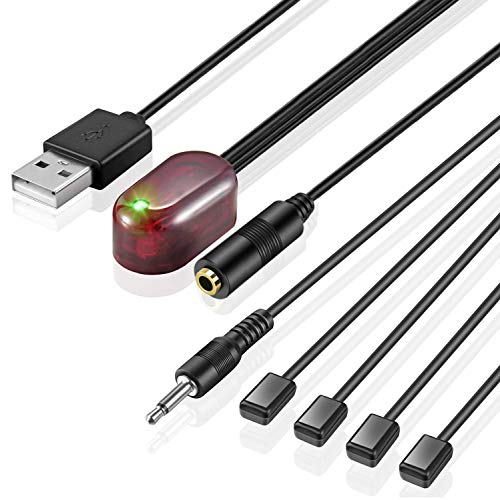
- Controls up to four IR devices
- Includes one receiver and four emitters
- Works across a 34–60 kHz frequency range
Best For: Smaller multi-component home theaters
Extended Wireless Reach

- Wireless distance rated up to 650 feet
- Supports up to 10 devices
- Includes USB and AC power options
Best For: Long-distance and multi-zone IR installations
Best Compact Wired Pick

- 6-foot USB-powered wired design
- Blue LED confirms signal transmission
- Adhesive-backed parts simplify mounting
Best For: Wall-mounted TVs with nearby concealed A/V equipment
Best Long-Range Wireless Pick
SPENFiLY WL-E2 Wireless IR Repeater

- Through-wall 433 MHz wireless control
- Over 50 m indoor range listed
- External antenna with 130° reception
Best For: Multi-room and multi-floor infrared A/V systems
Best Extended Cable Reach
Cable Matters 10ft IR Extender
- 10-foot cable supports flexible routing
- USB-powered with adhesive mounting
- Blue LED confirms signal transmission
Best For: TV setups with more distant concealed A/V sources
Best Ethernet Reach

- Up to 300 m over Cat5e/Cat6/Cat8 cable
- Controls up to four IR devices
- Replaceable emitters support expansion
Best For: Long-distance, multi-device AV installations
Best Simple Setup

- USB-powered receiver and transmitter
- Rated for remote operation up to 22 feet
- Designed for hidden cabinet AV equipment
Best For: Straightforward TV-cabinet and home-theater setups
Best Simple Pick

- Up to 700 feet between receiver and emitter
- Supports 20–60 kHz infrared devices
- LED signal indicator and compact design
Best For: Long-distance wireless IR installations
Multi-Device Cabinet Control – 10-Device IR Repeater
For shoppers comparing compact infrared repeaters for a hidden home-theater setup, this ICESPRING kit is designed to control equipment behind cabinet doors or in another room. It supports up to 10 devices and can expand to 12, with included emitters for connecting multiple components.
Best For: Large entertainment centers that need centralized control of multiple IR devices.
Pros:
- Controls up to 10 devices and is expandable to 12.
- Includes five dual IR emitters with 10-foot cables.
- Supports real-time transmission and works in most lighting environments, including areas with CFL lighting.
Cons:
- Plasma displays may cause interference.
- Multiple receivers should be spaced at least 6 meters apart.
- The included receiver cable is only 5 feet long.
This is a flexible choice when you need to hide several components, though careful receiver placement is important to reduce interference.
Long-Range USB Setup – 49-Foot IR Extender Cable
This Herfair kit is a practical option among compact infrared repeaters when you want to operate a cable box, DVD player, or other source from across the room. Its 11-foot cable assembly uses USB power and supports control distances up to 49 feet at a 45-degree angle.
Best For: Simple TV and set-top-box installations needing a long control range and USB power.
Pros:
- Supports up to 49 feet of remote-control distance.
- USB-powered design connects to a TV, cable box, or wall adapter.
- Adhesive backing makes both IR heads easy to mount.
Cons:
- Both IR heads need suitable placement and line of sight for the remote.
- Should be kept away from routers to help prevent interference.
- The kit is powered through USB and does not include a broader multi-emitter distribution system.
With its straightforward adhesive installation and generous range, this model suits tidy single-source setups more than complex multi-component systems.
Room-to-Room Control – Four-Emitter IR Repeater
If you need compact infrared repeaters for a modest entertainment system, this URWOOW kit provides one receiver and four emitters for controlling components from another room. Its 34–60 kHz operating range supports many common IR devices, while USB power keeps installation simple.
Best For: Home theaters with up to four IR-controlled components.
Pros:
- Includes four emitters for simultaneous control of multiple devices.
- Supports a 34–60 kHz operating range.
- USB-powered 5V design offers convenient connectivity.
Cons:
- Supports a maximum of four devices.
- Users should aim the remote at the receiver for optimal performance.
- The receiver cable is 2 meters and emitter cables are 1 meter, which may limit placement in larger cabinets.
This is a sensible middle-ground kit for a smaller system, especially when four emitters are enough and you value uncomplicated USB-powered installation.
Extended Wireless Reach – BlastIR Wireless Pro Repeater
For installations where distance matters, the Sewell BlastIR Wireless Pro stands out among compact infrared repeaters with a stated wireless distance of up to 650 feet, though obstacles can reduce that figure. It supports up to 10 devices and includes receiver and emitter cables, mounting adhesive, rubber feet, and USB and AC power cables.
Best For: Large homes or multi-zone setups requiring wireless IR extension over substantial distances.
Pros:
- Offers a stated wireless distance of up to 650 feet.
- Supports up to 10 devices and multi-zone control.
- Includes flexible power, mounting, and emitter-cable accessories.
Cons:
- Works only with IR devices, not remotes that use RF.
- The receiver is directional and requires appropriate aiming.
- Specific incompatibilities include Yamaha HTR 6140, Arris DCX 3520E-M, and OSD ATM-7 Speaker Selector.
This model is the strongest fit for long-distance or customized installations, provided your equipment uses compatible IR signals and is not among the listed exceptions.
Best Compact Wired Pick – Cable Matters 6ft IR Extender
For a straightforward home-theater installation, this compact infrared repeater uses a 6-foot cable to carry remote commands from your viewing area to concealed A/V equipment. Its USB power connection, adhesive-backed cables, and signal-confirming blue LED make it practical for TV and entertainment setups.
Best For: Wall-mounted TVs and compact entertainment systems where a wired repeater can connect to a hidden Blu-ray player, receiver, DVD player, or set-top box.
Pros:
- 6-foot cable helps connect a TV area with a nearby concealed device.
- Blue receiver LED verifies signal transmission.
- USB-powered design and adhesive backing support simple installation.
- Works with most A/V equipment using infrared sensors.
Cons:
- Requires a separate 5V USB wall charger; the TV USB port may not power it when the TV is off.
- Does not work with RF-only devices.
- Specified IR range is up to 15 feet.
This is a sensible choice when you want a lightweight, wired solution rather than a wireless multi-room system. Keep the receiver facing forward and position it away from potential interference sources such as Wi-Fi routers and CFL bulbs.
Best Long-Range Wireless Pick – SPENFiLY WL-E2 Wireless IR Repeater
SPENFiLY Remote Control Wireless Repeater-Dual Eye IR Emitter Remote Repeater System Kit WL-E2
Check Price On AmazonThis compact infrared repeater is designed for through-wall and multi-room control, using a 433 MHz wireless link instead of a direct cable. The external antenna, wide 130-degree reception angle, and included power accessories suit larger home-theater or office installations.
Best For: Multi-room, multi-floor, or multi-zone A/V setups that need wireless infrared control over longer distances.
Pros:
- Supports through-wall remote control for infrared devices.
- Wireless range is listed as over 50 meters indoors and over 200 meters outdoors.
- External antenna provides a 130-degree reception angle.
- Kit includes receiving and transmitting hosts, transmitter, receiver, USB cables, power adapters, and manual.
Cons:
- More equipment and power accessories than a simple wired repeater.
- Designed for infrared devices, so it is not a universal RF-device controller.
- The supplied specifications identify the wireless link as 433 MHz rather than describing a standard consumer remote protocol.
Choose this system when cable routing between rooms is the main obstacle. Its expansion-focused design can accommodate additional transmitters or receivers, making it better suited to distributed A/V control than a single-TV installation.
Best Extended Cable Reach – Cable Matters 10ft IR Extender
When a hidden source sits farther from the TV, this 10-foot compact infrared repeater provides extra cable reach without changing to a wireless system. It repeats remote commands to compatible A/V equipment, with USB power, adhesive mounting, and a blue LED to confirm transmission.
Best For: Wall-mounted TV installations where a concealed DVD player, receiver, or set-top box is more than a few feet from the display.
Pros:
- 10-foot cable offers more routing flexibility than the shorter version.
- Blue receiver LED helps confirm that commands are being transmitted.
- USB-powered design uses a 5V connection and includes adhesive-backed Tx and Rx cables.
- Compatible with most A/V equipment that uses infrared sensors.
Cons:
- Requires a 5V USB wall charger for reliable power when the TV is off.
- Does not work with RF signal devices.
- Listed IR signal range is up to 15 feet, so longer cable length does not expand that stated range.
The 10-foot version is the practical pick when installation distance matters more than minimizing cable. Position the receiver within remote line of sight, face its LED forward, and avoid placing it near likely interference sources.
Best Ethernet Reach – 4-Device Ethernet IR Repeater
For installations that need long cable runs, this Ethernet-based option is one of the more flexible compact infrared repeaters. It uses Cat5, Cat5e, Cat6, or Cat8 cable and can transmit signals up to 300 meters, making it useful for hiding AV equipment in cabinets or another room.
Best For: Multi-device setups that need extended reach over existing Ethernet cable.
Pros:
- Supports transmission distances up to 300 meters with compatible Ethernet cable.
- Can control up to four infrared devices simultaneously.
- Works with many common AV components, including cable boxes, DVD players, receivers, and game consoles.
- Replaceable IR emitters allow for future expansion or replacement.
Cons:
- Requires a wired Ethernet-cable installation.
- The supplied package lists one IR emitter port, so expansion may require additional emitters.
This is the strongest choice of the three for structured, long-distance installations. Choose it when cable length and multi-device control matter more than the simplest plug-and-place setup.
Best Simple Setup – USB IR Extender Kit
This USB-powered kit is a straightforward pick among compact infrared repeaters for a TV cabinet or home theater. Place the receiver where the remote can reach it, position the transmitter near the hidden device, and connect USB power for control at distances up to 22 feet.
Best For: Everyday TV-cabinet installations where simple setup and hidden AV equipment are the priorities.
Pros:
- Includes both an IR receiver and transmitter.
- USB-powered design is convenient for many entertainment centers.
- Supports common equipment such as cable boxes, satellite receivers, DVD/Blu-ray players, and AV receivers.
- Offers a simple one-tap setup and a 22-foot range.
Cons:
- Its stated range is shorter than the other options in this roundup.
- Requires the controlled device to use infrared remote technology.
For a typical cabinet installation, this kit keeps the process uncomplicated while preserving remote access. It is a practical choice when you do not need multi-room Ethernet wiring or an especially long transmission distance.
Best Simple Pick – 700-Foot Wireless IR Repeater
If you need a long-distance link without running Ethernet cable, this wireless model stands out among compact infrared repeaters. It supports 20–60 kHz infrared devices, includes LED signal indication, and is designed to hide AV components while maintaining remote access.
Best For: Wireless installations requiring unusually long separation between the IR receiver and emitter.
Pros:
- Advertises up to 700 feet between the infrared emitter and receiver.
- Supports a broad 20–60 kHz infrared frequency range.
- Provides real-time transmission and an LED indicator when a signal is received.
- Compact design with included cable and instruction manual.
Cons:
- Only works with devices that have an active infrared receiver.
- Not compatible with Bluetooth remotes or devices controlled through apps or Wi-Fi.
- Emitter cables need careful placement near the source device’s IR sensor for best results.
This model offers the greatest stated reach, but compatibility and emitter placement deserve close attention. Verify that your equipment uses IR before choosing it, especially if your system includes newer streaming devices or smart TVs.
How We Picked These Compact Infrared Repeaters
We selected these Compact Infrared Repeaters to cover the most common home-theater installation needs rather than focusing on one connection style. The lineup includes short and extended cables, wireless systems, dual-eye emitters, hidden-component designs, and models that use Cat5e or Cat6 Ethernet cabling. We prioritized practical setup features, broad device compatibility, signal reach, and the ability to keep equipment out of sight.
Before buying, verify the product’s connector type, emitter arrangement, power requirements, and compatibility with your television, receiver, set-top box, or other infrared-controlled device. IR repeaters generally work with standard infrared remotes, but they do not replace radio-frequency or Bluetooth control systems.
Quick Comparison
| Need | Best style to consider | Why |
|---|---|---|
| Simple single-device extension | 6- to 11-foot wired kit | Affordable and easy to route behind furniture |
| Multiple components | Dual-eye or multi-emitter system | Helps send commands to more than one hidden device |
| Minimal visible wiring | Wireless repeater | Offers more flexible placement between the remote and equipment |
| Long cable runs | Ethernet-connected repeater | Uses existing Cat5e, Cat6, or similar cabling |
| Large or separated spaces | Long-range wireless model | Useful when the receiver and equipment are far apart |
Key Buying Factors for Compact Infrared Repeaters
Connection and Cable Length
Measure the route from the receiver location to the hidden device before choosing a kit. Six-foot cables suit nearby components, while 10- or 11-foot versions provide more flexibility behind cabinets and wall-mounted displays. Avoid sharply bending cables or placing them where doors and drawers can pinch them.
Emitter Design
A single emitter is adequate for one component. Dual-eye systems are more practical when controlling a television and set-top box, receiver, or disc player from the same location. Check whether the emitters attach directly over the device’s IR sensor or sit nearby with a wider transmission pattern.
Wireless Range and Interference
Wireless repeaters can simplify installations, but stated range is usually measured in open conditions. Walls, cabinets, metal surfaces, and other wireless devices may reduce performance. For a short cabinet-to-sofa installation, a wired kit may be more predictable; for separated rooms or difficult cable routes, wireless may be worth the trade-off.
Power, Mounting, and Compatibility
Confirm whether the system uses USB power, an AC adapter, or another power source, and make sure an outlet is available near the receiver or transmitter. Adhesive-backed emitters and compact receivers can make installation easier. Test the repeater before permanently mounting components, especially if the device is inside a closed cabinet.
Who Should Buy Which Compact Infrared Repeaters?
Choose a basic wired repeater if you need an inexpensive solution for one hidden set-top box or AV component. Select a longer-cable model when the equipment is several feet from the display. A dual-emitter system is better for installations with multiple components, while a wireless kit suits rooms where routing a cable would be inconvenient. If your home already has unused Ethernet cabling between locations, an RJ45-compatible repeater can provide a cleaner long-distance installation. For unusually large spaces, consider a long-range wireless model, but treat its advertised distance as a best-case figure and confirm return policies in case the environment introduces interference.