
Choosing among 4K camera external recorders can be difficult because the category spans compact monitor-recorders, studio decks, integrated camcorders, and creator-focused video cameras. The right option depends on your workflow, inputs, recording format, and need for portability.
We compare ten notable choices for 2026, from professional SDI and HDR production tools to accessible cameras for streaming, music, and everyday content creation.
Best 10 4K Camera External Recorders Picks for 2026
Best Pro 4K Recorder

- 1500-nit 5-inch touchscreen
- Records up to 6K RAW
- HDMI, Wi-Fi 6E, and NDI support
Best For: Professional filmmakers needing advanced monitoring and RAW recording
Best All-in-One Camcorder
Canon XA75 Professional Camcorder

- 4K UHD internal recording
- 15x optical zoom with stabilization
- Mini-HDMI and 3G-SDI outputs
Best For: Documentary, journalism, events, and live streaming
Best Studio Deck
Blackmagic HyperDeck Studio 4K Pro

- 12G-SDI and HDMI 2.0 inputs
- Records to SSDs or SD cards
- Professional timecode and reference I/O
Best For: Studio, broadcast, switcher, and post-production systems
Best Budget Monitor Recorder
FEELWORLD CUT6S 6-inch Monitor

- 6-inch 1080p touchscreen
- Accepts 4K 60Hz HDMI input
- USB MP4 recording up to 1080p30
Best For: HD monitoring, basic recording, and SDI-to-HDMI workflows
Best All-in-One Audio Pick

- 4K video with up to four audio tracks
- Two XLR inputs with phantom power
- USB streaming and SD recording up to 512GB
Best For: Musicians and creators needing flexible multi-source audio
Best Monitoring and Recording Monitor

- 6-inch 1080p touchscreen display
- Records HDMI video up to 1080p30
- Accepts 4K 60Hz input with pro monitoring tools
Best For: Camera operators needing a large monitor and USB recording
Best Compact Live-Performance Recorder

- 4K video with a 150-degree wide-angle lens
- X/Y microphones rated to 120dB SPL
- USB streaming and tripod-ready pocket-sized design
Best For: Musicians recording concerts and rehearsals on the go
Professional ENG Pick

- UHD 4K60 4:2:2 10-bit capture
- 12G-SDI, HDMI, USB-C, and four XLR inputs
- 15x zoom with dual SD recording
Best For: ENG, sports, live entertainment, and narrative production
IP Production Choice

- 4K capture with 5-axis hybrid stabilization
- Ethernet, Wi-Fi, IP recording, and NDI|HX
- 25mm wide lens with 24x optical zoom
Best For: Live production, streaming, and networked event video
Budget Creator Option
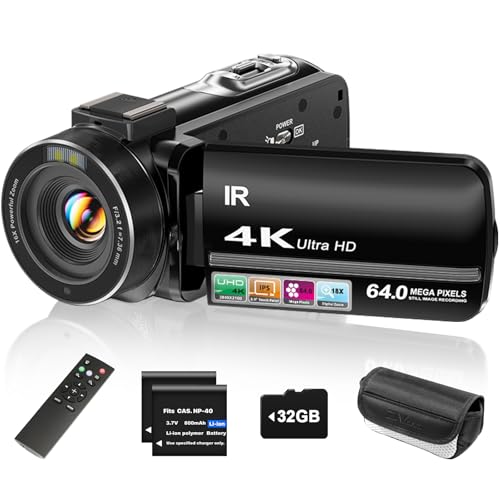
- 4K video and 64MP still-photo claims
- Rotating touchscreen and infrared night vision
- Webcam mode with remote, two batteries, and 32GB card
Best For: Beginner vloggers, travel recording, and family video
Best Pro 4K Recorder – Atomos Ninja TX GO
Atomos Ninja TX GO 5-inch Camera Monitor-Recorder, HDMI CFexpress Wi-Fi HDR Touchscreen ProRes RAW
Check Price On AmazonThe Atomos Ninja TX GO is a versatile choice for creators comparing 4k camera external recorders. Its bright 5-inch touchscreen combines monitoring, camera control, and recording, while HDMI and Wi-Fi 6E connectivity support modern production workflows.
Best For: Professional filmmakers and hybrid production teams needing RAW recording, monitoring tools, and flexible storage.
Pros:
- Records ProRes RAW, ProRes, Avid DNx, H.265, and H.264.
- Captures up to 6K RAW to CFexpress Type B or compatible USB-C storage.
- Bright 1500-nit touchscreen with touch-to-focus and professional scopes.
- Supports HDMI, Wi-Fi 6E, NDI, and direct ATOMOSphere uploads.
Cons:
- CFexpress storage, some accessories, and certain cloud services are sold separately.
- Its 0.7 kg body and external power or battery requirements add to a camera rig.
The Ninja TX GO stands out when recording flexibility matters more than a minimal setup. It is especially compelling for users working across multiple NLEs and needing both a high-visibility monitor and advanced external recording.
Best All-in-One Camcorder – Canon XA75 Professional Camcorder
The Canon XA75 is an all-in-one camcorder for shoppers who want 4k camera external recorders without building a separate camera-and-recorder rig. It combines a 1-inch sensor, 15x optical zoom, internal 4K recording, and professional video outputs.
Best For: Documentary, journalism, event, and live-streaming work requiring integrated zoom, stabilization, and pro audio.
Pros:
- Records 4K UHD up to 160Mbps at 30P or 24P.
- Provides mini-HDMI and 3G-SDI outputs for external devices.
- 15x optical zoom and optical image stabilization support flexible shooting.
- Dual SD slots enable relay or simultaneous recording.
Cons:
- This is a complete camcorder rather than a standalone external recorder.
- Its listed 4K recording formats are XF-AVC and MP4, not ProRes RAW.
The XA75 makes sense when simplicity and reliable field operation are priorities. Its integrated lens, dual-card recording, XLR audio, and SDI connectivity offer a practical package for professional video production.
Best Studio Deck – Blackmagic HyperDeck Studio 4K Pro
The Blackmagic Design HyperDeck Studio 4K Pro is a rack-style option for production environments evaluating 4k camera external recorders. It accepts 12G-SDI and HDMI 2.0 sources, records to SD cards or SSDs, and provides extensive signal, audio, timecode, and control connections.
Best For: Studio, broadcast, switcher, and post-production setups that need a high-capacity deck with professional I/O.
Pros:
- Records to two 2.5-inch SSD slots or two SD card slots.
- Supports ProRes, DNxHD, uncompressed, H.264, and H.265 recording.
- Offers 12G-SDI, HDMI 2.0, reference, timecode, 10 Gb/s Ethernet, and RS-422.
- Includes a front LCD, jog wheel, speaker, and streaming support.
Cons:
- Its 1 RU form factor and 8.1-pound weight are less suitable for lightweight field rigs.
- A power cord is not included.
This HyperDeck is best viewed as a serious facility recorder rather than a portable camera accessory. Its broad storage support and connectivity make it a strong fit for fixed installations and multi-device workflows.
Best Budget Monitor Recorder – FEELWORLD CUT6S 6-inch Monitor
The FEELWORLD CUT6S combines a 6-inch field monitor with basic USB recording, making it a practical entry-level choice among 4k camera external recorders. It accepts 4K 60Hz HDMI input but records compatible video up to 1080p30 in MP4 format.
Best For: Camera operators who want a larger touchscreen monitor, exposure tools, and simple recording for compatible HD signals.
Pros:
- 6-inch 1920×1080 touchscreen provides a clear monitoring view.
- Offers waveform, RGB parade, vectorscope, histograms, and other monitoring tools.
- Supports 3G-SDI input/output and HDMI input with SDI-to-HDMI conversion.
- Records to a FAT32 USB flash drive and supports LUT effects.
Cons:
- Recording is limited to up to 1080p30, despite accepting 4K 60Hz HDMI input.
- NP-F battery is not included in the listed package.
- USB recording requires a compatible FAT32 flash drive.
The CUT6S is a sensible monitor-first solution for HD recording and multi-person viewing. Buyers seeking native 4K recording should choose a more capable recorder, but this model offers useful scopes and signal conversion at a simpler level.
Best All-in-One Audio Pick – Zoom Q8n-4K
For creators comparing 4k camera external recorders, the Zoom Q8n-4K stands out as a complete video-and-audio solution. It records 4K video at up to 30fps, supports four simultaneous audio tracks, and includes two XLR inputs with phantom power.
Best For: Musicians, filmmakers, streamers, and solo creators who need flexible multi-source audio with 4K video.
Pros:
- Records 4K video alongside up to four audio tracks.
- Two XLR inputs with phantom power support microphones, instruments, and mixers.
- Streams over USB while recording locally to an SD card up to 512GB.
- Offers five fields of view and interchangeable capsules.
Cons:
- Its 680g handy form factor is less pocketable than a compact recorder.
- Maximum listed video frame rate is 30fps in 4K.
The Q8n-4K is a strong choice when audio flexibility matters as much as image quality. Its XLR connectivity, local recording, flip-out screen, and remote-control support make it especially practical for live performances and solo production.
Best Monitoring and Recording Monitor – FEELWORLD CUT6 6-Inch Monitor
The FEELWORLD CUT6 combines a 6-inch touchscreen monitor with basic external recording, making it a useful option among 4k camera external recorders for compatible DSLR and mirrorless setups. It accepts 4K 60Hz HDMI input but records video up to 1080p30 to a FAT32 USB flash drive.
Best For: Filmmakers and livestreamers who want a larger monitoring display, exposure tools, and straightforward USB recording.
Pros:
- 6-inch 1920×1080 touchscreen provides a clear monitoring view.
- Records compatible HDMI video up to 1080p30 in MP4 format.
- Supports 4K 60Hz HDMI input and HDMI loop-out up to 1080p60.
- Includes waveform, vectorscope, focus peaking, zebra, false color, and audio-meter tools.
Cons:
- Recording is limited to 1080p30 rather than 4K.
- USB recording requires a FAT32-compatible flash drive.
- It is a field monitor for compatible cameras, not a standalone camera.
The CUT6 is best viewed as a monitoring-first accessory with convenient recording features. Its LUT support and professional exposure and focus aids can streamline shooting, while the 4K input capability preserves compatibility with higher-resolution camera sources.
Best Compact Live-Performance Recorder – Zoom Q2n-4K
The pocket-sized Zoom Q2n-4K is a convenient choice for creators seeking 4k camera external recorders without a bulky setup. It captures 4K video through a 150-degree wide-angle lens and uses X/Y microphones rated to 120dB SPL for loud performances.
Best For: Musicians, performers, and streamers recording rehearsals, concerts, and live content on the go.
Pros:
- Captures 4K video with five field-of-view settings.
- X/Y microphones handle sound levels up to 120dB SPL.
- HDR and 12 scene presets help with varied lighting conditions.
- Streams to platforms such as YouTube, Twitch, and Facebook over USB.
Cons:
- It has no image stabilization.
- Fixed focus may be less flexible for changing subject distances.
- Its built-in microphones do not offer the Q8n-4K’s two XLR inputs.
The Q2n-4K favors portability and simplicity over expanded connectivity. Its wide view, high sound-pressure handling, tripod mount, and direct USB streaming make it well suited to documenting performances with minimal equipment.
Professional ENG Pick – Canon XF605 4K Camcorder
For demanding 4k camera external recorders workflows, the Canon XF605 combines UHD 4K60 capture, professional connectivity, and flexible recording options in a compact camcorder. Its 12G-SDI and HDMI outputs make it a strong fit for broadcast-style setups, while dual SD slots support simultaneous codec and rate recording.
Best For: ENG, sports, live entertainment, and narrative shooters who need professional video and audio connections.
Pros:
- Records UHD 4K60 in 4:2:2 10-bit with XF-AVC and H.264/H.265 options
- Offers 12G-SDI, HDMI, USB Type-C video output, and four XLR inputs
- Includes a 1-inch CMOS sensor, 15x optical zoom, Canon Log 3, HDR, and autofocus features
- Dual SD slots can record different codecs and rates simultaneously
Cons:
- Its professional feature set and 12.8-pound bundle weight may be more than casual users need
- The supplied notes do not indicate water resistance
The XF605 is the most production-oriented option here for buyers who need robust outputs and high-quality internal capture. It is especially compelling when an external recorder or broadcast workflow is part of the setup.
IP Production Choice – Panasonic CX20 4K Camcorder
Panasonic CX20 Professional Compact 4K Camcorder with XLR Inputs & IP Connectivity
Check Price On AmazonThe Panasonic CX20 is a practical choice for 4k camera external recorders setups that also require network production features. It pairs 4K capture with Ethernet, Wi-Fi, IP streaming and recording, and NDI|HX support, giving compact production teams several connectivity options.
Best For: Live production, streaming, and event video where IP connectivity and stabilization are priorities.
Pros:
- Supports 4K capture with a 1/2.5-inch MOS sensor
- Includes Ethernet, Wi-Fi, IP streaming and recording, and NDI|HX support
- Combines 5-axis hybrid stabilization with optical image stabilization
- Provides a 25mm wide lens and 24x optical zoom
Cons:
- The smaller 1/2.5-inch sensor is less substantial than the Canon XF605’s 1-inch sensor
- The supplied notes do not list SDI or HDMI outputs
The CX20 stands out when networked video matters as much as the camera itself. Its IP features and stabilization make it well suited to mobile crews and live workflows, though buyers specifically seeking traditional SDI output should verify compatibility before purchasing.
Budget Creator Option – ZYDIIE 4K Vlogging Camcorder
For entry-level 4k camera external recorders use, the ZYDIIE HDV3051LTRM-4K focuses on simple recording and creator-friendly extras rather than professional I/O. It includes a rotating touchscreen, USB webcam functionality, infrared night vision, a remote, two batteries, and a 32GB card.
Best For: Vlogging, family videos, travel recording, interviews, and beginner livestreaming.
Pros:
- Offers 4K video recording and 64MP still-photo capture according to the supplied notes
- Includes an 18x digital zoom and infrared night vision
- 270-degree rotating 3-inch touchscreen supports self-recording and unusual angles
- Works as a USB webcam and includes a remote, two batteries, and a 32GB card
Cons:
- Uses fixed focus and digital stabilization rather than professional autofocus and optical systems
- Connectivity details list USB only, with no professional SDI, HDMI, or XLR inputs noted
- Its stated AVI capture format is less production-oriented than the other options
This camcorder is best viewed as an affordable creator starter kit, not a professional external-recorder camera. Its bundled accessories and webcam mode add convenience, while the lack of listed pro outputs limits more advanced production workflows.
How We Picked These 4K Camera External Recorders
We evaluated the selected products by looking at recording resolution, supported codecs and media, input and output connectivity, monitoring features, audio capability, portability, and intended use. We also considered whether each model is best treated as an external recorder, a complete camcorder, a field monitor with recording, or a compact creator camera. This helps separate professional production equipment from simpler all-in-one options.
Quick Comparison
| Best For | Look For |
|---|---|
| Professional cinema and field production | RAW or ProRes recording, HDR monitoring, reliable media, and HDMI or SDI connectivity |
| Broadcast and studio workflows | SDI, rack-friendly design, timecode, reference support, and dependable long-form recording |
| Corporate, event, and documentary video | Integrated zoom lens, XLR audio, stabilization, autofocus, and practical battery life |
| Musicians and streamers | Simple operation, wide-angle coverage, good audio options, and easy file transfer |
| Budget vlogging | Flip or rotating screen, basic 4K capture, compact controls, and low purchase cost |
Key Buying Factors for 4K Camera External Recorders
Recording Format and Media
Check whether the recorder captures internally or only passes a signal to another device. ProRes, ProRes RAW, and other edit-friendly formats can simplify post-production but require faster, larger storage. Confirm the supported card, SSD, or CFexpress type before buying.
Inputs, Outputs, and Compatibility
HDMI is common in DSLR, mirrorless, and compact-camera setups, while SDI is preferred for longer cable runs and professional systems. Verify connector type, signal resolution, frame-rate support, and whether the recorder works with your camera’s clean output.
Monitoring and Exposure Tools
A bright touchscreen, HDR display, waveform, false color, focus peaking, and exposure zebras can be more valuable than resolution alone. For outdoor work, consider screen brightness and viewing angles rather than relying only on the display size.
Audio and Long-Recording Needs
For interviews, events, and live performances, prioritize XLR inputs, headphone monitoring, manual level controls, cooling, and uninterrupted recording behavior. Compact creator cameras may be convenient, but professional camcorders generally offer more dependable audio and handling.
Portability and Workflow
External monitor-recorders add weight, batteries, cables, and mounting requirements. Integrated camcorders are faster to deploy, while studio recorders are better suited to fixed installations. Match the equipment to how often you move, how long you record, and how quickly footage must reach an editor or stream.
Who Should Buy Which 4K Camera External Recorders?
Choose a monitor-recorder such as the Atomos option if you already own a compatible camera and want better monitoring or higher-quality external recording. A Blackmagic studio deck is more appropriate for controlled broadcast, post-production, or rack-based environments.
Professional camcorders from Canon or Panasonic make the most sense for event crews, news, education, and corporate teams that need an integrated lens, dependable audio, and fast setup. FEELWORLD models suit shooters who want an affordable field monitor with recording features.
Zoom’s compact recorders are strong choices for musicians, streamers, and filmmakers seeking simple operation and wide-angle coverage. The budget 4K camcorder is best for casual vlogging and inexpensive starter setups, provided its limitations in optics, audio, stabilization, and low-light performance fit your expectations.