
Large-format resin printers are ideal when you need more build volume without giving up the fine detail resin printing is known for. They’re a strong fit for terrain, helmets, prototypes, and batch printing.
This roundup focuses on models that balance print area, resolution, reliability, and day-to-day usability so you can choose a machine that matches your workflow and budget.
Best 10 Large Format Resin Printers Picks for 2026
High-Detail Smart Choice

- 16K resolution for fine detail
- Tank heating keeps resin at 30°C
- Auto-leveling plus AI monitoring
Best For: Detail-focused users who want easy setup
Reliable Viscosity Runner

- 14K LCD for crisp detail
- Supports resins up to 8,000 cps
- Auto-leveling and AI inspection
Best For: Advanced users printing high-viscosity resins
Precision Transparency Specialist

- 385nm light source reduces scattering
- 16K LCD with 14 × 19 μm XY resolution
- Heated resin system for cold-weather printing
Best For: Clear, high-detail prints and professional use
Compact Detail Specialist

- 7-inch 10K mono LCD for sharp, detailed prints
- LighTurbo light source supports smooth surface quality
- 6.04 x 3.42 x 6.49 inch build volume
Best For: Detail-focused users who want a compact resin printer for everyday projects
Budget-Friendly Precision Pick
ANYCUBIC Photon Mono 4 10K Resin Printer

- 7-inch 10K display with 9024 x 5120 resolution
- 17 x 17 µm pixels for detailed prints
- 4-point leveling and power-loss resume simplify use
Best For: Beginners and hobbyists who want high-resolution resin printing in a compact machine
Compact Precision Pick
ELEGOO Mars 5 Resin 3D Printer
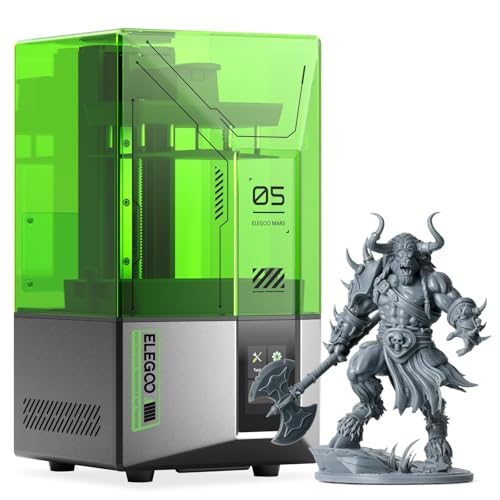
- One-click automatic leveling
- 4K mono LCD with COB light source
- Residue detection and overheat protection
Best For: Beginners who want easy setup and detailed resin prints
Advanced Large-Format Runner
Creality Halot-X1 Combo Resin 3D Printer

- 10.1-inch 16K mono LCD
- Large 211.68 × 118.37 × 200 mm build volume
- Intelligent resin heating and RFID loading
Best For: Advanced users who want a bigger build area and automation
Dual-Material Power Pick
ANYCUBIC Photon P1 Resin 3D Printer

- Dual-color and dual-material printing
- Supports ultra-high viscosity resins up to 8,000 cps
- AI monitoring with factory-calibrated leveling
Best For: Creators who want dual-material printing and tough resin support
Large-Format Speed Pick – ANYCUBIC Photon Mono M7 Max 7K
If you want large format resin printers that can handle full-size props without splitting models apart, the Anycubic Photon Mono M7 Max is built for exactly that. Its 298mm × 164mm × 300mm build volume gives you room for masks, game terrain, cosplay pieces, and bigger display models, while the upgraded light source and anti-aliasing features are aimed at cleaner detail.
Best For: Makers who need a very large build area plus faster resin printing for props, terrain, and oversized models.
Pros:
- Huge 298mm × 164mm × 300mm build volume for large prints
- LighTurbo 3.0 light source with reported 90%+ light uniformity
- Maximum speed up to 60mm/h with intelligent release 2.0
- Resin auto-fill, one-key recycling, and dynamic temperature control vat
Cons:
- Large footprint and 52.8-pound weight
- Big build area may be more printer than casual users need
The M7 Max stands out if your priority is volume first and detail second only in the sense that it still aims to keep layers sharp. It combines convenience features with high-capacity resin handling, so it suits users who regularly print bigger objects and want fewer interruptions.
High-Detail Smart Choice – ELEGOO Saturn 4 Ultra 16K
Among large format resin printers, the ELEGOO Saturn 4 Ultra 16K is aimed at users who want sharp detail, automation, and fast turnaround. Its 16K resolution is designed for smooth surfaces and fine textures, while the heated resin tank and tilt release system are there to improve print success and speed up model separation.
Best For: Creators who want high-detail prints with hands-off setup, heating, and monitoring features.
Pros:
- 16K resolution for very fine detail and smooth surfaces
- Smart tank heating maintains resin at 30°C for better adhesion
- Auto-leveling and plug-and-play setup reduce manual work
- AI camera with chamber light supports real-time monitoring
Cons:
- AI detection may vary by environment, model, and resin type
- Speed-focused features may be more than needed for simple prints
This is a strong pick if you want a machine that leans into convenience without giving up detail. The combination of auto-leveling, resin heating, and monitoring tools makes it a practical choice for users who want reliable workflow improvements as much as print quality.
Reliable Viscosity Runner – ANYCUBIC Photon P1 14K
The ANYCUBIC Photon P1 is a practical option if you need large format resin printers style workflow support with strong stability and materials flexibility. It combines auto-leveling, AI inspection, and a rigid motion system, while its 14K LCD and support for very high-viscosity resins make it appealing for users who want dependable results across advanced materials.
Best For: Makers and advanced users who want stable printing and compatibility with high-viscosity resins.
Pros:
- Stable structure with ball screws and precision guide rails
- Wave Release Technology reduces release force by 60%
- Smart Leveling 3.0 with factory calibration and corner feedback
- Handles resin viscosity up to 8,000 cps
Cons:
- Build volume is not highlighted in the supplied specs
- Advanced resin support may be unnecessary for basic hobby printing
If your priority is dependable operation with tougher resins, the Photon P1 is well equipped for that job. Its combination of stability, auto-leveling, and early issue detection makes it a sensible pick for users who value consistency and material flexibility.
Precision Transparency Specialist – UniFormation GK3 Pro 16K
The UniFormation GK3 Pro is built for users who care about fine detail, stable motion, and clear-print performance in resin printing. Its 385nm light source and 16K LCD are designed to reduce scattering and capture micro-detail, while the heated resin system helps keep prints consistent in colder conditions.
Best For: Professionals and makers who want high-precision clear prints, detailed models, and stable long-session performance.
Pros:
- 385nm light source helps reduce scattering and over-curing
- 16K LCD with 14 × 19 μm XY resolution for fine detail
- Heated resin system supports printing down to 5°C/41°F
- Rigid Z-axis with ball screw and linear guide for stable movement
Cons:
- Heavy machine at 53.7 pounds
- Designed more for precision workflows than quick casual printing
This printer makes sense if you want a highly controlled workflow for clear parts, prototypes, or detailed professional models. The combination of shorter-wavelength light, heating, and rigid mechanics suggests a machine aimed at consistency and accuracy first.
Compact Detail Specialist – ANYCUBIC Photon Mono 4
If you want a smaller resin machine for highly detailed work, this Anycubic model fits the bill well for buyers comparing large format resin printers and still wanting solid everyday usability. The 7-inch 10K mono LCD, 17 x 17 µm pixel size, and LighTurbo matrix light source are aimed at sharp output with smooth surfaces and reduced layer lines.
Best For: Hobbyists and makers who want high-detail resin printing in a compact, easier-to-manage footprint.
Pros:
- 7-inch 10K mono LCD with 9024 x 5120 resolution for fine detail
- LighTurbo matrix light source helps deliver balanced, uniform exposure
- 6.04 x 3.42 x 6.49 inch build volume covers many day-to-day projects
- Reworked build platform is designed to reduce lifting and warping
Cons:
- Build volume is much smaller than true large format resin printers
- Focused more on precision than on printing oversized parts
The Photon Mono 4 is a practical pick if detail matters more than size. It offers beginner-friendly touches like first-time leveling, power-loss resume, and pre-shipment calibration, making it easier to get consistent results without a steep setup curve.
Flagship Large-Volume Pick – ELEGOO Jupiter 2 16K Large MSLA Printer
Among large format resin printers, the ELEGOO Jupiter 2 stands out for builders who need serious volume and a feature-rich workflow. Its 302.4 × 161.98 × 300 mm build size, 16K resolution, auto-leveling, smart tank heating, and auto resin feeding all point toward high-capacity printing with fewer manual interruptions.
Best For: Users who want a very large resin printer for oversized models, batch production, and automated convenience.
Pros:
- Very large 302.4 × 161.98 × 300 mm build volume
- 16K resolution with 20 × 26 µm XY resolution for high detail
- Auto-leveling, auto resin feeding, and smart tank heating add convenience
- Wi-Fi cluster management and built-in monitoring tools support workflow control
Cons:
- Large footprint and 63.8 lb weight make it a substantial machine
- More advanced features may be more than casual users need
If your priority is printing big parts or multiple smaller parts at once, Jupiter 2 is the most capable option here. It combines large-scale output with smart automation and safety features, making it a strong fit for demanding resin printing setups.
Budget-Friendly Precision Pick – ANYCUBIC Photon Mono 4 10K Resin Printer
This Anycubic Photon Mono 4 is a straightforward option for buyers comparing large format resin printers but who actually need a more compact, detail-first machine. It delivers a 7-inch 10K display, 17 x 17 µm pixel size, and a 153.4 x 87 x 165 mm build area, giving you strong resolution and enough room for smaller daily projects.
Best For: Beginners and hobbyists who want a simple resin printer with high resolution and easy setup.
Pros:
- 7-inch 10K screen with 9024 x 5120 resolution
- 17 x 17 µm pixel size supports fine detail
- Laser-engraved platform is designed to improve adhesion
- 4-point leveling and power-loss resume help simplify use
Cons:
- Build volume is limited compared with true large format resin printers
- Anycubic APP service is not supported for this model
This version of the Photon Mono 4 is best viewed as a precision-oriented everyday printer rather than an oversized machine. If your focus is reliable detail, easy leveling, and compact prints, it offers a very practical setup.
Compact Precision Pick – ELEGOO Mars 5 Resin 3D Printer
If you want large format resin printers to be simple to live with, the ELEGOO Mars 5 leans hard into convenience rather than size. It is a compact resin printer, but it stands out for one-click automatic leveling, quick self-checks, residue detection, and overheat protection, making it a practical choice for users who value low-friction setup and dependable everyday printing.
Best For: Beginners and hobbyists who want easy setup, smart safety checks, and detailed 4K resin prints in a smaller footprint.
Pros:
- One-click automatic leveling reduces setup hassle
- Smart checks help catch residue, resin shortage, and leveling issues early
- 4K mono LCD with COB light source supports fine detail
- Overheat protection and cooling add a safety buffer during longer prints
Cons:
- Build size is not aimed at true large-format projects
- Focused more on ease of use than production-scale throughput
This is a good fit if you want a resin printer that emphasizes reliability and straightforward operation over maximum build volume. It is especially appealing for first-time users who want strong print quality without constant calibration.
Advanced Large-Format Runner – Creality Halot-X1 Combo Resin 3D Printer
Among large format resin printers, the Creality Halot-X1 Combo is built for users who want speed, size, and automation in one machine. Its 211.68 × 118.37 × 200 mm build volume, 16K mono LCD, fixed build plate, and intelligent resin handling make it a strong option when you want professional-looking output without spending time on manual bed leveling.
Best For: Makers and advanced users who want a larger build area, very high resolution, and automated resin management.
Pros:
- 10.1-inch 16K mono LCD for ultra-fine detail
- Large 211.68 × 118.37 × 200 mm build volume
- No leveling required, with a fixed build plate ready out of the box
- Intelligent resin heating, RFID recognition, and weight monitoring improve workflow
Cons:
- Heavier and larger than entry-level machines
- More advanced feature set may be more than casual users need
This model makes sense if you are prioritizing throughput, resolution, and automation over a simple bare-bones setup. Its combination of speed and resin management is especially useful for users who print frequently and want consistent results.
Dual-Material Power Pick – ANYCUBIC Photon P1 Resin 3D Printer
If you are comparing large format resin printers for more specialized workflows, the ANYCUBIC Photon P1 stands out for dual-color and dual-material printing rather than sheer size alone. It pairs factory-calibrated leveling, AI inspection, and strong motion hardware with support for ultra-high viscosity resins, which makes it a flexible choice for users who want creative output and dependable results.
Best For: Creators and advanced hobbyists who want dual-material printing and compatibility with demanding resins.
Pros:
- Dual-color and dual-material printing expands creative options
- Supports ultra-high viscosity resins up to 8,000 cps
- Factory-calibrated Smart Leveling 3.0 reduces setup work
- AI monitoring and residue detection help improve print reliability
Cons:
- Build volume is not the main selling point here
- Specialized features may be unnecessary for simple single-material prints
This printer is best viewed as a capability-focused machine for users who need more than standard resin output. If your projects benefit from mixed materials or high-viscosity resins, it offers a strong blend of automation and flexibility.
How We Picked the Best Large Format Resin Printers
We focused on Large Format Resin Printers that offer a meaningful build area, strong pixel detail, and practical features that improve real-world printing. That includes auto-leveling, resin management, improved vat systems, heating, and LCD resolution that supports both display quality and part fidelity.
We also considered brand support, workflow convenience, and whether the printer is better suited to hobbyists, creators, or users printing larger parts regularly.
Quick Comparison
Use the largest build volume when size is the priority, but don’t ignore resolution and print stability. A bigger printer is not automatically better if you mainly print miniatures. If you need crisp surfaces and faster setup, a mid-size high-resolution model may be the smarter buy.
Key Buying Factors for Large Format Resin Printers
Build Volume
Check the usable print area, not just the advertised screen size. For masks, props, and larger functional parts, extra height and footprint matter as much as width.
Resolution and Pixel Size
Higher resolution and smaller pixel pitch help preserve edges, textures, and fine features across bigger prints. This matters more as the part size increases.
Leveling and Workflow Automation
Auto-leveling, auto resin feeding, smart heating, and improved vat handling can reduce failed prints and save time, especially on machines used frequently.
Light Source and Resin Compatibility
Match the printer’s light source and screen tech with the resins you use most often. Some systems are tuned for speed, while others prioritize detail or special material support.
Maintenance and Consumables
Large-format machines use more resin, and replacement screens or vats can cost more. Factor in ongoing costs, cleaning effort, and access to spare parts before buying.
Who Should Buy Which Large Format Resin Printers?
If you want the biggest build area for large props or batch production, prioritize the most spacious options in this lineup. If you care more about detail and easier setup, choose a high-resolution model with auto-leveling and workflow aids. For mixed-use buyers, the best choice is usually the printer that balances size, resolution, and automation rather than chasing the highest spec in one category.
For most shoppers comparing Large Format Resin Printers, the right pick comes down to what you print most often, how much post-processing you want to handle, and whether speed or surface quality matters more in your workflow.