
Moisture can cause stringing, popping, inconsistent extrusion, and clogged nozzles—especially with hygroscopic materials such as nylon, TPU, and PETG. The right filament dryer for Bambu Lab can help protect filament before and during printing.
This roundup compares 10 options, from AMS heater upgrades to enclosed multi-spool dryers, so you can match capacity, temperature control, and workflow to your printer setup.
Best 10 Filament Dryer for Bambu Lab Picks for 2026
Best Four-Spool Dryer

- Dries up to four 1 kg spools
- Two independent temperature-controlled chambers
- Automatic drying and multi-point protection
Best For: High-volume printing with multiple filament types
Best Large-Capacity Standalone

- Holds four 1 kg or two 2 kg spools
- Dual 200W chambers reach 85°C
- Combines drying with sealed storage
Best For: High-volume users needing large-spool standalone drying
Best Standalone Dryer
Creality Space Pi Filament Dryer

- 360° PTC hot-air circulation
- 45°C–70°C temperature range
- Supports 1.75 mm and 2.85 mm filament
Best For: Flexible standalone drying across common and composite materials
Best Independent AMS Drying
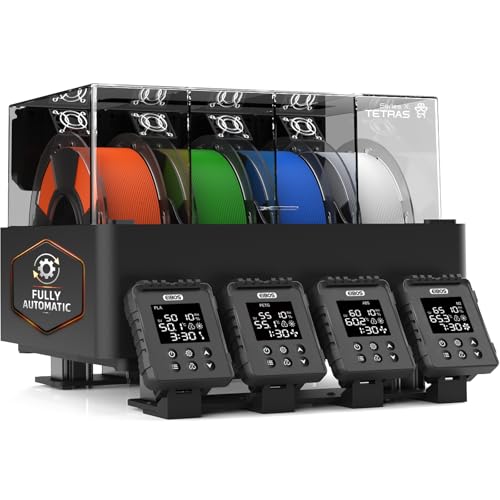
- Four independently controlled drying chambers
- Dries while printing from 20°C to 65°C
- Auto-vents, seals, and monitors humidity
Best For: Multi-material AMS Gen 1 workflows requiring separate spool settings
Best Dual-Spool Value

- Dries two 1kg spools simultaneously
- 150W PTC heating up to 70°C
- Presets for nine filament types
Best For: High-capacity drying for two spools or printers
Best Heavy-Duty Pick

- Two independent chambers for four spools
- Dries filament while printing
- Automatic venting, sealing, and humidity control
Best For: AMS Gen 1 owners running multi-material prints
Best Budget Storage Dryer

- Stores two 1kg spools
- 40–50°C adjustable heating
- LCD temperature and humidity monitoring
Best For: Simple PLA, PETG, ABS, and silk filament storage
Best AMS Upgrade – Sunlu AMS Active Heater
If you want a filament dryer for Bambu Lab without adding a separate box to your workspace, this SUNLU heater upgrades a first-generation Bambu Lab AMS with active drying. It can heat to 70°C in about 20 minutes and supports drying while printing.
Best For: Bambu Lab AMS Gen 1 owners who want integrated drying, humidity monitoring, and continued AMS functionality.
Pros:
- Enables simultaneous filament drying and printing inside the AMS.
- Supports common materials including PLA, PETG, ABS, TPU, PA, and nylon.
- Offers adjustable humidity settings, temperature monitoring, and automatic shutdown protections.
- Uses dual airflow and PTC heating for more uniform warming.
Cons:
- AMS is not included.
- Designed for first-generation Bambu Lab AMS units and not other brands’ material systems.
- Its integrated design is less suitable if you need a standalone dryer.
This is a practical choice when you already own a compatible AMS and want to reduce moisture-related bubbling, stringing, and adhesion problems without transferring spools to a separate dryer.
Best Four-Spool Dryer – Comgrow SH03 Filament Dryer
The Comgrow SH03 is a high-capacity filament dryer for Bambu Lab setups and other 3D printers. Its two independent chambers can hold up to four 1 kg spools, with separate controls for drying different materials at the same time.
Best For: High-volume users who need to dry or store multiple filament types simultaneously.
Pros:
- Holds up to four 1 kg spools in two independently controlled chambers.
- Adjustable 45–85°C temperature range suits materials from PLA and PETG to ABS, TPU, ASA, PA, and PC.
- 360° hot-air circulation promotes more consistent chamber temperatures.
- Includes automatic drying, humidity-based operation, and multiple protection monitors.
Cons:
- Its larger four-spool design may be more capacity than occasional users need.
- The supplied notes do not specify Bambu Lab-specific integration.
- Separate chamber controls may require more setup than a single-spool dryer.
Choose the SH03 if your priority is capacity and flexibility rather than direct AMS integration. Independent chambers are especially useful when different filaments require different drying temperatures.
Best Simple AMS Conversion – SUNLU AMS Heater
This SUNLU AMS Heater is a straightforward filament dryer for Bambu Lab AMS Gen 1 owners. It replaces the original lid in a three-step, non-destructive installation and lets the AMS dry filament while printing, reaching 70°C in around 20 minutes.
Best For: Users seeking a simple, space-saving AMS Gen 1 upgrade with four-spool capacity.
Pros:
- Enables simultaneous drying and printing.
- Installs by replacing the original lid without permanently modifying the AMS.
- Supports the AMS Gen 1’s existing functions and four-spool capacity.
- Directed airflow helps protect the feeding motor from overheating.
Cons:
- Not compatible with Bambu Lab AMS 2nd generation.
- The AMS itself is not included.
- Provides fewer listed humidity-control details than the other SUNLU AMS heater model.
This model makes sense if you want the core benefit of active AMS drying with minimal installation complexity. Confirm that your unit is a first-generation AMS before ordering.
Best Large-Capacity Standalone – Creality Space Pi X4
The Creality Space Pi X4 is a standalone filament dryer for Bambu Lab users who need more capacity than an AMS upgrade provides. It holds four standard 1 kg spools or two 2 kg spools, with dual 200W heating chambers reaching up to 85°C.
Best For: High-volume printers who want large-spool support, active drying, and moisture-controlled storage.
Pros:
- Accommodates four 1 kg spools or two 2 kg spools.
- Dual independent 200W chambers provide separate heating capacity.
- Supports temperatures from roughly 50–60°C for common materials and up to 85°C for advanced filaments.
- Sealed storage helps limit moisture reabsorption during pauses, while the viewing window keeps spools visible.
Cons:
- It is a standalone dryer rather than a direct Bambu Lab AMS upgrade.
- Its large capacity may take more space than a compact dryer.
- The supplied notes do not specify humidity automation details comparable to the Comgrow SH03.
The Space Pi X4 is a strong fit for users managing several spools or larger-format filament. It offers broad material support and storage functionality, but you will need to route filament from this separate enclosure to your printer.
Best AMS Gen 1 Upgrade – SUNLU AMS Heater
If you want a filament dryer for Bambu Lab AMS Gen 1, the SUNLU AMS Heater is designed to add active drying without replacing the four-spool AMS setup. It reaches 70°C in about 20 minutes and is intended to dry while printing.
Best For: Bambu Lab AMS Gen 1 owners who want a quick, no-tool upgrade for drying four spools simultaneously.
Pros:
- Reaches 70°C in approximately 20 minutes with PTC heating and dual airflow.
- Supports drying while printing and preserves AMS functions.
- Uses humidity sensing for automatic start and stop operation.
- Installs by swapping the original AMS top cover, without tools.
Cons:
- AMS Gen 1 is required; the Bambu Lab AMS is not included.
- It is an add-on heater rather than a standalone dryer.
The SUNLU is a practical choice when convenience and four-spool capacity matter most. Its automatic controls and fast heating make it a straightforward way to add active drying to a compatible AMS.
Best Standalone Dryer – Creality Space Pi Filament Dryer
The Creality Space Pi is a standalone filament dryer for Bambu Lab users who need flexible material support without modifying an AMS. Its 360° hot-air circulation, touchscreen controls, and broad temperature and timer settings suit everyday and composite filaments.
Best For: Makers who want a dedicated dryer for 1.75 mm or 2.85 mm filament, including PLA, PETG, TPU, ABS, ASA, and carbon-fiber blends.
Pros:
- 110W PTC heating and a fan circulate hot air for more uniform drying.
- Adjustable temperature from 45°C to 70°C.
- Supports up to 48 hours of timed drying with power-off setting memory.
- 3.7-inch LCD touchscreen offers material presets and °C/°F switching.
Cons:
- It is a separate dryer box, not an AMS-integrated upgrade.
- The supplied notes specify a 110V input, so compatibility should be checked before purchase.
Space Pi offers the broadest standalone control of these options. It is especially useful if you work with several filament types and prefer adjustable, long-duration drying rather than an AMS-mounted solution.
Best Independent AMS Drying – EIBOS Tetras AMS Dryer
The EIBOS Tetras is a premium-style filament dryer for Bambu Lab AMS Gen 1 that gives each of four spool positions its own drying controls. It can dry while printing, automatically vent moisture, and seal the chambers for storage after a cycle.
Best For: Bambu Lab AMS Gen 1 users who print multi-material projects and need independent drying settings for different spools.
Pros:
- Four independent chambers provide separate heaters, fans, sensors, and temperature controls.
- Supports drying during printing with settings from 20°C to 65°C and 30 minutes to 24 hours or unlimited operation.
- Automatic exhaust, sealing, and humidity monitoring help manage moisture after drying.
- Operates independently with its own power supply, separate from Bambu Lab firmware.
Cons:
- It is an add-on for Bambu Lab AMS Gen 1; the AMS is not included.
- At 8.8 pounds, it is substantially heavier than the listed standalone Space Pi.
Tetras is the most configurable option for mixed-material AMS workflows. Its independent chambers and automatic moisture management are compelling for users who regularly combine materials with different drying requirements.
Best Dual-Spool Value – Comgrow SH02 Filament Dryer
If you need a filament dryer for Bambu Lab that can handle two active spools, the Comgrow SH02 focuses on capacity, quick heating, and simple preset controls. Its 150W PTC heater reaches 50°C in about seven minutes and supports temperatures from 40–70°C.
Best For: Bambu Lab users who want to dry two 1kg spools at once or feed two printers from a sealed box.
Pros:
- Holds two 1kg spools and supports 1.75mm and 2.85mm filament.
- 360° circulating PTC heating reaches up to 70°C.
- One-key presets cover nine filament types, including PLA, PETG, TPU, ABS, and Nylon-related materials such as PA.
- Sealing rings and safety cutoffs help protect filament and the heater.
Cons:
- It is a separate dryer box rather than an AMS-integrated upgrade.
- The larger two-spool design may take more workspace than a single-spool dryer.
The SH02 is a practical choice when throughput matters more than direct Bambu Lab integration. Its dual-spool capacity and higher maximum temperature make it more versatile than basic low-temperature storage dryers.
Best Heavy-Duty Pick – EIBOS Dyas Filament Dryer
For Bambu Lab owners who want drying integrated with their AMS workflow, the EIBOS Dyas is an add-on for AMS Gen 1. It provides two independently controlled chambers for up to four spools and can dry filament while printing.
Best For: Bambu Lab AMS Gen 1 users who need multi-spool drying, independent temperature control, and automatic humidity management.
Pros:
- Upgrades an AMS setup to support four spools across two independent chambers.
- Dries while printing with adjustable chamber temperatures from 20–65°C.
- Automatic exhaust, sealing, and humidity monitoring help maintain storage conditions.
- Operates independently with its own power supply, so printer firmware updates do not affect dryer operation.
Cons:
- It is specifically an add-on for Bambu Lab AMS Gen 1; the AMS is not included.
- Its integration and four-spool capacity may be unnecessary for users with a single printer or occasional drying needs.
The Dyas is the most specialized option here for a Bambu Lab setup. Its independent chambers and print-while-drying operation are particularly useful for multi-material workflows, while the automatic sealing system also supports longer-term storage.
Best Budget Storage Dryer – Comgrow SH01 Filament Dryer
The Comgrow SH01 is a straightforward filament dryer for Bambu Lab users who want two-spool storage with gentle, adjustable heating. It supports standard 1.75mm and 2.85mm filament, with a 40–50°C temperature range and six- to 12-hour drying settings.
Best For: Everyday PLA, PETG, ABS, and silk filament storage when a simple two-spool dryer is sufficient.
Pros:
- Stores two 1kg spools in its large internal compartment.
- Works with standard 1.75mm and 2.85mm filament diameters.
- LCD controls show temperature and humidity information in real time.
- Sealed outlet design helps protect filament when the box is not in use.
Cons:
- The maximum temperature is 50°C, limiting its suitability for materials needing higher drying temperatures.
- Drying duration is limited to six- or 12-hour settings.
- The outlet must be opened during drying so moisture can escape.
The SH01 makes sense as a lower-temperature, dual-spool storage solution. It offers useful monitoring and sealed storage, but users drying higher-temperature materials should consider the SH02 or a more specialized system instead.
How We Picked the Best Filament Dryer for Bambu Lab
We focused on compatibility with Bambu Lab AMS workflows, practical spool capacity, heating performance, storage design, and the ability to dry filament while printing. The selection includes direct AMS heater upgrades as well as standalone dryers for users who need more capacity or broader printer compatibility.
We also considered useful differences between one-, two-, three-, and four-spool designs, including independent chambers, sealed storage, temperature range, heating coverage, and ease of loading. Product claims such as maximum temperature and drying speed should be checked against the manufacturer’s instructions before use.
Quick Comparison
| Type | Best For | Main Advantage | Potential Limitation |
|---|---|---|---|
| AMS heater upgrade | Bambu Lab AMS owners | Compact integration and drying during printing | Limited to compatible AMS hardware and capacity |
| Two-spool dryer | Small to medium print setups | Balanced size and flexibility | Less capacity than four-spool models |
| Four-spool dryer | Frequent printing and material variety | Higher throughput and larger storage capacity | Uses more workspace |
| Sealed storage box | Keeping filament dry between prints | Helps limit moisture exposure | May offer less active drying power |
Key Buying Factors for a Filament Dryer for Bambu Lab
AMS Compatibility
Confirm whether the unit is designed for the original Bambu Lab AMS, a specific generation, or standalone use. An AMS heater upgrade may be the cleanest option if you want to preserve your existing spool-handling workflow, but it will not provide the same flexibility as a separate dryer.
Capacity and Chamber Layout
Choose capacity based on how many materials you regularly use. Two-spool models suit occasional printing, while four-spool dryers are more useful for multicolor projects or users who rotate through several moisture-sensitive filaments. Independent chambers can be helpful when different materials need separate settings.
Temperature and Heating Control
Look for adjustable temperature control and even heat distribution rather than relying only on a high maximum temperature. PLA, PETG, TPU, nylon, and other materials have different drying requirements, so follow the filament manufacturer’s recommended settings.
Drying While Printing and Storage
If your filament absorbs moisture quickly, a dryer that feeds filament while heating can reduce re-exposure. Sealed storage, reliable spool clearance, and compatible outlet paths also matter for long prints.
Who Should Buy Which Filament Dryer for Bambu Lab?
Choose an AMS heater upgrade if you already own a compatible Bambu Lab AMS and want the most integrated solution. Choose a two-spool dryer if you need a compact unit for routine PETG, TPU, or occasional specialty-filament drying. Choose a four-spool dryer if you print frequently, use multiple materials, or want to prepare several spools at once. Choose a sealed storage-focused box if your main priority is keeping opened filament protected between jobs.