
The best field recorder with Bluetooth control gives you more freedom to monitor, manage, or transfer recordings without staying tethered to the device. The right model can simplify everything from lavalier interviews and location sound to music demos and voice notes.
Our selection spans compact 32-bit-float recorders, multitrack filmmaking tools, stereo handhelds, and Bluetooth-enabled voice recorders. Use the guide below to narrow the choices by workflow, connectivity, audio quality, and portability.
Best 10 Field Recorder with Bluetooth Control Picks for 2026
Best Pro XLR Pick
Zoom F3 with BTA-1 Bluetooth Adapter

- 32-bit float recording with dual AD converters
- Two locking XLR inputs and low-noise preamps
- Compact metal casing with wireless control adapter
Best For: Professional two-track field recording and sound design
Best Versatile Handheld
Xvive XV1-R 32-Bit Float Recorder

- 32-bit float WAV recording up to 96 kHz
- Built-in X/Y microphones handle up to 130 dB SPL
- USB microphone mode plus WAV and AAC formats
Best For: Creators needing portable recording and USB audio flexibility
Best Compact Bluetooth Recorder
Olympus LS-P4 Linear PCM Recorder

- TRESMIC three-microphone recording system
- FLAC lossless recording and playback
- Bluetooth compatibility in a 2.72-ounce body
Best For: Lightweight video production and high-resolution stereo capture
Best Multi-Pattern Recorder
Zoom H2essential Handheld Recorder

- Three microphones with nine recording patterns
- 32-bit float recording up to 96 kHz
- Bluetooth control and timecode sync for multiple units
Best For: Flexible handheld recording and synchronized multi-unit sessions
Pro Video Pick

- 32-bit float recording with dual ADCs
- Dual XLR/TRS inputs and built-in timecode
- Bluetooth monitoring requires optional AK-BT2
Best For: Videographers needing synchronized, professional field audio
Best Wearable Bluetooth Control

- Built-in Bluetooth works with the Zoom F2 Control app
- Includes lavalier mic, 32GB card, batteries, and case
- Compact recorder supports discreet placement
Best For: Wireless lavalier recording for interviews and presentations
Touchscreen Recorder Pick
Innioasis R1 Bluetooth Voice Recorder

- 3.69-inch touchscreen with multiple recording modes
- Offline speech-to-text and optional recording backup
- Storage expands via SD card up to 1TB
Best For: Meetings, lectures, interviews, and transcription-focused recording
Professional Production Pick
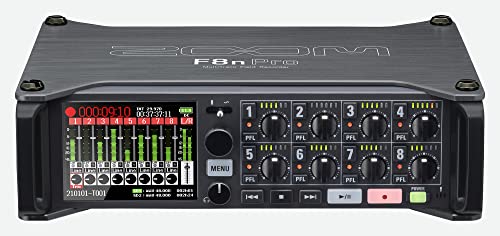
- 32-bit float, 8 inputs, and 10 tracks
- Dual SD recording with Bluetooth control
- 0.2ppm timecode for picture sync
Best For: Film crews and multitrack location production
Most Portable Premium Recorder

- Pocket-sized 170g recorder with internal mic
- Bluetooth, USB-C, and three two-way jacks
- 128GB storage and iOS transcription support
Best For: Mobile voice notes, interviews, and creative ideas
Everyday Touchscreen Value

- Touchscreen recorder with Bluetooth connectivity
- Multiple modes, voice activation, and scheduling
- Offline transcription and up to 1TB expansion
Best For: Meetings, lectures, interviews, and voice notes
Best Pro XLR Pick – Zoom F3 with BTA-1 Bluetooth Adapter
The Zoom F3 bundle is a strong choice when you need a field recorder with bluetooth control and professional XLR connectivity. Its 32-bit float recording, dual AD converters, and low-noise preamps are suited to demanding location audio without constant gain adjustments.
Best For: Sound designers, podcasters, and filmmakers who need compact two-track XLR recording with wireless control.
Pros:
- 32-bit float recording helps capture wide dynamic range without setting gain.
- Two locking XLR inputs support professional microphones and two-track recording.
- Compact metal casing, mounting bars, and tripod mount improve field portability.
- Included BTA-1 enables wireless control with compatible Zoom recorders.
Cons:
- Built-in microphone functionality is not the focus; external XLR microphones are required for recording.
- Bluetooth control compatibility is limited to supported Zoom devices.
The F3 is the most production-oriented option here for users who prioritize clean XLR inputs and rugged portability. The included adapter adds convenient wireless operation, provided your setup uses compatible Zoom equipment.
Best Versatile Handheld – Xvive XV1-R 32-Bit Float Recorder
The Xvive XV1-R is a flexible field recorder with bluetooth control appeal for creators who also want built-in stereo microphones and USB microphone operation. It records 32-bit float WAV audio, supports up to 96 kHz, and adds AAC recording for more storage-efficient sessions.
Best For: Musicians, podcasters, filmmakers, and mobile creators who want one compact recorder for field capture and USB audio.
Pros:
- 32-bit float recording reduces the need for manual gain adjustment.
- X/Y microphones capture audio up to 130 dB SPL without distortion.
- Supports WAV and AAC formats, with up to 12 hours of recording time.
- Works as a USB microphone with PC, Mac, iOS, and Android devices.
Cons:
- No headphone jack is listed in the supplied specifications.
- The supplied notes do not confirm a dedicated Bluetooth control function.
- Maximum file size is 4GB, so extended recordings are automatically split.
The XV1-R stands out for format flexibility and its built-in X/Y microphones. It is a practical all-around recorder, but buyers specifically seeking confirmed Bluetooth control should verify that capability before choosing it.
Best Compact Bluetooth Recorder – Olympus LS-P4 Linear PCM Recorder
The Olympus LS-P4 is a lightweight field recorder with bluetooth control potential, a three-microphone TRESMIC system, and support for FLAC lossless recording and playback. Firmware-added slate and test tones also make it useful in video production workflows.
Best For: Video creators and travelers who want a very light stereo recorder with lossless audio and Bluetooth compatibility.
Pros:
- TRESMIC three-microphone system supports high-resolution stereo recording.
- Records and plays back FLAC lossless-compression files.
- Bluetooth compatibility expands its supported uses and editing workflow.
- Weighs only 2.72 ounces and offers a listed battery life of up to 39 hours.
Cons:
- Its 2.5mm headphone jack is less common than a 3.5mm connection.
- The supplied notes do not specify 32-bit float recording.
- Bluetooth control capabilities are not detailed in the supplied information.
The LS-P4 is particularly appealing when low weight, long battery life, and FLAC support matter. Its Bluetooth compatibility is useful, though shoppers needing clearly specified remote control features should check the exact supported functions.
Best Multi-Pattern Recorder – Zoom H2essential Handheld Recorder
The Zoom H2essential combines 32-bit float recording with three built-in microphones and nine selectable patterns. It is a compelling field recorder with bluetooth control for users who need wireless recorder control and timecode synchronization across multiple units.
Best For: Journalists, podcasters, musicians, and filmmakers recording varied sources or synchronizing multiple H2essential units.
Pros:
- Three microphones and nine patterns support mono, stereo, and surround recording.
- 32-bit float recording captures clip-free audio without constant gain adjustment.
- Bluetooth enables wireless control and timecode synchronization between multiple units.
- Can operate as a USB microphone while recording a backup to an SD card.
Cons:
- Only two AA batteries are specified, with a listed average life of 20 hours.
- Bluetooth timecode and multi-unit features are specific to compatible H2essential units.
The H2essential is the most flexible built-in-microphone option in this group. Its selectable patterns and Bluetooth synchronization make it especially useful for multi-recorder setups, while USB operation adds everyday versatility.
Pro Video Pick – TASCAM FR-AV2
If you need a field recorder with bluetooth control for video production, the TASCAM FR-AV2 combines dual XLR/TRS inputs, 32-bit float recording, and built-in timecode generation. Wireless monitoring requires the optional AK-BT2 Bluetooth adapter, which is the only compatible adapter for this recorder.
Best For: Videographers who need timecode synchronization and flexible professional audio inputs.
Pros:
- Dual ADCs support 32-bit float recording for fast, no-clip capture.
- Two XLR/TRS combo inputs use Ultra HDDA preamps, plus a 3.5 mm input.
- Built-in timecode generation, input/output, and high-accuracy TCXO synchronization.
- Compact 9.5-ounce design with recording rates up to 192 kHz.
Cons:
- Bluetooth monitoring requires the separately available AK-BT2 adapter.
- Uses three AA batteries.
The FR-AV2 is the most production-focused option here, especially when timecode and balanced microphone connections matter. Factor in the additional Bluetooth adapter if wireless monitoring is part of your workflow.
Best Wearable Bluetooth Control – Zoom F2-BT Bundle
The Zoom F2-BT is a strong choice if you want a field recorder with bluetooth control that stays discreet on a waistband or in a pocket. Its built-in Bluetooth works with the free Zoom F2 Control app for wireless recording and settings management, while the included lavalier microphone suits spoken-word capture.
Best For: Interviews, presentations, and creators who need a lightweight concealed lavalier setup.
Pros:
- The Zoom F2 Control app can start and stop recordings wirelessly.
- The app displays battery levels and controls output volume and lo-cut.
- Screw-lock connectors help keep the lavalier microphone securely attached.
- Bundle includes a lavalier microphone, 32GB microSDHC card, batteries, and carrying case.
Cons:
- Records in mono WAV format.
- Requires four AAA batteries.
- Bluetooth control depends on the Zoom F2 Control app.
For portable dialogue recording, the F2-BT bundle offers a focused setup with useful remote controls and the essentials included. Its low-profile design is particularly practical when the recorder needs to remain out of sight.
Touchscreen Recorder Pick – Innioasis R1 Bluetooth Voice Recorder
The Innioasis R1 adds Bluetooth to a touchscreen voice recorder aimed at everyday recording rather than professional camera workflows. It offers multiple recording modes, voice activation, offline speech-to-text, and expandable storage, making it a practical field recorder with bluetooth control for interviews, meetings, lectures, and notes.
Best For: Students, journalists, office workers, and writers who want recording, transcription, and playback in one device.
Pros:
- 3.69-inch touchscreen complements traditional physical buttons.
- Includes interview, meeting, lecture, pocket, scheduled, and automatic recording modes.
- Offline speech-to-text can provide instant transcription and exportable documents.
- Supports external storage expansion up to 1TB and includes password protection.
Cons:
- Uses a built-in microphone rather than an external lavalier or XLR input.
- Bluetooth functionality is listed, but the supplied notes do not specify app-based remote recording controls.
- Fast charging is not supported.
The R1 is better suited to general-purpose voice work than multitrack or camera audio. Its combination of touchscreen operation, transcription, storage expansion, and long battery life makes it versatile for extended spoken-word sessions.
Professional Production Pick – Zoom F8n Pro
For film crews and serious location engineers, the Zoom F8n Pro is a field recorder with bluetooth control built around reliable multitrack capture. Its 32-bit float recording, dual AD converters, eight inputs, and ten tracks are designed for demanding production work.
Best For: Filmmakers, production sound teams, and field recording setups that need multiple inputs, timecode accuracy, and redundant storage.
Pros:
- 32-bit float recording and dual AD converters help deliver clip-free audio across a wide dynamic range.
- Eight inputs, ten tracks, and preamps offering up to 75dB of gain support complex location setups.
- Dual SD slots enable redundant recording, while Bluetooth control adds remote operation flexibility.
- Accurate 0.2ppm timecode helps keep tracks aligned with picture.
Cons:
- At 1.8 kg and roughly 7 x 5 x 2 inches, it is less pocket-friendly than compact voice recorders.
- Its professional feature set may be more than a casual user needs.
- Battery life is listed at approximately 8.5 hours.
The F8n Pro is the strongest choice here when production reliability, input count, timecode, and backup recording matter more than portability. It also works as an 8-in/4-out USB audio interface while recording to an SD card.
Most Portable Premium Recorder – Teenage Engineering TP-7
The Teenage Engineering TP-7 is a pocket-sized field recorder with bluetooth control for capturing ideas, interviews, and voice notes on the move. It combines an internal microphone and speaker with three two-way jacks, USB-C, Bluetooth, and 128GB of built-in storage.
Best For: Mobile creators, interviewers, and note-takers who value compact design, fast operation, and iOS transcription support.
Pros:
- Compact 170g design supports genuinely portable recording.
- Internal microphone, speaker, and three two-way jacks accommodate several recording and listening setups.
- Bluetooth and USB connectivity work with the companion iOS transcription app.
- 128GB of storage provides substantial space for recordings, with up to seven hours of battery life.
Cons:
- The supplied notes do not specify a dedicated Bluetooth remote-control feature beyond connectivity and app use.
- Transcription is tied to the companion app available on iOS devices.
- The product is more focused on portable ideas and voice recording than large multitrack production.
The TP-7 stands out for convenience and design rather than production-scale input expansion. Its motorized tape reel, one-handed controls, internal mic, and generous storage make it appealing for fast, everyday capture.
Everyday Touchscreen Value – Innioasis R1
The Innioasis R1 is a practical field recorder with bluetooth control for meetings, lectures, interviews, and personal voice notes. It pairs dual microphones and noise-reduction processing with a 3.69-inch touchscreen, voice activation, offline speech-to-text, and expandable storage.
Best For: Students, journalists, office users, and anyone who wants touchscreen operation, automatic recording modes, and transcription features.
Pros:
- Dual microphones, DSP, and RTC intelligent noise reduction are designed for clearer recordings.
- General, interview, meeting, lecture, and pocket modes simplify setup for different situations.
- Touchscreen and physical buttons provide two control methods, while scheduled and automatic recording add convenience.
- Offline speech-to-text, password protection, and support for storage expansion up to 1TB add useful everyday features.
Cons:
- The supplied notes do not detail how Bluetooth is used for remote control.
- Built-in storage is 8GB before adding external storage.
- It is a voice recorder with a built-in microphone rather than a professional multitrack field mixer.
The R1 is a feature-rich option for routine speech recording. Its touchscreen, recording presets, voice activation, offline transcription, and expandable storage make it especially convenient for long meetings and lectures.
How We Picked the Best Field Recorder with Bluetooth Control
We focused on recorders that offer a practical advantage for mobile audio work, with particular attention to Bluetooth connectivity or Bluetooth-enabled control. We also compared recording formats, input options, microphone design, size, power requirements, and suitability for different users.
Because “Bluetooth control” can mean different things, check each model’s supported functions before buying. Some devices use Bluetooth for wireless control or monitoring through an adapter, while others use it for file transfer, smartphone integration, or general connectivity. Bluetooth performance may also depend on an optional adapter or compatible app.
Quick Comparison
| Best For | What to Look For | Recommended Type |
|---|---|---|
| Solo creators and interviews | Small size, lavalier input, simple controls | Ultracompact recorder |
| Filmmaking and location sound | 32-bit float, XLR/TRS inputs, timecode | Professional field recorder |
| Music and ambient recording | Quality stereo microphones and WAV support | Handheld stereo recorder |
| Voice notes and dictation | Playback, voice activation, easy file access | Digital voice recorder |
| Multitrack production | Multiple inputs, track count, reliable power | Advanced multichannel recorder |
Key Buying Factors for a Field Recorder with Bluetooth Control
Bluetooth Function and Compatibility
Determine whether Bluetooth provides remote control, wireless monitoring, smartphone connectivity, or only a supplementary feature. If an adapter is required, include it in the total cost and verify that your phone or tablet supports the necessary app.
Recording Quality and Format
32-bit float recording is useful for unpredictable levels because it provides greater flexibility when recovering recordings in post-production. WAV remains the safer choice for editing, while AAC and other compressed formats can save storage for casual use.
Inputs, Microphones, and Expandability
Built-in stereo microphones suit ambience, rehearsals, and quick recordings. XLR or TRS inputs are better for professional microphones, mixers, and filmmaking setups. A lavalier-focused recorder is often the simplest option for interviews and single-person video.
Power, Storage, and Handling
Check battery type and expected runtime, then consider whether the recorder supports removable microSD media or internal storage. For field work, physical controls, a clear display, low handling noise, and a protective case can matter as much as headline specifications.
Who Should Buy Which Field Recorder with Bluetooth Control?
Choose a compact Bluetooth-enabled recorder if you prioritize discreet interviews, solo video, or lightweight travel. Pick a stereo handheld model for musicians, sound designers, and creators who need fast microphone-based recording. A 32-bit-float recorder is the stronger choice when levels may change quickly or you want more protection against clipping.
Filmmakers working with several microphones should consider models with multiple XLR/TRS inputs, timecode support, and enough tracks for the entire production. For dictation, lectures, and everyday notes, a touchscreen voice recorder with Bluetooth and voice activation may be more convenient than a professional field unit. Finally, advanced users who need extensive routing and multitrack capture should prioritize input count and track capacity over minimum size.