
The right DMX controller can turn a collection of fixtures into a coordinated show, whether you are lighting a wedding, DJ set, church service, stage production, or venue installation.
This roundup compares 10 event-ready options across standalone consoles, wireless systems, fixture bundles, and software-focused controllers. Use the guide below to match channel capacity, control style, and setup demands to your event.
Best 10 Dmx Controllers for Events Picks for 2026
Best All-in-One Console

- Standalone four-universe DMX control
- Touchscreen, buttons, BPM, and audio control
- Includes protective Decksaver cover
Best For: Mobile DJs and event technicians needing portable, expandable control
Best Traditional Scene Controller

- Controls up to 12 fixtures
- Stores scenes and programmable chases
- Includes fog, strobe, and MIDI controls
Best For: Operators who prefer physical sliders and programmed lighting scenes
Best Complete Lighting Package

- Eight RGB par lights with controller and cables
- Four operating modes for flexible use
- 192-channel DMX control for synchronized shows
Best For: Weddings, parties, DJs, churches, and small event productions
Best DJ Software Integration

- Two-universe DMX interface for SoundSwitch
- Tactile pads, encoders, and touch strip
- Works with select Engine DJ hardware
Best For: DJs syncing lighting control with live sets and compatible software
Full-Scale Control

- Controls up to 32 fixtures
- Stores up to 48 scenes
- LCD, faders, joystick, and metal casing
Best For: Large or complex event lighting setups
Fast Wireless Linking

- Includes one transmitter and two receivers
- Offers seven group IDs
- Uses frequency hopping for interference resistance
Best For: Mobile setups and cable-free fixture connections
Accessible Scene Mixing

- Controls up to 12 fixtures
- Stores up to 240 scenes
- Includes voice scene control
Best For: Smaller events and first-time DMX users
Wireless-Wired Event Pro

- 384 channels for up to 12 intelligent lights
- 2.4G wireless and 3-pin wired operation
- Sound, MIDI, auto, and manual control
Best For: Weddings, DJs, bars, and indoor stages needing flexible connectivity
Beginner Event Console

- Controls up to 12 devices and 192 channels
- Six programmable chases with 240 scenes
- Includes 3-pin cable, adapter, and manual
Best For: Beginners running small parties, concerts, or seasonal shows
Reliable Chase Programmer
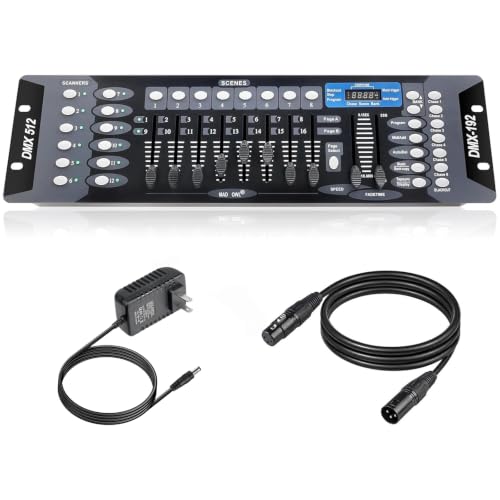
- Controls 12 fixtures with up to 16 channels each
- Six programmable chases and 240-step scenes
- Includes a 6.6-foot DMX cable
Best For: Wired DJ, club, stage, and performance lighting rigs
Best All-in-One Console – ADJ WMX1 MK2 WolfMix Bundle
For mobile DJs, venues, and event technicians seeking capable DMX controllers for events, the ADJ WMX1 MK2 provides standalone touchscreen operation without requiring a laptop. Its included Decksaver cover adds practical protection for transport and storage.
Best For: Mobile DJs, corporate events, houses of worship, weddings, and small venues that need fast setup and multi-universe control.
Pros:
- Controls up to four DMX universes and supports up to 680 fixtures.
- Includes a 4.3-inch touchscreen, 37 backlit buttons, BPM detection, and audio input.
- Comes with a protective Decksaver cover for touring and storage.
- Offers extensive fixture support through built-in profiles and WTOOLS expansion.
Cons:
- May offer more control capacity than smaller, simpler event setups require.
- Its advanced feature set may involve a learning curve for first-time users.
The WMX1 MK2 is a strong choice when portability, computer-free operation, and room to expand matter. The bundled cover makes it especially practical for traveling event professionals.
Best Traditional Scene Controller – CHAUVET DJ OBEY40
The CHAUVET DJ OBEY40 is a conventional hardware option among DMX controllers for events, offering dedicated buttons and sliders for programmed scenes, chases, fixtures, fog, and strobe effects. It suits operators who prefer hands-on control over touchscreen workflows.
Best For: DJs, small production teams, and venues controlling several intelligent fixtures with repeatable scenes and chases.
Pros:
- Controls up to 12 fixtures with up to 16 channels each.
- Provides 192 DMX channels for detailed fixture management.
- Stores up to 240 scenes across 30 banks and includes six chase sets.
- Adds dedicated fog and strobe controls plus MIDI compatibility.
Cons:
- It is a button-and-slider controller rather than a touchscreen interface.
- Its 2010-era design may feel less streamlined than newer standalone controllers.
The OBEY40 is a practical choice for structured lighting shows where programmed banks and physical controls are more important than extensive universe capacity or modern visual interfaces.
Best Complete Lighting Package – 8-Pack RGB Par System
This 8-pack combines RGB par lights, a DMX512 controller, and connecting cables, making it a convenient starting point for event lighting. For buyers comparing DMX controllers for events, it offers both the control hardware and fixtures needed for synchronized color washes and effects.
Best For: Weddings, parties, DJs, churches, clubs, karaoke rooms, and event planners who want a ready-to-use multi-light setup.
Pros:
- Includes eight RGB par lights, controller, and cables.
- Each fixture uses 18 3W RGB LEDs for colorful washes and effects.
- Supports DMX, sound-activated, automatic, and master-slave modes.
- Offers daisy-chain connections and adjustable mounting brackets.
Cons:
- The included controller is designed around this system rather than a broad standalone lighting rig.
- Its 192-channel capacity may be limiting for larger or more complex productions.
Choose this package when you need fixtures and control together instead of assembling a system piece by piece. Its multiple operating modes also make it approachable for users with varying experience.
Best DJ Software Integration – SoundSwitch Control One
The SoundSwitch Control One is designed for music-driven lighting workflows, providing tactile control over SoundSwitch software and two DMX universes. It is a compelling option among DMX controllers for events when lighting needs to follow DJ sets, live audio, or compatible DJ hardware.
Best For: DJs and performers using Engine DJ, SoundSwitch, compatible AlphaTheta systems, or computer-based audio workflows.
Pros:
- Provides two DMX universe inputs and outputs with a thru option.
- Offers touch-strip intensity control, encoders, and customizable RGB pads.
- Works directly with compatible Engine DJ devices without a computer.
- Supports live audio BPM detection and control of colors, strobes, moving heads, and gobos.
Cons:
- Its deepest functionality depends on SoundSwitch software and compatible hardware.
- Some AlphaTheta rekordbox workflows require a laptop running SoundSwitch.
Control One is best viewed as a performance-focused interface rather than a general-purpose standalone console. It is particularly effective for DJs who want to make lighting adjustments alongside music performance.
Full-Scale Control – 512-Channel DMX Controller
For event planners who need hands-on control, this DMX512 console provides 512 channels and support for up to 32 fixtures. Its LCD display, faders, joystick, and scene controls make it a practical choice among DMX controllers for events with more involved lighting setups.
Best For: DJs, stages, nightclubs, parties, festivals, and other events using moving heads, PAR lights, spotlights, or fog machines.
Pros:
- Controls up to 32 fixtures with 16 channels per fixture.
- Stores and runs up to 48 scenes for repeatable show programming.
- Includes an LCD screen, gooseneck console lamp, power cable, manual, and 3-pin DMX cable.
- Durable metal casing with a joystick and dedicated fader controls.
Cons:
- Its 17.73-pound weight and larger package may be less convenient for highly mobile setups.
- The extensive controls may require more programming time for beginners.
This is a strong fit when your event requires centralized, programmable control rather than a compact wireless solution. The included console lamp is also useful for programming in dark venues.
Fast Wireless Linking – 2.4G Wireless DMX Set
This three-piece wireless DMX set helps event crews reduce cable runs between a lighting controller and fixtures. With one transmitter, two receivers, seven group IDs, and a claimed range of up to 1,000 feet, it is a convenient option among DMX controllers for events requiring flexible placement.
Best For: Mobile DJs, weddings, stage events, disco parties, and venues where quick installation or separated lighting rigs is important.
Pros:
- Replaces some XLR cable runs and is designed for faster setup.
- Uses 126-channel frequency hopping to help resist interference.
- Supports seven independent group IDs for separate lighting rigs.
- Includes power adapters for the transmitter and both receivers.
Cons:
- It is not battery-powered and requires power adapters during operation.
- The set includes two receivers, so additional fixtures may require more compatible units.
This kit is best viewed as a wireless DMX link rather than a standalone lighting console. It makes sense when your existing controller works properly but cable routing would slow down the event setup.
Accessible Scene Mixing – CO-Z 192 DMX Controller
The CO-Z 192 DMX controller is designed for users who want straightforward scene and fixture control without stepping up to a larger 512-channel console. It supports up to 12 intelligent lights with up to 16 channels each, making it a practical option among DMX controllers for events such as weddings, parties, and church gatherings.
Best For: Amateur users, DJs, nightclubs, weddings, family gatherings, church events, and smaller lighting systems.
Pros:
- Controls up to 12 fixtures with up to 16 channels each.
- Supports up to 240 scenes for building varied shows.
- Includes voice control for switching among lighting scenes.
- Provides dedicated fixture, scene, channel, page, speed, and function controls.
Cons:
- Its 192-channel capacity is lower than full 512-channel consoles.
- It is corded electric, so placement depends on access to power.
- The supplied notes identify a three-pin cable, so connector compatibility should be checked before purchase.
Choose this console when ease of operation and a generous scene count matter more than maximum channel capacity. Its voice-control feature can also help simplify scene changes during smaller event productions.
Wireless-Wired Event Pro – 384-Channel DMX Controller
For event planners comparing DMX controllers for events, this 384-channel console offers flexible wired or 2.4G wireless operation. Its faders, LED display, programmable scenes, and sound-reactive modes suit setups that need hands-on control with quick atmosphere changes.
Best For: Weddings, DJs, bars, indoor stages, and event layouts that benefit from wireless flexibility.
Pros:
- Controls up to 12 intelligent lights across 384 DMX channels.
- Supports both 2.4G wireless transmission and 3-pin XLR wired connection.
- Offers sound-activated, automatic, manual, and MIDI control modes.
- Stores 30 banks and 240 preset static scenes for quick show recall.
Cons:
- Its broader feature set may take more time for beginners to learn.
- Requires a 9V battery according to the listed specifications.
This is the most flexible option of the three for events where cable placement, music synchronization, and fast scene access matter. The 384-channel capacity also leaves more control room than the two 192-channel consoles.
Beginner Event Console – 192-Channel DMX Controller
This 192-channel console is a straightforward choice for shoppers seeking DMX controllers for events such as small parties, music shows, and seasonal gatherings. Its organized controls, manual faders, programmable scenes, and included 3-pin cable support basic stage-lighting programming.
Best For: Beginners and small event setups using compatible 3-pin stage-lighting equipment.
Pros:
- Controls up to 12 devices with 16 channels each.
- Provides 23 sets of programmable scenarios and six programmable chases.
- Includes eight sliders for manual channel adjustment.
- Comes with a 3-pin cable, power adapter, and manual.
Cons:
- Offers fewer channels than the 384-channel model.
- Uses corded electric power and does not list wireless operation.
- The listed warranty information is inconsistent, mentioning both 360-day repair service and a 90-day manufacturer warranty.
With a layout built around light selection, scene switching, channel sliders, and speed controls, this model emphasizes approachable operation. It is a practical fit when you need programmable effects without the added complexity of wireless control.
Reliable Chase Programmer – 192-Channel DMX Board
For buyers choosing DMX controllers for events, this corded 192-channel board focuses on dependable wired control and programmable lighting sequences. Its faders, buttons, scene banks, and included 6.6-foot DMX cable make it suitable for hands-on operation at stages, clubs, and performance venues.
Best For: Wired DJ, club, stage, and performance setups that need programmable chases.
Pros:
- Controls up to 12 fixtures with up to 16 channels each.
- Provides 23 banks of eight programmable scenes.
- Supports 240-step scenes across six programmable chases.
- Includes a 6.6-foot DMX cable for connecting compatible equipment.
Cons:
- Has 192 channels rather than the larger capacity of the 384-channel option.
- Does not list wireless or sound-activated control.
- Its listed dimensions make it longer than the more compact second 192-channel controller.
This board is a sensible choice when programmed scenes and chase effects are more important than wireless convenience. The included cable and manual controls also make it a focused option for established wired lighting rigs.
How We Picked the Best Dmx Controllers for Events
We focused on controllers that suit real-world event production, including mobile DJs, performers, churches, small venues, and stage operators. The selection covers beginner-friendly 192-channel boards, larger 384- and 512-channel consoles, wireless DMX kits, fixture bundles, and advanced systems designed for computer or software integration.
We considered channel count, fixture compatibility, programming options, portability, wireless flexibility, sound activation, MIDI or software support, and the learning curve. Because event needs vary widely, no single controller is best for every setup.
Quick Comparison
| Controller type | Best suited to | Main advantage | Potential limitation |
|---|---|---|---|
| Basic 192-channel console | Small parties and simple rigs | Affordable, direct fixture control | Limited programming depth |
| 384- or 512-channel console | Multiple fixtures and larger shows | More room for scenes and channels | More setup and programming required |
| Wireless DMX system | Fast deployments and difficult cable runs | Reduces signal cabling | Requires receiver compatibility and reliable power |
| Fixture bundle with controller | New lighting systems | Matched components in one package | Less flexibility than a custom rig |
| Software-oriented controller | Automated, music-synced productions | Advanced show control and integration | May require compatible software and hardware |
Key Buying Factors for Dmx Controllers for Events
Channel Capacity and Fixture Count
Check both the controller’s total channels and the channel footprint of each fixture. A moving head may use many channels, while a simple PAR can use only a few. Leave capacity for future additions rather than buying a controller that is already full.
Programming and Live Operation
Faders and dedicated buttons are useful for hands-on changes during a show. Scene, chase, bank, and preset functions matter when you need repeatable looks. Beginners may prefer straightforward controls, while experienced operators may value deeper programming and automation.
Connectivity and Compatibility
Confirm that the controller uses standard DMX512 connections and supports your fixtures’ channel modes. If you want wireless operation, verify whether the transmitter and receivers use compatible protocols. MIDI, USB, computer, or software integration can also affect your choice.
Portability and Reliability
Mobile operators should prioritize manageable size, protective cases, clear displays, and quick setup. For permanent or semi-permanent installations, focus on stable power, durable controls, backup plans, and easy access for maintenance.
Sound Activation and Synchronization
Sound-active modes are convenient for unattended parties, but they offer less precision than programmed scenes. For tightly synchronized shows, choose a system with stronger sequencing, software, or MIDI capabilities.
Who Should Buy Which Dmx Controllers for Events?
Choose a basic 192-channel controller if you run small parties, use a few conventional fixtures, and want an inexpensive hands-on board.
Choose a 384- or 512-channel console if your rig includes several fixture types, moving heads, or multiple lighting zones that need independent control.
Choose a wireless DMX option for venues where long cable runs are inconvenient, temporary installations must go up quickly, or fixtures are spread across a room. Keep wired backups for critical events.
Choose a fixture-and-controller bundle if you are building your first complete lighting system and want components designed to work together.
Choose a software-friendly controller if automated cues, music synchronization, advanced programming, or integration with a larger production workflow are priorities. Before buying, map your fixtures, required channel modes, event size, and operator experience so the controller fits the show rather than restricting it.