
Moisture can cause brittle filament, bubbling, stringing, and inconsistent classroom prints. The right dryer helps schools protect materials and reduce failed projects without adding unnecessary complexity.
This roundup compares 10 filament dryers across single- and multi-spool capacity, temperature range, storage design, and day-to-day practicality for school makerspaces and STEM labs.
Best 10 Filament Dryers for Schools Picks for 2026
Best Dual-Spool Value
Comgrow SH01 Filament Dryer Box

- Stores two 1 kg spools
- Supports 1.75 mm and 2.85 mm filament
- 40–50°C settings with LCD monitoring
Best For: Classrooms needing simple two-spool drying and storage
Best Easy-Use Option

- 35–70°C temperature range
- 0–99 hour timer
- Supports three filament diameters
Best For: Classrooms needing flexible, accessible controls
Best Guided Drying

- Dual-spool drying with 360° hot air
- 12 filament presets
- 45–70°C range and 48-hour timer
Best For: Technical classrooms working with varied materials
Best High-Capacity Choice

- Dries up to four 1 kg spools
- Eight filament exit holes
- Three fans with a 350W PTC heater
Best For: Busy makerspaces running several printers
Best for Easy Setup
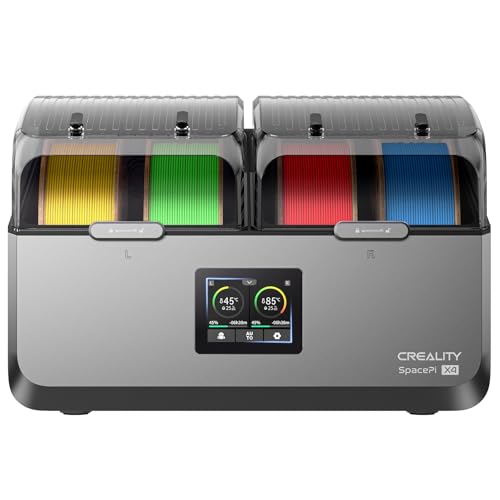
- Dries and prints four spools at once
- Two chambers with independent temperature control
- Reaches up to 85°C for engineering filaments
Best For: Busy school labs with multiple 3D printers
Classroom Workhorse

- Monitors temperature and humidity in real time
- Holds two narrow rolls or one wider roll
- Includes timed heating from 40°C to 50°C
Best For: Small classrooms needing simple filament drying and storage
Dry-and-Store Solution

- Dries, stores, and prints without breaking the seal
- Built-in hygrometer supports humidity monitoring
- Works with common materials and three filament diameters
Best For: Makerspaces prioritizing sealed storage between print sessions
Best with Extra Features

- Dries up to four 1 kg spools
- Independent dual-chamber controls
- Automatic mode and multiple safety monitors
Best For: Busy school labs running multiple printers and materials
Best Simple Single-Spool Option

- No assembly required
- Reaches 65°C within 15 minutes
- Humidity display and 0–24-hour timer
Best For: Classrooms needing simple drying for one spool at a time
Best Two-Spool Value

- Dries two 1 kg spools together
- Fast 150W PTC heating
- Presets for nine filament types
Best For: Small and medium labs using two printers
Best Dual-Spool Value – Comgrow SH01 Filament Dryer Box
For schools seeking filament dryers for schools, the Comgrow SH01 is a practical dual-spool option for keeping commonly used materials dry during printing. It accommodates two 1 kg spools and supports both 1.75 mm and 2.85 mm filament.
Best For: Classrooms that need straightforward drying and storage for two standard filament spools.
Pros:
- Stores up to two 1 kg spools.
- Supports 1.75 mm and 2.85 mm filament diameters.
- Offers adjustable 40–50°C temperatures and 6–12 hour drying times.
- Includes an LCD screen, temperature and humidity monitoring, and a sealed design.
Cons:
- Its maximum temperature of 50°C may be limiting for some higher-temperature materials.
- The work state must be displayed or the motherboard can shut down after three minutes.
The SH01 fits schools that prioritize capacity, simple controls, and dry storage over high-temperature performance. Staff should follow the setup instructions carefully, including opening the sealing hole during drying.
Best Easy-Use Option – SUNLU Filament Dryer S2
The SUNLU S2 is a user-friendly choice for schools comparing filament dryers for schools. Its large touch screen, translucent lid, and broad temperature and timer ranges make it convenient for routine classroom filament maintenance.
Best For: Schools wanting flexible settings and simple operation for a variety of common filament types.
Pros:
- Adjusts from 35–70°C with a 0–99 hour timer.
- Works with 1.75 mm, 2.85 mm, and 3.00 mm filament.
- Can dry filament while it is being used as a spool holder.
- Built-in spindle supports continuous rotation for more even drying.
Cons:
- The supplied notes do not specify a multi-spool capacity.
- It has a single-unit design rather than the larger capacity of the four-spool S4.
With broad material compatibility and intuitive touch controls, the S2 is well suited to shared makerspaces where students or staff need to change settings quickly. Its translucent lid also allows visual checks without opening the dryer.
Best Guided Drying – Creality Space Pi Plus
The Creality Space Pi Plus gives schools a guided approach to filament drying. For programs using several materials, its 12 presets, dual-spool format, 360° hot-air circulation, and real-time humidity monitoring can simplify repeatable preparation.
Best For: Technical education rooms using multiple standard and composite filament types.
Pros:
- Dries two spools with circulating 360° hot air.
- Provides 12 one-key filament presets, including PLA-CF, PA-CF, and ASA.
- Offers adjustable 45–70°C temperatures and a 0–48 hour timer.
- Uses a 3.7-inch touchscreen with Celsius/Fahrenheit switching.
Cons:
- Its minimum temperature of 45°C is less flexible than models starting at 35°C.
- The supplied notes do not state the spool weight capacity.
The Space Pi Plus is a strong fit when instructors want students to select a material preset rather than calculate settings from scratch. Its dual-spool design also supports preparing more than one roll at a time.
Best High-Capacity Choice – SUNLU S4 Filament Dryer
For busy labs searching for filament dryers for schools, the SUNLU S4 stands out with capacity for four 1 kg spools and eight filament outlets. Its multiple fans and 350W PTC heater are designed for simultaneous drying and printing across several machines.
Best For: School makerspaces running multiple printers and processing several rolls at once.
Pros:
- Holds and dries up to four 1 kg spools.
- Provides eight filament exit holes for multiple printers and loading angles.
- Uses three circulation fans and a 350W PTC heater for surrounding heat circulation.
- Supports 35–70°C temperatures, 0–99 hour timers, and 1.75 mm, 2.85 mm, and 3.00 mm filament.
Cons:
- At 4 kg, it is substantially heavier than the smaller dryers listed here.
- Its large footprint may require dedicated makerspace shelving or bench space.
- The supplied notes describe modification for 3 kg rolls as a DIY option, not standard capacity.
The S4 is the most productive choice for a shared school lab that needs multiple outlets and high spool capacity. It costs more space and handling effort, but its four-spool design can reduce drying bottlenecks when several printers are active.
Best for Easy Setup – Creality Space Pi X4
For schools comparing filament dryers for schools, the Creality Space Pi X4 stands out when several printers need filament prepared at once. It has two independent chambers, supports four spools, and can dry and feed filament to four printers simultaneously.
Best For: School labs or classrooms running multiple printers and using varied filament types.
Pros:
- Four-spool drying and printing with eight filament holes and PTFE tubing.
- Dual chambers provide independent temperature control for two filament types.
- Reaches up to 85°C, supporting engineering materials such as PA, PAHT, PC, and flexible filament.
- Single-chamber operation can save up to 40% energy compared with dual-chamber use.
Cons:
- Other brands’ plastic trays should be checked for heat resistance.
- Its advanced multi-spool capacity may be more than a small classroom needs.
The Space Pi X4 is the strongest fit when throughput and material flexibility matter most. Schools should verify tray compatibility and consider whether their printers can use its four-spool workflow.
Classroom Workhorse – Sovol SH01 Filament Dryer
Among filament dryers for schools, the Sovol SH01 offers a straightforward option for classrooms that need moisture control without a large multi-spool system. It provides real-time temperature and humidity monitoring, timed heating, and room for one or two rolls.
Best For: Classrooms that need simple drying and sealed storage for one or two filament rolls.
Pros:
- Displays the dry box’s temperature and humidity in real time.
- Supports 40°C, 45°C, and 50°C settings with six- to 12-hour timers.
- Stores two rolls under 70 mm wide or one roll under 150 mm wide.
- Sealed storage supports power-off filament protection, with space for up to four desiccant bags.
Cons:
- Desiccant bags are not included.
- The box may not reach 50°C in rooms below 16°C.
- PTFE seals should be opened during heating so moisture can escape.
The SH01 is a practical choice for smaller school setups that value visible readings and easy operation. Its capacity and temperature range are more limited than those of high-temperature, multi-chamber dryers.
Dry-and-Store Solution – Polymaker PolyDryer
For schools seeking filament dryers for schools that also support day-to-day storage, the Polymaker PolyDryer combines a Dry Dock with a sealed storage box. It is designed to dry, store, and feed filament without breaking the seal, helping reduce exposure between print sessions.
Best For: School makerspaces that want an integrated drying, storage, and direct-printing workflow.
Pros:
- Combines heated drying, sealed storage, and desiccant support.
- Allows filament to dry, remain stored, and print without breaking the seal.
- Built-in hygrometer helps users monitor storage conditions.
- Supports PA Nylon, PLA, PVB, PETG, ABS, ASA, and TPU in 1.75 mm, 2.85 mm, and 3.00 mm sizes.
Cons:
- Its single-box setup is intended for one filament spool at a time.
- The product is a modular system, so users must manage both the Dry Dock and storage box.
The PolyDryer is a good fit when preserving filament between classes is as important as the initial drying cycle. Its broad material and diameter compatibility can simplify equipment choices in mixed-material school labs.
Best with Extra Features – Comgrow SH03 Four-Spool Dryer
For schools running several printers or teaching multiple filament types, the Comgrow SH03 is one of the more capable filament dryers for schools. Its dual chambers can hold up to four 1 kg spools, with separate temperature controls and dedicated filament paths for flexible classroom use.
Best For: School labs that need to dry multiple spools or filament types simultaneously.
Pros:
- Holds up to four 1 kg spools across two independently controlled chambers.
- Supports a broad range of materials, including PLA, ABS, PETG, TPU, ASA, PA, and PC.
- Offers 360-degree hot-air circulation, automatic drying mode, and up to 98 hours of operation.
- Includes multiple monitoring and protection systems, including fan and overheat monitoring.
Cons:
- Its larger capacity may be more than a small classroom needs.
- Dual 200W heating modules may require more power than smaller dryers.
- The feature-rich touchscreen system may take longer for students to learn.
The SH03 is a strong choice when throughput matters. Independent chambers and automatic humidity-based operation can help staff manage several materials while reducing hands-on monitoring.
Best Simple Single-Spool Option – Creality Space Pi SE Dryer
The Creality Space Pi SE is a straightforward option for schools seeking filament dryers for schools without a complicated setup. It accepts most 1 kg spools, reaches 65°C within 15 minutes, and uses a display and control knob to show humidity and drying progress.
Best For: Classrooms that want an easy-to-operate dryer for common 3D-printing materials.
Pros:
- Requires no assembly and is ready to use out of the box.
- Heats to 65°C within 15 minutes with 360-degree hot-air circulation.
- Provides adjustable temperatures from 45°C to 65°C and drying times from 0 to 24 hours.
- Supports 1.75 mm and 2.85 mm filament in materials such as PLA, PETG, TPU, ABS, ASA, and nylon.
Cons:
- It is designed around one 1 kg spool, limiting simultaneous drying capacity.
- The temperature range is narrower than some higher-capacity dryers.
- Filament is best moved to a vacuum bag after drying for continued storage.
With simple controls and real-time humidity information, the Space Pi SE is well suited to shared classrooms where students need a clear, manageable drying routine rather than a high-throughput setup.
Best Two-Spool Value – Comgrow SH02 Filament Dryer
The Comgrow SH02 offers a practical middle ground for schools comparing filament dryers for schools. It can dry two 1 kg spools at once, feeds filament directly through PTFE-compatible outlets, and uses preset settings for nine filament types to simplify routine classroom use.
Best For: Small or medium school labs that need two-spool drying with quick preset controls.
Pros:
- Dries two 1 kg spools simultaneously and can support two printers.
- 150W PTC heating reaches 50°C within seven minutes and 70°C within 25 minutes.
- One-key settings cover nine filament types, including PLA, PETG, TPU, ABS, PA, and PC.
- Includes sealed openings, automatic thermal cutoff, and fan-failure alerts.
Cons:
- It has less capacity than four-spool models.
- The maximum drying temperature is 70°C.
- Preset settings may offer less control than fully manual temperature programming.
The SH02 is a balanced choice for a school makerspace that regularly uses two printers but does not need a large dual-chamber system. Its fast heating and guided presets can reduce setup time for students and instructors.
How We Picked the Best Filament Dryers for Schools
We focused on features that matter in shared educational environments: dependable heating, clear controls, useful spool capacity, compatibility with common materials, and the ability to keep filament dry while printing. We also considered whether a unit suits a single classroom printer or a larger makerspace with several printers running at once.
Because filament types require different drying conditions, adjustable temperature control is especially important. A dryer should also offer practical cable routing, stable spool movement, and a design that teachers and students can operate safely with minimal supervision.
Quick Comparison
| Best For | Recommended Capacity | What to Prioritize |
|---|---|---|
| Single-printer classrooms | 1 spool | Compact size, simple controls, low noise |
| Small school labs | 2 spools | Independent or flexible heating, print-while-drying support |
| Busy makerspaces | 4 spools | High capacity, even airflow, sturdy construction |
| Engineering and advanced materials | 1–2 spools | Higher maximum temperature and precise adjustment |
Key Buying Factors for Filament Dryers for Schools
Capacity and Classroom Workflow
Choose capacity based on how many printers need dry filament at the same time. A single-spool model is easier to place beside one printer, while dual- or four-spool designs can reduce handling and preparation in a busy lab.
Temperature Range and Material Support
PLA and PETG generally need different drying settings from moisture-sensitive materials such as nylon. Look for adjustable temperature control rather than a single preset if students will work with multiple filament types. Higher maximum temperatures are useful for advanced materials, but they should not replace careful manufacturer guidance.
Drying While Printing and Storage
A useful school dryer can feed filament directly to a printer while heating or maintaining a dry environment. Sealed storage is equally valuable because filament can reabsorb moisture after drying. Check for compatible outlet openings, spool clearance, and a lid or enclosure that closes securely.
Safety, Controls, and Maintenance
Prioritize stable bases, insulated surfaces, clear displays, automatic shutoff or timed operation, and easy-to-clean interiors. In classrooms, simple controls and visible status information reduce operating errors. Keep units on a level, heat-resistant surface and follow the manufacturer’s temperature and loading instructions.
Who Should Buy Which Filament Dryers for Schools?
Choose a compact single-spool dryer if your classroom has one main printer, limited bench space, or a modest material budget. These models are convenient for routine PLA and PETG work.
Choose a dual-spool dryer for a small makerspace or a classroom that frequently prepares two materials. Dual capacity offers a useful balance between throughput and footprint.
Choose a four-spool dryer when several printers share a materials station. The larger capacity can streamline preparation, but confirm that the unit fits your available workspace and electrical setup.
Choose a higher-temperature or independently controlled model for technology programs using nylon and other engineering filaments. For younger students or occasional users, prioritize straightforward controls, dependable storage, and safety features over maximum specifications.