
The right recorder can make podcast production simpler by capturing separate microphones, remote guests, and backup audio without relying entirely on a computer. These picks cover compact handheld devices, dedicated podcast recorders, and mixer-style systems.
We compare the features that matter most for real-world podcasting, including input count, headphone monitoring, portability, recording quality, remote-interview support, and workflow flexibility.
Best 10 Multitrack Recorders for Podcasts Picks for 2026
Best All-in-One Podcast Hub

- Four XLR inputs with phantom power
- Four headphone outputs with separate volume control
- Mix-minus support for phone and USB interviews
Best For: Multi-person podcasts and portable remote interviews
Best for Clip-Free Field Recording

- Four-track recorder with stereo microphones
- Two XLR/TRS inputs for external gear
- 32-bit float recording and USB-C connectivity
Best For: Mobile creators recording podcasts, interviews, and video audio
Best for Assisted Podcast Mixing

- Four XLR inputs and four headphone outputs
- Up to +70dB of gain for demanding microphones
- AI noise reduction, tone enhancement, and compression
Best For: Group podcasts seeking easier onboard audio processing
Best Mixer-Recorder for Larger Setups

- Records up to 12 tracks at 24-bit/96kHz
- Four headphone outputs with three monitor mixes
- Simultaneous SD card and computer recording
Best For: Larger podcasts, live shows, and music-oriented sessions
Best Podcast Multitrack Pick

- Four XLR inputs for multi-person recording
- Four headphone outputs with separate volume controls
- Includes 64GB microSDXC card and SD adapter
Best For: Podcast teams recording multiple local speakers
Best Creative Multitrack Pick

- Four-track recording with bounce-based layering
- 32-bit float capture helps avoid clipping
- Includes USB interface, effects, rhythms, and battery operation
Best For: Podcasters who also record music or layered audio
Best Mic Bundle for Groups
Zoom PodTrak P4 with ZDM-1 Mics

- Four XLR inputs with +48V phantom power
- Four independent headphone outputs
- Includes two Zoom ZDM-1 Podcast Packs
Best For: Podcast teams building a multi-microphone setup
Best All-Around Pick

- Six-track 32-bit float recording
- Four XLR/TRS inputs plus X/Y mics
- USB interface with SD backup
Best For: Podcasters needing multiple inputs and flexible recording workflows
Best Compact Multitrack Bundle
- Two XLR/TRS combo inputs
- Includes 64GB microSD card and adapter
- Compact USB-compatible recorder
Best For: Mobile podcasters with two-source recording setups
Best Simple Stereo Recorder

- Three mics with nine recording patterns
- 32-bit float without manual gain adjustment
- USB mic and SD recording simultaneously
Best For: Solo podcasters and field recordists seeking quick setup
Best All-in-One Podcast Hub – Zoom PodTrak P4
The Zoom PodTrak P4 is a practical choice among multitrack recorders for podcasts when you need to connect several guests, provide individual headphone monitoring, and handle remote callers. Its four XLR inputs, phone connectivity, sound pads, and battery-powered design suit mobile podcast setups.
Best For: In-person podcasts with up to four microphone inputs, individual headphone monitoring, and phone or USB remote interviews.
Pros:
- Four XLR microphone inputs with phantom power support
- Four headphone outputs with individual volume controls
- Multitrack recording for inputs and sound pads
- Automatic mix-minus for phone interviews and USB remote sessions
Cons:
- Battery life is listed at up to 3.5 hours on two AA batteries
- Its feature set is focused on podcast recording rather than broader live mixing
The P4 stands out for podcast teams that want a straightforward, portable recorder with dedicated guest monitoring and built-in remote-interview support.
Best for Clip-Free Field Recording – Zoom H4 Essential
The Zoom H4 Essential is a versatile option among multitrack recorders for podcasts, especially when you also record interviews, video audio, music, or live performances. Its built-in stereo microphones, two XLR/TRS inputs, 32-bit float recording, and USB-C connectivity make it adaptable for mobile and computer-based workflows.
Best For: Podcasters and creators who need a compact handheld recorder for dialogue, field work, music, and video production.
Pros:
- Four-track recording with built-in stereo microphones
- Two XLR/TRS inputs for external microphones or instruments
- 32-bit float recording helps provide clip-free audio
- Can record or stream over USB-C while saving a backup to SD card
Cons:
- Provides two external XLR/TRS inputs rather than four
- Uses two AA batteries for portable operation
The H4 Essential is a strong fit when podcast recording is only one part of your workflow and you want a handheld unit that can cover both field capture and USB recording.
Best for Assisted Podcast Mixing – Zoom PodTrak P4next
The Zoom PodTrak P4next adds AI noise reduction, tone enhancement, and compression to a podcast-focused multitrack recorder. With four XLR inputs, four independently controlled headphone outputs, and phone connectivity, it is designed for group conversations where clear monitoring and easier processing matter.
Best For: Four-person podcast setups that want high-gain microphone support and onboard tools to help balance spoken audio.
Pros:
- Four XLR inputs support up to four people plus a call-in guest
- Up to +70dB of gain accommodates demanding microphones
- AI noise reduction, tone enhancement, and compression assist with processing
- Four headphone outputs include separate volume controls
Cons:
- Requires two AA batteries for battery-powered operation
- Its AI processing features may be unnecessary for users who prefer manual editing
The P4next is a focused upgrade for podcast teams that want the P4-style multi-person layout with additional onboard assistance for cleaner, more balanced recordings.
Best Mixer-Recorder for Larger Setups – Zoom LiveTrak L-8
The Zoom LiveTrak L-8 is a mixer-recorder for podcasters who need more routing and mixing control than a compact podcast interface provides. It records up to 12 tracks simultaneously to an SD card, can record to a computer at the same time, and offers multiple headphone mixes for collaborative sessions.
Best For: Larger podcast productions, live shows, bands, and creators who need eight channels, multiple monitor mixes, and hands-on mixing controls.
Pros:
- Records 12 tracks simultaneously at up to 24-bit/96kHz
- Six preamps provide up to +54dB of gain
- Four headphone outputs with three independent monitor mixes
- Records to SD card and computer simultaneously over USB
Cons:
- At 1,500 g, it is less lightweight than compact handheld recorders
- The larger mixer layout may be more capability than a simple two-person podcast requires
The L-8 makes the most sense when your podcast setup overlaps with live production or music recording and you value channel count, monitor flexibility, and simultaneous SD and computer recording.
Best Podcast Multitrack Pick – Zoom PodTrak P4next
Zoom PodTrak P4next Podcast Recorder Bundle with 64GB microSDXC Card and Adapter
Check Price On AmazonThe Zoom PodTrak P4next is a practical choice among multitrack recorders for podcasts when you need to record several people in one room. Its four XLR inputs, four headphone outputs, remote call-in support, and included 64GB microSDXC card make it well suited to group recording with minimal setup.
Best For: Podcast teams recording up to four local microphones, with an occasional remote guest.
Pros:
- Four XLR inputs support multitrack recording for up to four people plus a call-in guest.
- Four independently controlled headphone outputs help each participant monitor comfortably.
- AI noise reduction, Tone Enhancement, and COMP assist with balanced audio.
- Includes a 64GB microSDXC card and SD adapter.
Cons:
- External microphones are not included.
- Its podcast-focused design may be less suited to layered music production.
Choose the P4next if straightforward multi-person podcast recording is your priority. The high-gain XLR inputs and direct phone-video connection add flexibility for both audio-only shows and filmed episodes.
Best Creative Multitrack Pick – Zoom R4 Multi-Track Recorder
The Zoom R4 is a compact option among multitrack recorders for podcasts when you also want music and sound-design flexibility. It records up to four tracks, supports bounce-based layering, and combines recorder, USB audio interface, effects, rhythms, and battery operation in one device.
Best For: Creators who want podcast recording plus portable vocals, instruments, layered ideas, or musical beds.
Pros:
- Records up to four tracks and lets you bounce them to continue adding layers.
- 32-bit float recording is designed to help prevent clipping without constant gain adjustments.
- Two XLR/TS combo inputs accept microphones, instruments, keyboards, and other sources.
- Works as a 2-in/2-out USB audio interface and runs on four AA batteries or USB-C.
Cons:
- Only two combo inputs are provided, so it is less suited to larger panel discussions.
- Its built-in stereo microphone and musical features may be more than a voice-only podcaster needs.
The R4 stands out when podcasting is only part of your workflow. It is a flexible portable recorder for creators who want to capture speech, music, and layered audio without carrying separate interface and recording devices.
Best Mic Bundle for Groups – Zoom PodTrak P4 with ZDM-1 Mics
Zoom PodTrak P4 Portable Multitrack Podcast Recorder Bundle with 2X Zoom ZDM-1 Podcast Pack
Check Price On AmazonThis Zoom PodTrak P4 bundle is a convenient starting point among multitrack recorders for podcasts because it pairs the recorder with two Zoom ZDM-1 Podcast Packs. Four high-gain XLR inputs, four headphone outputs, sound pads, and simultaneous TRRS and USB call-ins give it a useful setup for collaborative shows.
Best For: New or growing podcast teams that need a recorder and two podcast microphone packs together.
Pros:
- Four high-gain XLR microphone inputs include +48V phantom power.
- Four independent headphone outputs support individual monitoring.
- Sound pads can trigger music and samples during a recording.
- Supports simultaneous TRRS and USB call-ins for remote participation.
Cons:
- The supplied notes do not specify the contents of each included ZDM-1 Podcast Pack.
- It does not list AI mixing or noise-reduction tools.
This bundle makes sense if you want to assemble a multi-person podcast setup with fewer separate purchases. Its four-input layout leaves room for additional microphones beyond the included packs, while the call-in options support remote guests.
Best All-Around Pick – Zoom H6 Essential
For shoppers comparing multitrack recorders for podcasts, the Zoom H6 Essential offers a flexible setup for interviews, panels, music, and field recording. Its six-track, 32-bit float recording is designed to help prevent clipping, while four combo inputs and built-in X/Y microphones support varied source arrangements.
Best For: Podcasters who need multiple inputs, onboard microphones, and a recorder that can also serve as a USB interface.
Pros:
- Records up to six tracks with clip-free 32-bit float audio.
- Four XLR/TRS inputs plus built-in X/Y microphones support several sources.
- Works as a USB audio interface while recording to an SD card for backup.
- Interchangeable capsule system adds recording flexibility.
Cons:
- Requires four AAA batteries.
- Its larger input capacity may be more than a solo podcaster needs.
The H6 Essential is a strong choice when your podcast may grow from a single voice to multiple guests or microphones. Audio guidance and an 18-hour battery average also add practical usability for mobile recording.
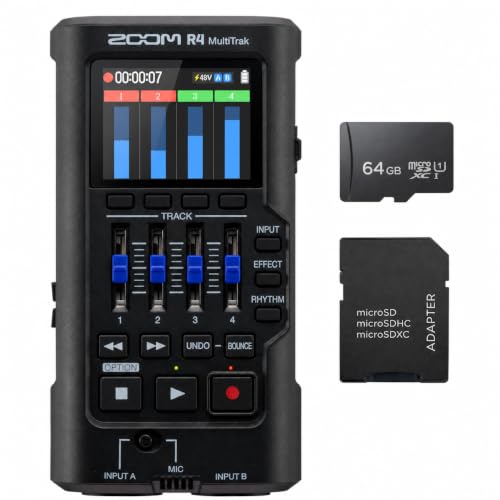
Best Compact Multitrack Bundle – Zoom R4 Multi-Track Recorder
The Zoom R4 is a compact option for shoppers seeking multitrack recorders for podcasts, especially when portability matters. This bundle includes the recorder’s two XLR/TRS combo inputs and a 64GB microSD card with adapter, giving you recording media to get started.
Best For: Mobile creators who want a small multitrack recorder with two combo inputs and included storage.
Pros:
- Includes a 64GB Ultra microSD card and adapter.
- Two XLR/TRS combo inputs accommodate external microphones or instruments.
- Built-in stereo microphone supports quick recording.
- USB connectivity works with computers, laptops, smartphones, and tablets.
Cons:
- Two combo inputs provide less expansion than larger multitrack recorders.
- Requires two AAA batteries.
- The 0.96-inch screen is relatively small.
The R4 bundle makes sense for straightforward two-source podcast setups and travel recording. Its included microSD card improves out-of-box convenience, while the compact design keeps the kit easy to carry.
Best Simple Stereo Recorder – Zoom H2 Essential
For podcasters who value simple setup and adaptable microphone coverage, the Zoom H2 Essential is a streamlined choice among multitrack recorders for podcasts. Its three built-in microphones provide nine selectable patterns, while 32-bit float recording removes the need to adjust gain during a session.
Best For: Solo podcasters, journalists, and field recordists who prefer built-in microphones over connecting several external sources.
Pros:
- Three microphones and nine patterns support different recording perspectives.
- 32-bit float recording captures clip-free audio without manual gain adjustment.
- Can operate as a USB microphone while recording to an SD card simultaneously.
- Supports wireless Bluetooth timecode synchronization with multiple H2 Essential units.
Cons:
- Built-in microphone design offers less external-input flexibility than models with multiple XLR inputs.
- Requires two AA batteries.
The H2 Essential is particularly appealing for quick interviews, solo narration, and portable recording. Its selectable mono, stereo, and surround modes provide useful flexibility without requiring a separate microphone setup.
How We Picked the Best Multitrack Recorders for Podcasts
We focused on recorders that can capture multiple sources independently, because separate tracks give you more control over voices, music, and background noise during editing. The lineup includes dedicated podcast recorders such as the Zoom PodTrak series, handheld recorders for flexible field work, and mixer-style models for larger or more hands-on setups.
We also considered the number and type of inputs, headphone outputs, computer connectivity, portability, storage, power options, monitoring controls, and features such as 32-bit float recording or built-in sound pads. Bundle versions can add useful accessories, but they should be judged against the underlying recorder rather than treated as a different performance class.
Quick Comparison
- Best for straightforward multi-person podcasts: A dedicated PodTrak model with four microphone inputs and multiple headphone outputs.
- Best for remote interviews: A podcast recorder with phone or USB connectivity and independent guest monitoring.
- Best for field recording: A compact H2, H4, or H6 Essential handheld recorder.
- Best for live mixing: The LiveTrak L-8, especially when you need hands-on level control and several inputs.
- Best for portable music and podcast experimentation: The R4 multi-track recorder with bouncing, effects, and built-in microphones.
Key Buying Factors for Multitrack Recorders for Podcasts
Input and Headphone Capacity
Count both microphone inputs and headphone outputs. Four XLR inputs are useful for a host plus several guests, while multiple headphone outputs let everyone monitor without extra hardware. Check whether inputs accept dynamic microphones, condenser microphones, instruments, or line-level sources.
Remote Guest Connectivity
If you regularly interview guests by phone or computer, look for dedicated phone, USB, or loopback support. Confirm how the recorder handles mix-minus monitoring so remote callers do not hear their own delayed voice.
Track Control and Recording Quality
Separate tracks make mistakes and volume differences easier to fix. 32-bit float recording can provide additional protection against clipping in supported workflows, but microphone placement and gain still matter. Built-in limiters, effects, and sound pads may speed up production, though they are not essential for every show.
Portability, Power, and Storage
For field work, compare size, battery life, external power, and the availability of microSD storage. A handheld recorder is easier to carry, while a larger mixer may offer better controls but require more setup space. Check whether a bundle includes a card, microphones, cables, or only storage accessories.
Who Should Buy Which Multitrack Recorders for Podcasts?
Choose a dedicated PodTrak recorder if your priority is a repeatable podcast workflow with several microphones, headphone monitoring, and guest connectivity. Select a PodTrak bundle when included microphones or storage reduce the total cost of building your setup.
Choose an H2, H4, or H6 Essential if you need one recorder for podcasts, filmmaking, music, interviews, and ambient sound. The H6 is the more expandable choice, while smaller models suit lighter travel kits. Pick the LiveTrak L-8 if tactile mixing and a higher-capacity studio-style setup matter most. The R4 is a better fit for creators who want portable multi-track recording with musical features and less dependence on a computer.