
Building a home studio does not require a full-size keyboard or a room packed with hardware. The right compact synthesizer, controller, sampler, or production center can provide hands-on sound design and a practical way to turn ideas into finished tracks.
These 10 picks cover several workflows, including computer-based production, portable beatmaking, performance sampling, and self-contained music creation. Use the buying guide below to match features, connectivity, and format to the way you actually make music.
Best 10 Synthesizers for Home Studios Picks for 2026
Versatile Vocal Synth

- 18-voice analog modeling with 256 presets
- Built-in vocoder, microphone, and VocalTune
- Animate controls, arpeggiator, USB, and MIDI
Best For: Producers wanting flexible sounds and vocal effects
Standalone Production Hub

- Computer-free production with MPC3 OS
- Expressive MPCe pads and 7-inch touchscreen
- Battery, speakers, mic, storage, and broad I/O
Best For: Standalone beatmaking and portable production
Pocket Retro Synth

- Distinctive analog-style vintage sound
- Stylus control with three octaves and vibrato
- Battery powered with speaker and headphones
Best For: Beginners and producers seeking portable retro tones
Compact Songmaking Center

- Standalone MPC3 workflow with 7-inch touchscreen
- 16 expressive pads and expanded processing
- USB-C audio/MIDI plus sampling and arrangement tools
Best For: Compact studio production and beatmaking
Best Portable FM Pick
M-VAVE Wireless FM Synthesizer

- Six-operator FM engine with 32 algorithms
- Built-in effects, arpeggiator, and sequencer
- Battery powered with speaker and flexible MIDI
Best For: Portable practice, beginner sound design, and compact home studios
Best Sampling Workstation
Roland SP-404MKII Creative Sampler

- Performance-focused sampler with 17 RGB pads
- OLED editing and extensive sample tools
- Portable power with 32-voice polyphony
Best For: Beatmaking, sample-based production, and live performance
Best Mini FM Workstation

- Six-operator FM with DX7 SysEx import
- Built-in sequencer, arpeggiator, and six effects
- 12-hour battery with three MIDI connection options
Best For: Mobile production, FM experimentation, and compact bedroom studios
Portable Sampling Hub

- Standalone battery-powered sampler with speaker and microphone
- 16 MPC pads, sample chopping, sequencing, and onboard effects
- USB-C, MIDI, line I/O, and microSD support
Best For: Portable beatmaking, sampling, and DAWless production
Compact Controller Choice

- 25 velocity-sensitive mini keys for virtual instruments
- Eight pads, eight knobs, arpeggiator, and pitch/modulation control
- USB-powered design with included production software and sounds
Best For: Compact home-studio control of software synthesizers and beats
Ableton Performance Controller
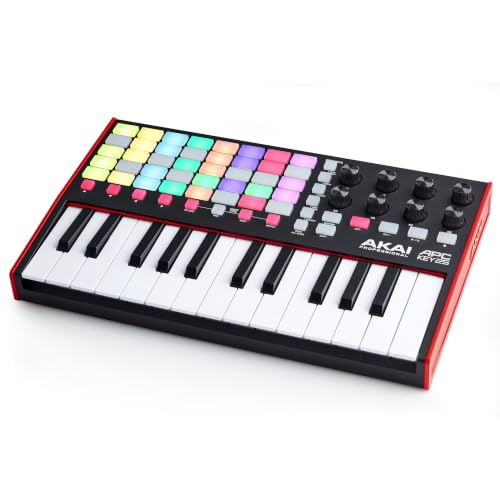
- 25 velocity-sensitive keys with octave controls
- 40 RGB pads for Ableton clip launching
- Eight knobs and pre-mapped Ableton Live integration
Best For: Ableton Live production, clip launching, and live performance
Versatile Vocal Synth – Novation MiniNova
The Novation MiniNova is a practical choice for home studios that need a compact synthesizer with broad sound-shaping options. Its 37 mini keys, 18-voice polyphony, 256 presets, built-in vocoder, and USB/MIDI connectivity support everything from basses and leads to vocal effects.
Best For: Home-studio producers seeking versatile analog-modeling sounds, vocal processing, and hands-on performance controls.
Pros:
- Offers 18-voice polyphony with deep basses, leads, pads, and vintage-style sounds.
- Includes a gooseneck microphone, built-in vocoder, and VocalTune vocal processing.
- Provides Animate buttons, an arpeggiator, five effects per voice, and USB/MIDI connectivity.
Cons:
- Its 37 mini keys may feel limiting for players who prefer a full-size keyboard.
- The plastic body prioritizes portability over a more substantial construction.
With fast preset browsing and plenty of performance controls, the MiniNova is a flexible centerpiece for a compact home-studio setup, especially when vocal and live-tweak features matter.
Standalone Production Hub – Akai MPC Live III Retro
The Akai MPC Live III Retro is a powerful all-in-one option for producers building synthesizers for home studios into a broader standalone workflow. It combines sampling, sequencing, clip launching, audio recording, plugin instruments, and performance controls without requiring a computer.
Best For: Producers who want a portable, computer-free production center for beatmaking, sampling, sequencing, and live performance.
Pros:
- Runs standalone with an 8-core processor, 8GB RAM, MPC3 OS, and 128GB internal storage.
- Features expressive 3D-sensing MPCe pads, a 7-inch touchscreen, clip launching, and a performance touch-strip.
- Includes a rechargeable battery, stereo monitors, microphone, extensive connectivity, and a large factory library.
Cons:
- Its broad production-center feature set may be more than needed for users seeking only a keyboard synthesizer.
- The unit is larger and heavier than pocket-sized or compact synth options.
The MPC Live III Retro is best viewed as a complete music-making workstation rather than a traditional keyboard synth. Its standalone design and extensive connections make it suitable for flexible home, mobile, and performance setups.
Pocket Retro Synth – Stylophone Original
The Stylophone Original offers an inexpensive, highly portable way to add character to a home studio. This pocket electronic synthesizer uses a stylus and touch-sensitive metal surface to produce its distinctive analog-style sound, with three octaves, optional vibrato, and a headphone output.
Best For: Beginners, experimental producers, and musicians who want a compact retro sound source for recording and inspiration.
Pros:
- Produces an iconic warm, vintage, retro organ-like sound.
- Compact battery-powered design includes a built-in speaker and headphone socket.
- Can connect to a computer or other gear through a 3.5mm stereo cable.
Cons:
- The stylus-based playing surface is less conventional than a standard keyboard.
- Its auxiliary connectivity is more limited than USB- or MIDI-equipped studio synths.
The Stylophone is not a full-featured workstation, but its unusual playing method and recognizable tone make it a fun supplementary instrument for sketches, effects, and retro-flavored recordings.
Compact Songmaking Center – Akai MPC One G2
The Akai MPC One G2 is a compact standalone production center for home studios that prioritize sampling, sequencing, and complete song arrangement. Its MPC3 OS, 7-inch touchscreen, 16 responsive pads, USB-C audio/MIDI connectivity, and expanded processing support computer-free production as well as hybrid workflows.
Best For: Bedroom producers and beatmakers who need a compact hub for sampling, sequencing, arranging, and external-gear integration.
Pros:
- Works without a laptop for beatmaking, sampling, sequencing, and full song arrangement.
- Provides 16 velocity- and pressure-sensitive RGB pads, a touchscreen, and support for up to 16 stereo audio tracks.
- USB-C offers multichannel audio and expanded MIDI, while bundled content includes plugins and over 20GB of factory material.
Cons:
- It is pad-focused rather than a conventional keyboard synthesizer.
- Its extensive MPC workflow may require learning for users new to standalone production systems.
The MPC One G2 is a strong choice when synthesizers for home studios need to fit into a larger production workflow. It combines portable hardware with serious sequencing, sampling, and DAW integration in a compact desktop format.
Best Portable FM Pick – M-VAVE Wireless FM Synthesizer
For musicians seeking synthesizers for home studios that can also travel, this compact M-VAVE model combines six-operator FM synthesis with a built-in speaker, battery operation, presets, effects, and sequencing. It is designed for quick, self-contained sound creation without requiring a separate keyboard or monitor.
Best For: Beginners, portable sketching, and producers who want classic FM sounds in a compact format.
Pros:
- Six operators, 32 algorithms, and 128 factory presets provide a broad FM sound palette.
- Built-in effects, arpeggiator, and 16-step sequencer support standalone idea generation.
- USB MIDI, Bluetooth MIDI, and 3.5mm MIDI input offer flexible studio connections.
- Battery power, a built-in speaker, and 27 silicone keys make it easy to use away from a desk.
Cons:
- The compact 27-key keyboard may feel limiting for two-handed performance.
- Its plastic construction and small form factor prioritize portability over a full-size studio feel.
This is a practical choice when portability and immediate playability matter as much as deep FM editing. Its MIDI options also let it serve as either a small controller or a sound module in a home-studio setup.
Best Sampling Workstation – Roland SP-404MKII Creative Sampler
The Roland SP-404MKII is a strong alternative for producers who want synthesizers for home studios alongside sampling, sequencing, and performance effects. Rather than focusing on traditional keyboard synthesis, it provides a fast sample-based workflow with responsive pads, detailed editing, and extensive onboard processing.
Best For: Beatmakers, sample-based producers, and performers who want a portable creative workstation.
Pros:
- Seventeen velocity-sensitive RGB pads support expressive performance and rapid beatmaking.
- OLED waveform editing, auto-chop, BPM detection, pitch shifting, and resampling streamline sample work.
- Thirty-two-voice polyphony, 160 samples per project, and 16 internal projects support substantial arrangements.
- USB-C, AC, mobile battery, and six-AA-battery operation provide flexible power options.
Cons:
- It is a sampler and effector rather than a conventional keyboard synthesizer.
- The pad-based workflow may not suit players who primarily want traditional keys.
Choose the SP-404MKII when hands-on sampling and live manipulation are central to your workflow. Its storage, effects, and portable power options make it especially useful for beat-focused home setups that may also leave the studio.
Best Mini FM Workstation – M-VAVE FM-1 Orange
The M-VAVE FM-1 Orange packs a six-operator FM engine, keyboard, sequencing, effects, and wireless connectivity into a lightweight unit. For home studios looking for synthesizers for home studios that can also support travel or mobile creation, it offers a particularly self-contained setup with presets and extensive tone editing.
Best For: Mobile producers, FM enthusiasts, beginners, and small bedroom studios.
Pros:
- Six operators, 32 algorithms, 145-parameter editing, and DX7 SysEx import support detailed FM sound design.
- Up to 12-voice polyphony, switchable mono/poly modes, and 128 presets cover leads, chords, basses, and pads.
- Integrated arpeggiator, 16-step sequencer, six effects, and Bluetooth audio playback reduce the need for extra gear.
- Its 12-hour battery, built-in speaker, headphone output, and USB-C/Bluetooth/3.5mm MIDI connections suit mobile use.
Cons:
- The 27-key silicone keyboard is compact and may not replace a full-size controller.
- Its small display and controls may be less comfortable for extended, detailed editing than larger hardware.
The FM-1 Orange is appealing when you want a complete miniature music station rather than a basic sound module. Its combination of FM editing, sequencing, effects, and long battery life makes it one of the most versatile options here for compact production.
Portable Sampling Hub – MPC Sample
For producers exploring synthesizers for home studios alongside sampling, the Akai Professional MPC Sample offers a compact, standalone workflow. Its battery, speaker, microphone, built-in effects, and microSD storage make it useful for creating away from a computer.
Best For: Beatmakers, DAWless creators, finger drummers, and producers who want portable sampling and sequencing.
Pros:
- Standalone, battery-powered operation with built-in speaker and microphone
- 16 velocity-sensitive MPC pads and a color display support hands-on beatmaking
- Includes factory kits, sample chopping, timestretching, resampling, and 60 effect types
- Offers USB-C audio/MIDI, MIDI connectivity, line I/O, and microSD storage
Cons:
- It is primarily a sampler and sequencer rather than a traditional keyboard synthesizer
- The MIDI DIN adapter is not included
- The compact 2.4-inch display may feel limiting for detailed editing
The MPC Sample is a flexible creative companion for a home studio, especially when portability and sample-based production matter more than traditional synth-keyboard controls.
Compact Controller Choice – MPK Mini MK3
The Akai Professional MPK Mini MK3 is a practical control surface for synthesizers for home studios, particularly when you use virtual instruments. It combines 25 velocity-sensitive mini keys with pads, knobs, an arpeggiator, and a pitch/modulation thumbstick in a compact USB-powered design.
Best For: Home producers, beatmakers, and musicians controlling virtual synthesizers, plugins, and DAW sessions.
Pros:
- 25 velocity-sensitive mini keys provide a compact melodic input
- Eight MPC-style pads support drum programming, sample triggering, and Note Repeat
- Eight assignable knobs and a four-way thumbstick offer hands-on plugin control
- Includes an arpeggiator, MPC Beats, virtual instruments, and 2GB of sound content
Cons:
- It requires a USB-compatible computer or device and does not operate as a standalone synth
- Mini keys may not suit players who prefer a full-size keyboard feel
- It has a single USB connection
As a compact MIDI controller, the MPK Mini MK3 gives a home studio a broad set of performance controls without taking up much desk space. It is best paired with software synthesizers rather than used independently.
Ableton Performance Controller – APC Key 25 MK2
For Ableton-based synthesizers for home studios, the Akai Professional APC Key 25 MK2 combines a 25-note velocity-sensitive keyboard with clip launching and software control. Its RGB pad matrix and pre-mapped Ableton integration also make it suitable for arranging and performing ideas live.
Best For: Ableton Live users who want keyboard input, clip launching, and hands-on control in one compact controller.
Pros:
- 40 RGB pads provide visual clip-launching feedback in Ableton Live
- 25 velocity-sensitive mini keys cover chords, basslines, leads, and melodic parts
- Eight assignable knobs support volume, pan, sends, automation, and device macros
- Includes Ableton Live Lite plus Hybrid 3, Mini Grand, and Velvet instruments
Cons:
- Its strongest integration is with Ableton Live rather than broad standalone use
- It requires a USB-connected computer and does not include battery operation
- The 25-key mini keyboard offers a limited physical range without octave switching
The APC Key 25 MK2 is a focused choice for producers building an Ableton-centered setup. It adds more clip and performance control than a basic MIDI keyboard while remaining compact enough for a home studio desk.
How We Picked the Best Synthesizers for Home Studios
We evaluated these instruments and controllers for the needs of home producers: sound creation, sequencing, sampling, portability, computer integration, and ease of use. Because “synthesizer” can describe several types of gear, this selection includes true synthesizers alongside MIDI keyboards, samplers, grooveboxes, and standalone production centers that can play a central role in a compact studio.
We also considered whether each product offers a clear advantage for a particular workflow. Important distinctions include built-in sounds versus software control, battery operation versus desktop power, onboard sequencing, pad-based performance, and the number of connections available for expanding a setup.
Quick Comparison
| Best For | Look For |
|---|---|
| Computer-based production | USB MIDI, compact keys, software compatibility |
| Standalone beatmaking | Sequencing, sampling, storage, and screen controls |
| Portable sound design | Battery power, built-in speaker, and onboard presets |
| Live sampling and effects | Responsive pads, performance controls, and effects |
| Learning and experimentation | Simple layouts, accessible controls, and low cost |
Key Buying Factors for Synthesizers for Home Studios
Choose the Right Type of Instrument
A dedicated synthesizer is best when you want to shape oscillators, filters, envelopes, and effects directly. A MIDI controller produces no sound by itself but can provide a better hands-on interface for virtual instruments. Samplers and MPC-style workstations are more suitable if your priority is arranging beats, triggering clips, and building complete tracks without relying entirely on a computer.
Check Your Workflow and Connectivity
Confirm whether the unit connects through USB MIDI, traditional MIDI, Bluetooth, audio outputs, or a combination of these. If you plan to record its internal sounds, make sure your audio interface has the necessary inputs. For a small desk, also check the footprint and whether the controls are comfortable to access beside your computer or monitor.
Consider Keys, Pads, and Portability
Compact 25-key controllers save space and work well for bass lines, melodies, and software control, while pad-based devices are often better for finger drumming and sample triggering. Battery-powered instruments and built-in speakers are useful for travel and sketching, but desktop-focused gear may offer deeper controls and more reliable expansion.
Who Should Buy Which Synthesizers for Home Studios?
Choose a compact keyboard controller if you already produce in a DAW and mainly need keys, knobs, or pads to control virtual instruments. Pick a dedicated portable FM or modeling synthesizer if you want immediate access to onboard sounds and hands-on synthesis away from the computer.
Standalone MPC-style devices suit producers who want sequencing, sampling, and arrangement in one box. A performance sampler and effects unit is a strong choice for beatmakers, live performers, and anyone who enjoys reshaping loops in real time. Finally, a simple pocket instrument is ideal for beginners, casual experimentation, or adding an inexpensive source of unusual sounds to an existing studio.