
Moving a desktop’s display, keyboard, and mouse across a room or between work areas does not require relocating the entire computer. The right KVM extender sends video and USB control over network-style cabling while keeping your desktop accessible from a more convenient location.
This roundup compares 10 options spanning 1080p and 4K systems, direct point-to-point extenders, and models designed for longer Ethernet runs or IP-based installations. Use the buying guide below to match each design with your monitor, cable infrastructure, distance, and workflow.
Best 10 Kvm Extenders for Desktops Picks for 2026
Best Budget 1080p Pick
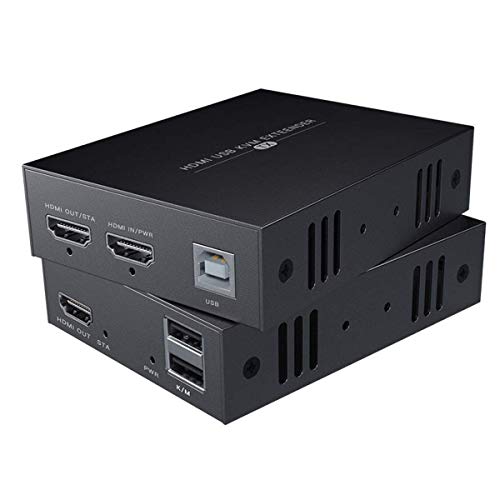
- 1080p at 60Hz
- USB keyboard-and-mouse control
- Up to 50m over Cat6/7
Best For: Basic remote desktop and home-office setups
Best Dual-Monitor Switcher

- Dual-monitor copy or extend modes
- 8K60 and 4K120 support
- Four USB 3.0 sharing ports
Best For: Two-computer, dual-display desktop workstations
Best Long-Range 4K Value

- 4K60 transmission up to 230ft
- USB keyboard-and-mouse control
- HDMI loop-out and audio extraction
Best For: Long-distance 4K desktop and AV installations
Best for High-Refresh Displays

- 4K60 4:4:4 support
- 1080p240 and 2K144 modes
- Four remote USB device ports
Best For: Gaming and high-refresh desktop workstations
Best Long-Range Choice
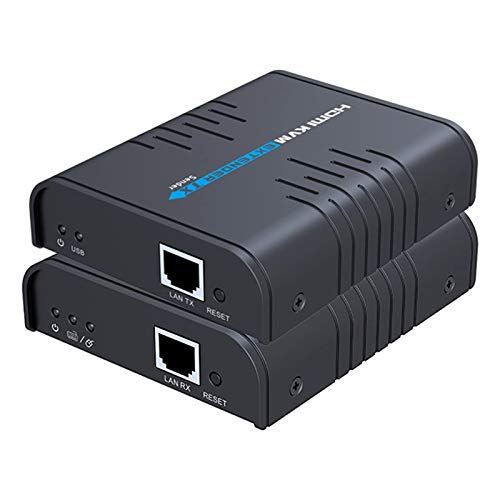
- 1080p video up to 120 meters
- USB KVM control over Cat cable
- Supports multiple receivers
Best For: Large homes, facilities, and control centers
Best Plug-and-Play Pick
AV Access 80m HDMI KVM Extender
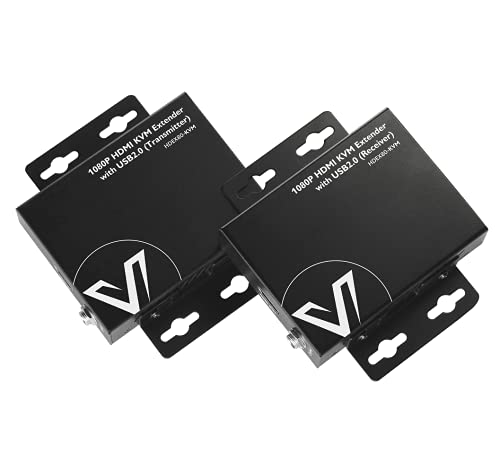
- 1080p at 60Hz to 80 meters
- Two USB 2.0 ports
- One-power-supply two-way PoE
Best For: Remote PC and NVR control
Best With Loop Out

- 1080p transmission to 120 meters
- HDMI loop-out for local monitoring
- Supports standard USB keyboard and mouse
Best For: Classrooms, conference rooms, and home theaters
Best Long-Range IP KVM

- 4K30 video and USB over Ethernet
- Up to 120m on Cat5e; 150m on Cat6/7
- Supports existing IP networks and 16 sets
Best For: Long-distance workstations and scalable networked KVM installations
Best 4K60 HDBaseT KVM

- 4K60 4:2:0 video over up to 100m
- Four USB 2.0 device ports at the receiver
- Adds RS232, audio, EDID, and PoH
Best For: Feature-rich offices, control rooms, and AV installations
Best Zero-Latency IP KVM
4K HDMI Extender over Ethernet

- Responsive zero-latency remote control
- 4K30 video and USB up to 120m
- Works directly or through Gigabit switches
Best For: Networked control rooms and distributed desktop workstations
Best Budget 1080p Pick – 50m HDMI KVM Extender
For straightforward desktop remote-control setups, this HDMI KVM extender for desktops sends 1080p video and USB keyboard-and-mouse signals over Cat5e, Cat6, or Cat7 cable. It reaches up to 50 meters with Cat6/7 and uses a simple transmitter-and-receiver installation.
Best For: Home offices, basic computer workstations, and users who need reliable 1080p KVM control over a moderate distance.
Pros:
- Supports 1080p at 60Hz for smooth Full HD output.
- Extends HDMI and USB KVM signals over Ethernet cable.
- Works with Windows, Mac OS, and Linux systems.
- Simple setup with a power adapter for the transmitter.
Cons:
- Video resolution is limited to 1080p.
- Maximum distance varies by cable type, with Cat5e rated to 40 meters.
This is a practical choice when you want basic remote desktop access without paying for 4K features. Use Cat6 or Cat7 cable to achieve the longest listed range and best signal quality.
Best Dual-Monitor Switcher – 8K HDMI KVM for Two PCs
This dual-monitor KVM switch suits desktops that need to share two displays and multiple USB peripherals between two computers. It supports copy or extended display modes, 8K at 60Hz, and switching through front-panel buttons or the included wired controller.
Best For: Multi-monitor desktop users who need to switch two computers while sharing keyboards, mice, printers, scanners, webcams, and other USB devices.
Pros:
- Supports up to 8K at 60Hz and 4K at 120Hz.
- Handles dual-monitor copy and extended display modes.
- Includes four USB 3.0 ports with up to 5Gbps transfer speeds.
- External 12V power helps support higher-power USB devices.
Cons:
- Requires each computer to provide two HDMI outputs for extended dual-monitor operation.
- Keyboard-hotkey switching is not supported.
- It cannot create dual-monitor functionality from a single-monitor PC.
Among these kvm extenders for desktops, this model is better viewed as a high-resolution dual-monitor KVM switch rather than a long-distance Ethernet extender. Confirm your computers have two HDMI outputs and support the desired display mode before buying.
Best Long-Range 4K Value – OREI 230ft HDMI KVM Extender
The OREI EX-230PRO-KVM is a strong option for kvm extenders for desktops when the display and computer need to be separated by a longer cable run. It sends 4K video at 60Hz up to 230 feet over Cat6 or Cat7 and adds remote USB keyboard-and-mouse control.
Best For: Offices, control rooms, presentation spaces, and desktop installations requiring long-distance 4K video and basic KVM access.
Pros:
- Extends 4K at 60Hz up to 230 feet over Cat6/7.
- Supports HDR formats, Dolby Vision, HLG, and HDCP 2.2.
- Provides USB KVM control at the receiver.
- Includes HDMI loop-out and 3.5mm analog audio extraction.
Cons:
- Requires suitable Cat6 or Cat7 cabling for the full listed distance.
- It is a point-to-point extender rather than a multi-computer KVM switch.
Its long reach, 4K60 support, local HDMI loop-out, and audio extraction make it flexible for professional AV layouts. The included one-year warranty adds useful support coverage for a specialized installation.
Best for High-Refresh Displays – AV Access 4K KVM Extender
For gaming and responsive desktop work, this AV Access unit combines 4K video with high-refresh support and remote USB access. It transmits up to 50 meters, supports 4K at 60Hz with 4:4:4, and can handle 1080p at 240Hz or 2K at 144Hz.
Best For: Gaming desks, home offices, CCTV monitoring, and studios where high refresh rates and full remote USB control matter.
Pros:
- Supports 4K at 60Hz with 4:4:4 color and visually lossless compression.
- Handles 1080p at 240Hz and 2K at 144Hz.
- Offers four USB device ports for keyboards, mice, drives, cameras, and more.
- Uses one-way PoC so one power adapter can power both units.
Cons:
- USB transmission is USB 2.0, limited to up to 480Mbps.
- Full-range operation requires a suitable Ethernet cable run up to 50 meters.
- The Phoenix audio connection may be less convenient for casual users.
This is one of the more performance-focused kvm extenders for desktops, especially for fast gaming displays and demanding peripherals. Its independent EDID management and PoC design also help simplify a clean, stable installation.
Best Long-Range Choice – AGPTEK 120m HDMI KVM Extender
For buyers comparing kvm extenders for desktops, the AGPTEK model stands out when you need to place a display and USB controls far from the source PC. It sends 1080p video and keyboard/mouse data up to 120 meters over one Cat5e, Cat6, or Cat7 cable.
Best For: Large homes, factories, construction sites, and control centers needing long-distance desktop access.
Pros:
- Extends 1080p video up to 365 feet/120 meters.
- Supports USB 1.1 wired or Bluetooth keyboard and mouse setups.
- One transmitter can work with multiple receivers.
- Includes EDID copying, Ethernet compatibility, LED indicators, and ESD protection.
Cons:
- USB support is limited to USB 1.1 devices.
- Does not work with wireless 2.4G mouse kits.
This AGPTEK extender is a strong fit if maximum cable distance and multi-receiver flexibility matter most. Its USB limitations make it better for standard keyboard-and-mouse control than high-speed peripherals.
Best Plug-and-Play Pick – AV Access 80m HDMI KVM Extender
The AV Access HDEX80-KVM is a practical option for kvm extenders for desktops when you want straightforward installation and faster USB connectivity. It carries 1080p video at 60Hz plus USB 2.0 signals up to 80 meters over a single compatible Ethernet cable.
Best For: Remote control of PCs, NVRs, DVRs, and compatible systems where plug-and-play USB 2.0 access is useful.
Pros:
- Extends 1080p at 60Hz up to 260 feet/80 meters.
- Provides two USB 2.0 ports with speeds up to 480Mbps.
- Two-way PoE allows one power supply at either side.
- Metal housing helps with durability, heat dissipation, and interference reduction.
Cons:
- Maximum range is shorter than some 120-meter alternatives.
- Requires compatible Cat5e, Cat6, Cat6a, or Cat7 cabling.
Choose this model for a balanced desktop-extension setup with USB 2.0 support and a compact metal enclosure. Its operating-system compatibility and no-driver installation also make it convenient for mixed environments.
Best With Loop Out – VPFET 120m HDMI KVM Extender
For desktop users seeking kvm extenders for desktops with local monitoring, the VPFET model combines long-range 1080p transmission with an HDMI loop-out connection. It uses one Cat5e, Cat6, or Cat7 cable for distances up to 120 meters and supports standard keyboard and mouse control.
Best For: Classrooms, conference rooms, home theaters, and setups that need to view the local and remote display status.
Pros:
- Transmits 1080p video at 60Hz up to 400 feet/120 meters.
- HDMI loop-out supports local monitoring of the source signal.
- Plug-and-play design includes status indicators and a reset button.
- Compatible with Windows, Mac OS, and Linux systems listed by the manufacturer.
Cons:
- Supports only USB 1.1 devices and standard keyboards and mice.
- Does not support gaming peripherals or switches.
- Transmitter and receiver require power at both ends.
The loop-out function is the main reason to choose this VPFET extender over a basic long-distance model. It is well suited to conventional KVM control, but the USB 1.1 limit rules it out for demanding peripherals.
Best Long-Range IP KVM – 4K HDMI USB Extender to 390ft
For buyers comparing kvm extenders for desktops, this AV Access model stands out when you need to send 4K video, audio, USB, and remote keyboard-and-mouse control over existing Ethernet infrastructure. It supports up to 120m over Cat5e and up to 150m over Cat6/6a/7, with direct or switched-network deployment.
Best For: Remote workstations, server rooms, control centers, classrooms, and distributed desktop setups that need long-distance KVM control.
Pros:
- Extends 4K video at 30Hz and 1080p at 120Hz over one Ethernet cable.
- Supports remote USB keyboard, mouse, controller, and other peripherals through three receiver-side USB ports.
- Can use an existing Gigabit network and supports up to 16 paired extender sets.
- Works with Windows, macOS, and Linux without additional drivers.
Cons:
- 4K output is limited to 30Hz.
- Network-based installation may require compatible Gigabit switching for longer or centralized deployments.
This is a flexible choice for desktop environments that prioritize distance, network scalability, and remote USB access. Its 4K30 limit makes it less suited to buyers seeking high-refresh 4K desktop use.
Best 4K60 HDBaseT KVM – 100m HDMI Ethernet Extender
Among kvm extenders for desktops, this HDBaseT model is a strong fit when smoother 4K output and broad peripheral support matter. It sends video, USB 2.0, audio, and RS232 over a single Cat6/6a/7 cable for distances up to 100m.
Best For: Offices, server rooms, CCTV systems, industrial controls, and desktop workstations needing 4K60-ready video with multiple remote USB devices.
Pros:
- Supports 4K at 60Hz in 4:2:0 and 1080p at up to 120Hz over 100m.
- Provides four receiver-side USB ports for keyboards, mice, storage, cameras, and other devices.
- Includes bidirectional RS232 and analog stereo audio pass-through for AV integration.
- PoH allows the transmitter to power both units, reducing installation cable clutter.
Cons:
- Its stated maximum extension distance is 100m, shorter than the 120m-to-150m ranges of the other listed models.
- 4K support uses 4:2:0 chroma sampling.
This model offers the most feature-rich point-to-point option in the group, particularly for installations that need 4K60, four USB ports, RS232, and audio. It is best suited to structured AV or control environments rather than simple desktop-only extension.
Best Zero-Latency IP KVM – 4K HDMI Extender over Ethernet
This AV Access unit is worth considering when shopping for kvm extenders for desktops that need responsive remote control over an IP network. It carries 4K video, USB 2.0, and multichannel audio up to 120m over Cat5e, or up to 150m over Cat6/6a/7, with direct or Gigabit-switch connectivity.
Best For: Control rooms, server environments, professional AV systems, classrooms, and distributed desktops where responsive keyboard-and-mouse interaction is important.
Pros:
- Designed for zero-latency remote computer control over Ethernet.
- Supports 4K at 30Hz, 1080p at 120Hz, and HDCP 1.4 compatibility.
- Receiver includes three USB 2.0 ports for keyboards, mice, flash drives, and other peripherals.
- Carries PCM up to 7.1 channels plus Dolby and DTS formats.
Cons:
- 4K output is limited to 30Hz.
- Expanded network deployments require compatible Gigabit Ethernet switches.
Choose this model when low-latency interaction and IP-network flexibility are more important than 4K high-refresh output. Its combination of remote USB, long reach, and multichannel audio makes it especially practical for centralized desktop and control-room layouts.
How We Picked the Best Kvm Extenders for Desktops
We evaluated these Kvm Extenders for Desktops by focusing on the specifications that affect everyday use: supported resolution and refresh rate, maximum transmission distance, cable compatibility, USB keyboard and mouse support, signal type, and installation requirements. We also considered useful features such as HDMI loop-out, USB hubs, power-over-cable designs, HDCP support, and IP-based expansion.
Distance claims are typically maximums under suitable cabling and conditions. Actual performance can vary with cable quality, connectors, interference, and whether the extender uses a dedicated link or a shared network.
Quick Comparison
| Priority | Look for |
|---|---|
| Basic remote control | 1080p video with USB keyboard and mouse support |
| Sharp 4K desktop output | 4K at 60Hz, preferably with 4:4:4 chroma |
| High-refresh displays | Support for 1080p at 240Hz or 1440p at 144Hz |
| Long cable runs | 120m-rated point-to-point or IP extender over Cat6 or better |
| Multiple computers or displays | A KVM switch with the required monitor and USB ports |
Key Buying Factors for Kvm Extenders for Desktops
Resolution, Refresh Rate, and Chroma
Choose an extender that matches the monitor you actually use. Office work may be fine at 1080p, while 4K at 60Hz is better for detailed productivity and creative applications. Check refresh-rate support separately: a product may handle 4K at 60Hz but offer higher rates only at 1080p or 1440p. For text clarity, 4:4:4 chroma is preferable when available.
Distance and Cabling
Cat5e can work for many shorter runs, but Cat6 or Cat6a is a safer choice for demanding 4K signals and longer installations. Confirm whether the stated range applies to a direct transmitter-to-receiver connection or requires network switches. IP models can be more flexible, but they may need compatible switches, network configuration, and a reliable dedicated path.
USB and KVM Functionality
Verify that the extender supports the peripherals you need. Keyboard and mouse control is common, but USB bandwidth and device compatibility vary. If you need storage, webcams, or other high-speed accessories, check for USB 3.0 rather than assuming every USB port offers the same performance. A KVM switch is different from a simple extender: it may let you select among multiple computers or drive multiple displays.
Installation Details
Look for included power adapters, EDID handling, HDCP compatibility, loop-out ports, and plug-and-play operation. PoC can reduce power requirements at one end, while loop-out is useful when the local monitor must remain active. For business or rack installations, confirm the unit’s heat, mounting, and network-management requirements.
Who Should Buy Which Kvm Extenders for Desktops?
Choose a basic 1080p extender for routine office control, signage, or a modest remote workstation. Select a 4K 60Hz model for modern productivity desktops and detailed displays. High-refresh support suits gaming or motion-sensitive applications, provided both the computer and monitor use compatible outputs. For runs approaching 120m, prioritize a long-distance model with Cat6 or better cabling. Choose an IP-based extender when you need flexible routing through network infrastructure or future expansion. If your main requirement is switching between computers or using two monitors, consider a dedicated multi-port KVM switch rather than relying on a single point-to-point extender.