
The best analog synthesizers can add warm basses, expressive leads, evolving sequences, and hands-on control to a studio, live rig, or beginner setup. The right choice depends on more than oscillator count: keyboard format, workflow, connectivity, and portability matter just as much.
We selected 10 standout instruments across true analog, hybrid, analog-modeling, semi-modular, and portable designs so you can match your budget and playing style to a practical synth.
Best 10 Analog Synthesizers Picks for 2026
Editor's Choice

- Deep hands-on control with 40 knobs and 74 switches
- Two-note paraphony and expressive 37-key keyboard
- MIDI, USB, CV, gate, audio, and headphone connections
Best For: Advanced sound design and expressive studio performance
Best Bass Value

- Two analog oscillators with sub-oscillator and ring modulation
- Classic and Acid filter options with 12 or 24 dB slopes
- Built-in arpeggiator, step sequencer, and 128 patch slots
Best For: Accessible bass lines, leads, and electronic sequences
Best Hybrid Option

- Six-voice polyphonic hybrid synthesis
- Portable 37-key format for hands-on playing
- Includes a matching MiniFreak VST counterpart
Best For: Portable chord playing and modern hybrid sound design
Best Modern Monosynth

- Two wavefolding VCOs with sync, FM, and sub-oscillator
- Expressive 32-key keyboard with velocity and aftertouch
- 64-step sequencer, CV patch points, and 256 presets
Best For: Expressive live performance and modern Moog monosynth work
Best for Easy Setup
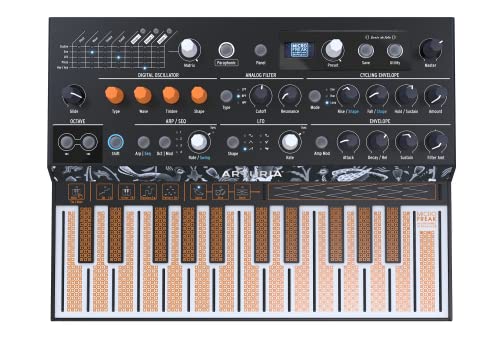
- Digital oscillator engines with a resonant analog filter
- Pressure-sensitive 25-key keyboard with poly-aftertouch
- CV, USB, and MIDI connectivity plus creative sequencing
Best For: Advanced experimental sound design and hybrid setups
Best Compact Bass Synth

- Three oscillators for powerful analog bass tones
- 16-step sequencer with slide and Active Step functions
- Battery-powered design with speaker, SYNC, and MIDI
Best For: Portable basslines, acid patterns, and electronic grooves
Best Portable Performance Synth

- Battery-powered design with built-in speaker and headphones
- Stylus keyboard plus finger-sensitive expression strip
- Analog delay, sub-octaves, and CV/Gate outputs
Best For: Portable expressive play and compact hardware rigs
Exploration Workstation

- Dual oscillators, wavefolder, and resonant filter
- Generative dual eight-step sequencers
- 32-jack semi-modular patch bay
Best For: Experimental sound design and evolving sequences
Pocket Retro Pick

- Stylus-controlled three-octave interface
- Battery-powered with built-in speaker
- Iconic retro analog sound and vibrato
Best For: Beginners, travel, and playful retro sounds
Portable Performance Choice

- Eight-note polyphony plus mono mode
- 37-key mini keyboard and phrase looper
- Built-in speakers with MIDI USB connectivity
Best For: Portable performance, chords, pads, and leads
Editor's Choice – MOOG Subsequent 37
The MOOG Subsequent 37 is a premium choice for musicians who want an expansive analog synthesizer with hands-on control. Its 37 semi-weighted keys, two-note paraphony, extensive modulation, and broad connectivity make it suitable for detailed sound design and expressive performance.
Best For: Experienced players and producers seeking deep Moog sound design with keyboard expression and CV control.
Pros:
- Extensive panel control with 40 knobs and 74 switches
- Two variable-waveshape oscillators, sub-oscillator, noise generator, and external filter input
- 37 velocity- and aftertouch-sensitive keys with 256 presets
- Includes MIDI, USB, audio, headphone, CV, and gate connections
Cons:
- Two-note paraphony is more limited than full polyphony
- Its extensive controls may be more than beginners need
- At 10 kg, it is relatively heavy for a portable setup
The Subsequent 37 stands out when tactile control and modulation depth matter more than compact size. The included editor/librarian software adds useful preset management for studio workflows.
Best Bass Value – Novation Bass Station II
The Novation Bass Station II is a focused analog synthesizer for bass lines, leads, and sequence-driven ideas. Its two oscillators, sub-oscillator, dual filter types, arpeggiator, and step sequencer provide a strong range of sounds in a compact 25-key format.
Best For: Beginners and electronic musicians who want accessible analog bass, lead, and sequencing tools.
Pros:
- Two analog oscillators plus sub-oscillator, noise, and ring modulation
- Classic multimode filter and separate 24 dB Acid Filter
- Pattern-based arpeggiator and real-time step sequencer
- 128 patch slots with factory and downloadable artist sounds
Cons:
- Its 25-key keyboard is smaller than the keyboards on the other listed models
- Plastic construction may feel less substantial than metal-bodied alternatives
- It is primarily a monosynth despite its listed paraphonic mode
The Bass Station II is a practical entry point into analog synthesis, especially for bass-heavy electronic styles. Its filter choices and built-in sequencing make it easy to move from sound creation to a playable pattern.
Best Hybrid Option – Arturia MiniFreak 37-Key
Arturia MiniFreak 37 Key Polyphonic 6-Voice Hybrid Synthesizer Keyboard (Standard, 37 Key)
Check Price On AmazonThe Arturia MiniFreak is a compact hybrid synthesizer for players who want to explore digital and analog-inspired sound possibilities. Its 37-key layout, portable design, six-voice polyphony, and included VST counterpart make it a flexible option for experimentation and modern production.
Best For: Beginners and producers wanting a portable, polyphonic hybrid instrument with software integration.
Pros:
- Six-voice polyphony supports chords and layered parts
- 37 keys provide more playing room than compact mini-key controllers
- Hybrid digital-and-analog sound profile encourages broad sonic exploration
- Includes the MiniFreak VST counterpart
Cons:
- It is a hybrid synthesizer rather than a purely analog design
- The supplied notes provide limited detail about its synthesis controls
- USB is the listed connector, with no other connections specified in the supplied details
The MiniFreak is the most versatile fit here for users who value polyphony, portability, and software-based workflow. Choose it over a traditional analog monosynth when chords and hybrid sound creation are priorities.
Best Modern Monosynth – MOOG Messenger
The MOOG Messenger is a modern monophonic analog synthesizer that combines classic Moog-style architecture with performance-focused features. Its two wavefolding VCOs, resonance-compensated ladder filter, expressive 32-key keyboard, sequencer, and CV connectivity suit both studio and live use.
Best For: Performers and producers wanting a portable, expressive Moog monosynth with modern sequencing and modulation.
Pros:
- Two continuously variable-shape VCOs with sync, FM, and sub-oscillator
- Four- or two-pole filter with low-pass, band-pass, high-pass, and RES BASS settings
- 32 velocity- and aftertouch-sensitive semi-weighted keys
- 64-step sequencer, arpeggiator, 256 presets, and six analog CV patch points
Cons:
- Monophonic architecture does not support chords
- Its 5.14 kg weight and full-size format may be less convenient for frequent travel
- It has a one-year manufacturer warranty
The Messenger is a strong option for players who want a dedicated analog monosynth with immediate controls and substantial performance features. Its expressive keyboard and flexible connections make it especially appealing for live sound shaping and modular integration.
Best for Easy Setup – Arturia MicroFreak
The Arturia MicroFreak is a strong choice for musicians who want an unusually flexible entry in the analog synthesizers category. Its digital oscillator engines pair with a resonant analog filter, while the pressure-sensitive 25-key touch keyboard, modulation matrix, sequencing tools, and CV connectivity support experimental sound design.
Best For: Advanced users seeking hybrid tones, expressive sequencing, and modular or DAW integration in a compact instrument.
Pros:
- Offers multiple oscillator modes spanning physical modeling, wavetable synthesis, vocoder, noise, and more.
- 25-key PCB keyboard detects individual-note pressure or poly-aftertouch.
- Includes a modulation matrix, automation recording, Spice and Dice functions, USB, MIDI, and CV outputs.
Cons:
- Its advanced feature set is aimed at experienced users.
- The 25-key touch keyboard may not suit players wanting a conventional keybed.
The MicroFreak stands out when creative experimentation and connectivity matter more than traditional analog architecture. It is a compact, versatile option for building evolving patterns and distinctive hybrid patches.
Best Compact Bass Synth – Korg Volca Bass
The Korg Volca Bass is a focused option for shoppers comparing analog synthesizers for basslines and electronic grooves. Its three analog oscillators, simple signal path, 16-step sequencer, slide function, and Active Step feature make it practical for acid-inspired patterns and rhythm-driven production.
Best For: Producers and performers who want portable analog bass sounds, hands-on sequencing, and easy synchronization with other gear.
Pros:
- Three oscillators provide a range of bass sounds, from aggressive to fat and supportive.
- Built-in 16-step sequencer includes slide and Active Step functions for evolving patterns.
- Battery operation, built-in speaker, SYNC, and MIDI input support portable setups.
- Self-tuning helps address pitch drift common with analog synthesizers.
Cons:
- Its sound design structure is intentionally simple, with one VCF, VCA, LFO, and envelope generator.
- It is specialized for bass-heavy sounds rather than broad, general-purpose synthesis.
The Volca Bass is a straightforward and portable groovebox-style instrument for low-end-focused music. Choose it when dedicated bass tones and quick pattern creation are more important than extensive synthesis flexibility.
Best Portable Performance Synth – Stylophone GENX-2
The Stylophone GENX-2 brings an unusually portable approach to analog synthesizers, combining a stylus-controlled keyboard with hands-on sound shaping. Its LFO, resonant low-pass filter, envelope, pulse-width modulation, dual sub-octave switches, analog delay, and CV/Gate outputs make it suitable for both standalone play and hardware integration.
Best For: Mobile creators and performers who want expressive stylus play, built-in sound, and a compact controller for modular or semi-modular equipment.
Pros:
- Battery operation, built-in speaker, headphone connection, and audio output support playing anywhere.
- Includes a flexible LFO, resonant filter, attack/decay envelope, and pulse-width modulation.
- Dual sub-octave switches and built-in analog delay expand its bass and atmospheric sound options.
- CV and Gate outputs allow control of external modular or semi-modular gear.
Cons:
- The stylus-based keyboard is a specialized playing interface rather than a conventional keyboard.
- Its compact controls may be less suitable for players seeking a full-size instrument.
The GENX-2 is appealing for spontaneous sound creation and expressive performance in a very small format. Its CV/Gate connectivity also gives it a role beyond novelty, particularly in portable hardware rigs.
Exploration Workstation – Moog Labyrinth
The MOOG Labyrinth is a strong choice for musicians seeking analog synthesizers with an experimental, semi-modular workflow. Its dual oscillators, wavefolder, resonant filter, generative sequencers, and extensive patch bay make it suited to evolving textures and hands-on sound design.
Best For: Experimental producers, sound designers, and performers who want generative sequencing and deep patching.
Pros:
- Dual low-harmonic oscillators support metallic FM and wavefolding textures.
- Includes a voltage-controlled wavefolder and morphing lowpass/bandpass filter.
- Dual eight-step generative sequencers add evolving movement.
- 32-jack patch bay offers substantial reconfiguration options.
Cons:
- The exploratory semi-modular design may be less immediate for players wanting conventional presets.
- Its 1.5 kg format and patch-oriented workflow are less pocket-friendly than compact synths.
Choose the Labyrinth when unusual timbres and changing sequences matter more than straightforward keyboard performance. It is especially compelling as a color and movement source alongside drums or bass.
Pocket Retro Pick – Stylophone Original
The Original Stylophone is a compact entry point for shoppers comparing analog synthesizers and vintage-inspired electronic instruments. Its stylus-controlled metal surface, three octaves, optional vibrato, built-in speaker, and battery power make it exceptionally portable and approachable.
Best For: Beginners, casual players, collectors, and musicians who want a pocket-sized retro sound source.
Pros:
- Simple stylus interface is easy to play for beginners and experienced users.
- Provides an iconic analog sound with three octaves and optional vibrato.
- Runs on three AA batteries and includes a built-in speaker and headphone socket.
- Can connect to a computer or other gear through its 3.5mm connection.
Cons:
- The compact touch-surface design is less suitable for traditional keyboard technique.
- Its built-in sound and controls are more limited than those of larger synthesizers.
The Stylophone is best viewed as a fun, highly portable instrument rather than a full studio centerpiece. It makes a practical first synth or a distinctive retro texture tool for travel and quick ideas.
Portable Performance Choice – Yamaha REFACE CS
The Yamaha REFACE CS is a practical option for players who want portable analog-modeling synthesizers with more conventional performance controls. It combines multiple synthesis and oscillator types, eight-note polyphony, a 37-key mini keyboard, phrase looper, speakers, and MIDI USB connectivity.
Best For: Keyboardists, live performers, and producers needing portable chords, pads, basses, and leads.
Pros:
- Eight-note polyphony handles chords and pads, while mono mode supports bass and leads.
- Analog physical modeling provides multiple synthesis and oscillator types.
- 37-key keyboard supports more natural performance than pocket-sized instruments.
- Built-in phrase looper, speakers, and MIDI USB connectivity support mobile workflows.
Cons:
- Its mini keyboard is portable but not a full-size 61-key playing surface.
- At 29.52 inches wide and 6 pounds, it is less pocketable than the Stylophone.
The REFACE CS is a versatile middle ground for musicians who value immediate keyboard playability without giving up portability. Its polyphony and looper make it suitable for both sketching ideas and performing away from a full-size setup.
How We Picked the Best Analog Synthesizers
We evaluated these instruments by considering sound-shaping flexibility, hands-on controls, keyboard or pad usability, sequencing features, connectivity, portability, and overall value. Because synth terminology varies, this roundup includes traditional analog instruments alongside hybrid and analog-modeling options that deliver a similar hands-on experience. We also looked for products suited to different users, from first-time buyers and mobile musicians to experienced producers building a larger setup.
Quick Comparison
| Best For | Recommended Pick | Format |
|---|---|---|
| Deep bass and expressive performance | Moog Subsequent 37 | Paraphonic analog keyboard |
| Classic affordable monosynth sounds | Novation Bass Station II | Analog monosynth |
| Versatile hybrid synthesis | Arturia MiniFreak | Polyphonic hybrid keyboard |
| Experimental semi-modular patching | Moog Labyrinth | Semi-modular analog synth |
| Compact sequencing | Korg Volca Bass | Desktop analog groovebox |
| Portable practice and performance | Yamaha Reface CS | Portable analog-modeling keyboard |
Key Buying Factors for Analog Synthesizers
Synthesis Type and Sound Design
Traditional analog oscillators and filters are valued for their immediacy and character, while hybrid and digital instruments may offer more voices, effects, and advanced modulation. Decide whether you want classic subtractive tones, experimental textures, or a combination of both.
Monophonic, Paraphonic, or Polyphonic Operation
Monosynths play one note at a time and are ideal for basses and leads. Paraphonic instruments can trigger multiple pitches while sharing parts of the signal path. Polyphonic models are better for chords, pads, and richer keyboard arrangements.
Keyboard, Sequencer, and Control Layout
Full-size keys are useful for performance, while compact keyboards and desktop units save space. A built-in sequencer is valuable for pattern-based music, and clearly labeled knobs make real-time sound shaping faster.
Connectivity and Expansion
Check for MIDI, USB, CV/Gate, audio input, and synchronization options before buying. CV/Gate is especially useful in modular systems, while USB and MIDI simplify computer-based recording and external-controller setups.
Size, Power, and Budget
Portable instruments may use batteries or compact power supplies, making them convenient for travel and live use. Larger keyboards usually provide more performance control but require more desk or stand space. Budget for accessories such as cables, a sustain pedal, headphones, or a protective case.
Who Should Buy Which Analog Synthesizers?
Beginners
The Bass Station II, MicroFreak, and Volca Bass offer approachable ways to learn synthesis without requiring a large studio. Choose the Volca for sequencing and compactness, or a keyboard model for more traditional playing.
Producers and Performers
The Subsequent 37 is a strong choice for hands-on bass and lead work, while the MiniFreak covers broader polyphonic and hybrid production duties. The Reface CS is a practical option when portability is a priority.
Experimental Sound Designers
The Moog Labyrinth suits users who enjoy semi-modular routing and generative patching. The Arturia MicroFreak and Stylophone GENX-2 are also useful for unusual timbres, compact experimentation, and unconventional performance techniques.
Portable and Casual Players
The Original Stylophone and GENX-2 are easy to carry and quick to explore. They are best for sketching ideas, informal playing, and adding distinctive textures rather than replacing a full studio keyboard.