
The best camera gimbal with subject tracking can keep people centered while delivering smoother footage than handheld shooting alone. The right model depends on your camera, payload, tracking needs, and willingness to manage accessories or apps.
This roundup compares phone gimbals, action-camera stabilizers, compact camera models, and full-size mirrorless systems so you can choose a setup that fits your style of shooting.
Best 10 Camera Gimbal with Subject Tracking Picks for 2026
Best DSLR/Mirrorless Pick

- Integrated AI subject tracking
- 2.5 kg payload capacity
- Quick vertical-shooting setup
Best For: DSLR and mirrorless camera creators
Best Compact Camera Option
- AI horizontal face tracking
- 4K video and 75MP photos
- Compact design with Wi-Fi
Best For: Beginners and solo vloggers
Best Phone Gimbal

- Native phone subject tracking
- Three-axis stabilization
- Built-in tripod and extension rod
Best For: Smartphone vloggers and travelers
Best Multi-Device Upgrade
- 4.4-pound stated payload
- AI tracking up to 59 feet
- Supports cameras, action cams, and phones
Best For: Hybrid creators with varied camera gear
Best Hands-Free Phone Setup
Smart Tracking Selfie Stick Tripod

- App-free 360° face and body tracking
- 70.9-inch tripod with detachable selfie stick
- Includes LED fill light and remote
Best For: Solo smartphone creators and livestreamers
Best Mirrorless-Camera Gimbal

- Includes intelligent subject-tracking module
- Three-axis stabilization with 2 kg payload
- Fast horizontal-to-vertical switching
Best For: Mirrorless-camera videographers and mobile creators
Best GoPro-Compatible Option

- AI face and body tracking from front or rear
- Three-axis stabilization for phones and GoPros
- Includes fill light and interchangeable mounts
Best For: GoPro users and action-focused vloggers
Best All-in-One Phone Gimbal

- 3-axis stabilization with intelligent subject tracking
- Built-in extension rod and tripod
- Lighting and DJI Mic receiver features
Best For: Smartphone creators wanting a complete solo-filming kit
Best Multi-Camera Gimbal

- Independent AI tracking without an app
- Supports cameras up to 1.2 kg
- Includes screen, fill light, rod, and tripod
Best For: Creators using phones, action cameras, and larger cameras
Best Lightweight Phone Gimbal

- ActiveTrack 7.0 subject tracking
- Lightweight 300 g design
- Built-in tripod and up to 10-hour use
Best For: Portable smartphone filming and solo creators
Best DSLR/Mirrorless Pick – FeiyuTech SCORP 2
If you need a camera gimbal with subject tracking for a DSLR or mirrorless setup, the FeiyuTech SCORP 2 combines an integrated AI tracking sensor with motorized three-axis stabilization. Its 2.5 kg payload, gesture controls, vertical-shooting setup, and camera connection options make it a flexible choice for creators using interchangeable-lens cameras.
Best For: DSLR and mirrorless camera users who want built-in tracking, vertical video, and hands-on gimbal controls.
Pros:
- Integrated AI tracking sensor works without an added tracking accessory.
- Supports camera setups up to 2.5 kg.
- Quick-release system simplifies switching to vertical shooting.
- Offers a 1.3-inch touchscreen, control knob, Bluetooth, and cable control.
Cons:
- At about 1,070 g, it is less travel-friendly than a phone gimbal.
- It is not water resistant.
- Camera compatibility and wireless features may vary by setup.
The SCORP 2 is a strong fit when camera support and built-in tracking matter more than minimizing weight. The included lens holder, multiple control cables, and app support add flexibility for more involved shooting setups.
Best Compact Camera Option – HolyEye 4K Vlogging Camera
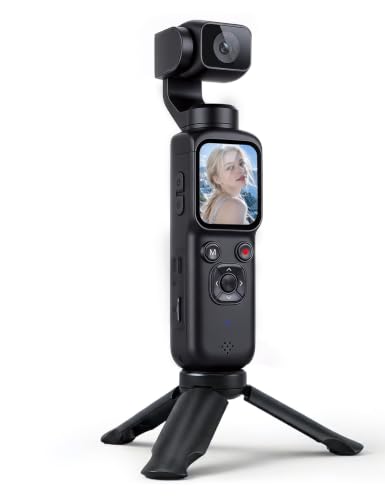
For beginners seeking a camera gimbal with subject tracking in a compact all-in-one camera, this HolyEye model provides AI horizontal face tracking without requiring a separate stabilizer. It also combines 4K video, autofocus, a rotating lens, Wi-Fi transfer, and a portable design for casual solo recording.
Best For: Beginners, travelers, and solo vloggers who want an easy-to-carry camera with face tracking.
Pros:
- AI face tracking helps keep the subject centered from left to right.
- Records 4K video and captures 75MP still images according to the supplied specifications.
- Rotating lens supports selfie, low-angle, and overhead perspectives.
- Wi-Fi enables previewing, file transfer, and sharing through the companion app.
Cons:
- Tracking is described as horizontal face tracking rather than full 360-degree subject following.
- It is a compact camera, not a motorized three-axis gimbal for interchangeable-lens cameras.
- The listed manufacturer warranty is 30 days.
This is better viewed as a lightweight tracking camera than a conventional gimbal stabilizer. It makes solo recording straightforward, especially when portability and simple controls are more important than advanced stabilization or camera-system flexibility.
Best Phone Gimbal – DJI Osmo Mobile 8
The DJI Osmo Mobile 8 is a practical camera gimbal with subject tracking for smartphone creators. Its three-axis stabilization, native tracking module, 360-degree pan rotation, built-in extension rod, tripod, and 10-hour battery make it suited to vlogging, travel clips, live streaming, and hands-free recording.
Best For: Smartphone users who want stabilized footage, integrated tracking, and an all-in-one filming handle.
Pros:
- Native tracking works with the included multifunctional module.
- Three-axis stabilization helps smooth handheld phone footage.
- Built-in extension rod and tripod support flexible shooting angles.
- Up to 10 hours of battery life and phone charging support longer sessions.
Cons:
- It is compatible with cellphones rather than DSLR or mirrorless cameras.
- The DJI Mimo app is not available through Google Play and requires downloading from DJI’s official website.
- Advanced features depend on phone and app compatibility.
Choose the Osmo Mobile 8 when your primary camera is a phone and you want tracking without assembling several accessories. Its integrated lighting and audio capabilities, extension rod, and tripod make it particularly versatile for mobile content creation.
Best Multi-Device Upgrade – Feiyu SCORP Mini 3 Pro
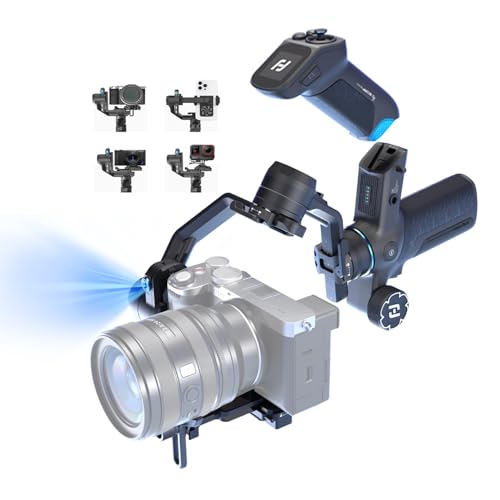
The Feiyu SCORP Mini 3 Pro is a camera gimbal with subject tracking designed for a broad range of gear, including mirrorless cameras, action cameras, and smartphones. Its claimed 4.4-pound payload, upgraded AI tracking, detachable handle, OLED screen, and quick-release system make it a capable option for creators who switch between devices.
Best For: Hybrid creators who need one gimbal for heavier camera setups, action cameras, and smartphones.
Pros:
- Supports a stated maximum payload of 4.4 pounds.
- AI tracking is rated for distances up to 59 feet with a 0.003-second response time.
- Detachable handle and 1.3-inch OLED screen provide remote control and clear settings access.
- Quick-release hardware supports rapid horizontal-to-vertical transitions.
Cons:
- Actual payload and compatibility depend on the camera, lens, and accessory combination.
- The feature-rich design may be more equipment than casual phone users need.
- Tracking performance can depend on subject distance and shooting conditions.
The SCORP Mini 3 Pro stands out for versatility and payload capacity. It is a sensible choice for creators building a flexible kit around several camera types, especially when fast setup changes and longer-range tracking are priorities.
Best Hands-Free Phone Setup – Smart Tracking Selfie Stick Tripod
If you want a camera gimbal with subject tracking for phone-based filming, this DMYWB setup combines automatic face or body tracking with a detachable selfie stick, tripod, remote, and fill light. It rotates horizontally and tilts vertically, while the no-app design keeps setup simple for live streams, tutorials, and solo videos.
Best For: Smartphone creators, livestreamers, educators, fitness instructors, and travelers who need hands-free tracking and a tall, portable stand.
Pros:
- Tracks faces or bodies in 360° without requiring an app.
- Includes a detachable LED fill light with warm, cool, and natural settings.
- Reaches 70.9 inches and folds to 13.8 inches for transport.
- Works with smartphones, action cameras, compact cameras, and other 1/4-inch accessories.
Cons:
- Designed primarily around phones and lightweight devices rather than larger camera systems.
- Tracking and rotation functions require charging and use of the included hardware.
This is a practical choice when convenience matters more than advanced camera stabilization. Its tripod height, lighting, remote, and app-free subject tracking make it especially useful for solo phone filming.
Best Mirrorless-Camera Gimbal – DJI RS 4 Mini Combo
The DJI RS 4 Mini Combo is a more capable camera gimbal with subject tracking for mirrorless cameras, phones, and vlog cameras. Its three-axis stabilization, included Intelligent Tracking Module, automatic axis locks, and responsive follow modes are suited to moving shots and fast changes between filming positions.
Best For: Videographers and creators using compatible mirrorless or vlog cameras who want stabilized footage, intelligent framing, and vertical-video support.
Pros:
- Includes an Intelligent Tracking Module for keeping subjects framed during solo filming and orbit shots.
- Three-axis stabilization supports smooth camera movement.
- Supports payloads up to 2 kg/4.4 lb and works with cameras and smartphones.
- Switches from horizontal to vertical shooting in about 10 seconds.
Cons:
- Not water resistant.
- The DJI Ronin app is not available through Google Play and must be downloaded from DJI’s website.
- Its camera support depends on balancing within the 2 kg payload limit.
For users with a compatible camera, this combo offers a stronger stabilization platform than phone-first tracking stands. The included tracking module and briefcase handle add useful flexibility for dynamic and low-angle video.
Best GoPro-Compatible Option – GoPro Fluid Pro AI Gimbal
The GoPro Fluid Pro is a camera gimbal with subject tracking built for GoPro cameras and smartphones. Its three-axis stabilization, forward- or rear-facing AI tracker, integrated fill light, interchangeable mounts, and wireless camera-control capabilities make it a versatile option for vlogging and action-camera content.
Best For: GoPro owners and smartphone vloggers who want AI framing, stabilized movement, built-in lighting, and support for multiple mounting formats.
Pros:
- AI module tracks a person’s face or body from the front or rear position.
- Three-axis stabilization helps smooth footage from phones and GoPro cameras.
- Includes interchangeable phone and GoPro mounts plus a tripod base.
- Built-in fill light and device-charging support add convenience while filming.
Cons:
- GoPro Bluetooth functionality is limited to HERO9 Black through HERO13 Black models.
- It is not water resistant.
- Compatibility with compact point-and-shoot cameras is limited to select models.
This is the most natural fit for creators already using GoPro equipment, while phone users also get a capable stabilized setup. Its interchangeable mounts and two-way tracking placement provide more flexibility than a phone-only gimbal.
Best All-in-One Phone Gimbal – DJI Osmo Mobile 7P
If you want a camera gimbal with subject tracking for smartphone videos, the DJI Osmo Mobile 7P combines 3-axis stabilization with a Multifunctional Module for intelligent tracking, lighting, and audio reception. Its built-in extension rod and tripod also make it practical for solo creators.
Best For: Smartphone vloggers and content creators who want tracking, lighting, audio support, and hands-free shooting in one kit.
Pros:
- Multifunctional Module provides intelligent tracking, lighting features, and DJI Mic 2/DJI Mic Mini reception.
- 3-axis stabilization, built-in extension rod, and tripod support varied shooting setups.
- Up to 10 hours of operating time, with phone charging support when using the Multifunctional Module as a mic receiver.
- Magnetic mounting, quick launch, ShotGuides, and One-Tap Edit simplify setup and editing.
Cons:
- Its 300 g maximum weight recommendation limits it to compatible smartphones rather than cameras.
- Android users must download DJI Mimo from DJI’s website because it is unavailable on Google Play.
The 7P is a feature-rich choice when subject tracking is only part of your needs. It is especially compelling for creators who also want built-in lighting, microphone reception, and flexible solo-shooting accessories.
Best Multi-Camera Gimbal – FeiyuTech SCORP Mini 2 Kit
The FeiyuTech SCORP Mini 2 Kit is a camera gimbal with subject tracking designed for more than phones. Its built-in AI tracker can follow faces and objects without an app, while the 1.2 kg payload supports mirrorless cameras, DSLRs, video cameras, smartphones, and action cameras.
Best For: Creators who switch between camera types and need independent AI tracking with a higher payload capacity.
Pros:
- Built-in AI tracking follows faces and objects without connecting to an app.
- Supports mirrorless cameras, smartphones, DSLR cameras, and video cameras up to 1.2 kg.
- Includes a 1.3-inch touchscreen, five-way joystick, extension rod, tripod, and wireless fill light.
- Bluetooth and cable control support camera operation and focus adjustment.
Cons:
- At 852 g, it is substantially heavier than the DJI phone gimbals in this roundup.
- The broader camera compatibility may mean a more involved setup than a dedicated phone gimbal.
The SCORP Mini 2 stands out for its independent tracking and flexible payload. Choose it when you need to stabilize multiple device types; phone-only users may prefer a lighter, simpler option.
Best Lightweight Phone Gimbal – DJI Osmo Mobile 7
For a lightweight camera gimbal with subject tracking, the DJI Osmo Mobile 7 pairs 3-axis stabilization with DJI Mimo’s ActiveTrack 7.0. Its 300 g body, foldable design, built-in tripod, and 10-hour operating time suit creators who want a portable phone setup.
Best For: Phone users who prioritize low weight, portability, and straightforward tracking for vlogs, livestreams, and solo videos.
Pros:
- ActiveTrack 7.0 supports subject tracking in a range of shooting scenarios.
- At 300 g, it is lightweight with an ergonomic, anti-slip grip.
- Foldable design and built-in tripod make storage and hands-free filming easier.
- Up to 10 hours of use, plus USB-C phone charging support.
Cons:
- Its 300 g maximum weight recommendation limits it to compatible smartphones.
- The OM 7 Series Tracking Kit is sold separately for additional tracking possibilities.
- Android users must download DJI Mimo from DJI’s website because it is unavailable on Google Play.
The Osmo Mobile 7 is a sensible everyday option for phone creators who want tracking without carrying a larger camera stabilizer. It gives up the 7P’s included Multifunctional Module but keeps the core stabilization and tracking features in a lighter package.
How We Picked the Best Camera Gimbal with Subject Tracking
We selected models across several practical categories, including smartphone gimbals, action-camera accessories, compact vlogging kits, and three-axis stabilizers for mirrorless and DSLR cameras. Our comparison focuses on stabilization, subject or face tracking, payload compatibility, control options, portability, and the accessories included in each package.
Tracking claims can vary: some products use a built-in AI sensor, while others rely on a phone app, a detachable module, or native camera and smartphone features. Check the exact compatibility list before buying, particularly if you use a newer phone, a heavy lens, or a camera with an unusual body shape.
Quick Comparison
| Best For | Look For | Typical Product Type |
|---|---|---|
| Phones and casual creators | Fast setup, app support, compact design | Smartphone gimbal |
| Hands-free selfies | Built-in tracking, tripod function, no-app operation | Tracking selfie stick |
| Action cameras | Camera compatibility, wireless control, lighting | Action-camera gimbal |
| Mirrorless and DSLR video | Payload capacity, balancing range, focus and shutter control | Full-size camera gimbal |
| Travel and lightweight kits | Foldable design, low weight, included tracker | Mini camera gimbal |
Key Buying Factors for a Camera Gimbal with Subject Tracking
Camera Compatibility and Payload
Start with the camera and lens combination, not just the camera body. A gimbal must support the total weight and remain balanced across its adjustment range. Larger mirrorless lenses may require a more powerful model, while phone and action-camera gimbals are usually designed for narrower setups.
Tracking Method
Built-in AI tracking can simplify setup and may work without a phone app. App-based tracking can offer more creative controls but may require Bluetooth, a compatible operating system, or a supported camera application. Also confirm whether tracking follows faces, full bodies, or general subjects, and whether it works in portrait orientation.
Stabilization and Controls
Three-axis stabilization is the baseline for smooth walking and panning. Look for useful modes such as follow, lock, portrait, and time-lapse, plus controls for recording, zoom, focus, or camera movement. A physical joystick and responsive motors are especially valuable with larger cameras.
Battery, Mounting, and Accessories
Consider operating time, charging method, mounting threads, quick-release plates, and included cables. A built-in tripod, fill light, extension handle, or tracking module can reduce the need for extra gear, but bundled accessories may increase size and price.
Who Should Buy Which Camera Gimbal with Subject Tracking?
Choose a smartphone gimbal if you primarily film with an iPhone or Android phone and want the simplest route to stabilized social, travel, or family video. A tracking selfie stick is better for hands-free presentations, solo filming, and casual selfies. Action-camera users should prioritize a purpose-built model with wireless camera control and reliable mounting.
For interchangeable-lens cameras, choose a full-size gimbal when you need stronger motors, broader balance adjustment, and camera controls. A mini model makes more sense for lightweight mirrorless bodies, small lenses, and travel. Before ordering, verify the exact camera, lens, phone, app, and tracking requirements; those details determine whether the advertised features will work in your setup.